The Right Way to Track Billable Hours Across a Remote Team of 10 (Without Paying Per Seat)
Getting one freelancer to track time is hard. Getting ten people across time zones to do it consistently is a management problem, not a willpower problem. Here's the system that actually works.

Why Individual Time Tracking Advice Doesn't Work for Teams
Most articles about billable hours tracking are written for a single freelancer trying to build a personal habit. That advice — 'just remember to start the timer,' 'review your week on Friday' — assumes one person with full control over their own workflow and full motivation to get the number right because it's their own income on the line. A 10-person agency has none of those conditions guaranteed. Different team members have different relationships to the tracking requirement. Some are naturally diligent. Some see it as administrative overhead that gets done last, if at all. Junior staff may not understand why it matters. Contractors may resist it entirely as scope creep on the working relationship. This is a management and systems design problem, not a motivation problem. Telling ten people to 'just be better at tracking time' produces the same inconsistent results as telling ten people to 'just remember.' The fix has to be structural.
"The problem isn't that your team doesn't want to track time. It's that you're asking ten different people to maintain ten separate habits in a tool that lives outside their actual work."
The Real Failure Modes of Team Time Tracking
Across the agencies we've talked to (including our own, before we fixed this), the same handful of failure patterns show up repeatedly:
- The end-of-week reconstruction — someone tracks nothing during the week and tries to remember what they worked on every Friday. The resulting data is consistently lower than reality and skewed toward whatever they remember most clearly
- The block-logging habit — someone logs '8 hours — general project work' once a day instead of tracking per task. This satisfies a tracking requirement on paper but produces data that's useless for understanding which deliverables actually consumed time
- The silent non-compliance — someone simply doesn't track at all, and because there's no visibility into who is and isn't doing it, the gap goes unnoticed until an invoice doesn't reconcile or a project review reveals a huge blind spot
"We had one contractor who never once opened our time tracking tool in four months. We only found out when we tried to bill her hours against a fixed retainer and the numbers didn't add up at all."
— Operations lead, 12-person creative agency
Why Per-Seat Time Tracking Tools Make This Worse
Standalone time trackers like Toggl or Harvest are genuinely well-built products. The problem for teams specifically is twofold: cost and friction compound with headcount. On cost: a 10-person team on Toggl Track Premium runs roughly $1,200/year just for time tracking, on top of whatever the task management tool costs. That's before counting the contractor-seat problem — guest or short-term contributors often still require a paid seat, even for a three-week engagement. On friction: every team member has to remember to switch to a separate app, find or create the right project entry, and start the clock. Multiply the individual failure modes by ten people, and the aggregate data quality across a team using a standalone tracker is reliably worse than what any single diligent freelancer could produce alone.
Flat-fee · No seat tax
Done paying per seat? Melororium covers tasks, time tracking, and client CRM for teams of 4–25 — one flat monthly price.
The System: Architecture Over Discipline
The fix that actually works at team scale removes the separate tracking step entirely, rather than trying to train ten people into a better habit.
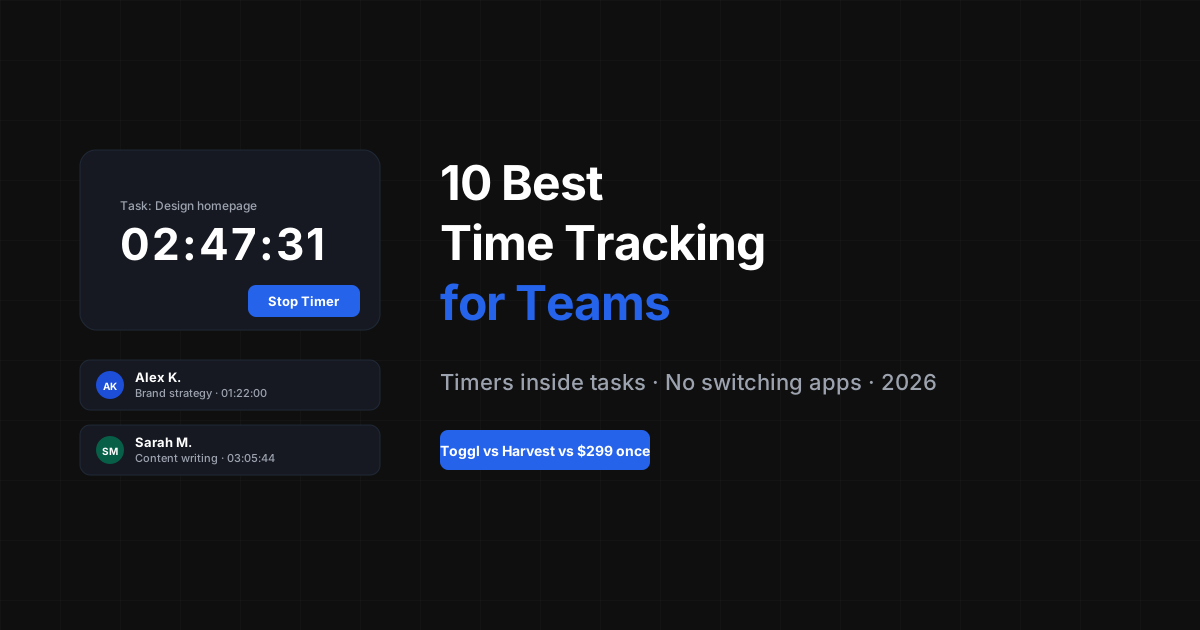
- Principle 1: The timer lives inside the task, not in a parallel tool — if starting a timer requires opening a different application, a percentage of your team will skip it on busy days. When the timer is a button inside the task someone already has open, the habit requires zero additional behavior change
- Principle 2: Visibility is shared, not private — individual time trackers are typically private by default. For a team, visibility into who has and hasn't logged time this week needs to be available to whoever manages the project, without requiring an awkward individual check-in
- Principle 3: No per-seat penalty for short-term contributors — contractors on a three-week project shouldn't trigger the same seat cost as a full-time employee. A system priced per-team rather than per-seat removes the financial disincentive to track everyone's time properly
Built into every task, with team-wide work reports showing who has and hasn't logged time — included in every plan with no per-seat tracking fee
See team pricingSetting Up Time Tracking That People Actually Use
Three structural changes that reliably improve compliance across a team:
- Make the default action the easy one — when a task is assigned, the timer should be one click away from the task itself, not buried in a menu, not in a different application. The fewer steps between 'I'm starting this work' and 'the clock is running,' the higher the compliance rate
- Set the expectation explicitly, once, in writing — don't assume new team members understand why time tracking matters. A short onboarding note connecting tracking to project pricing converts a vague administrative requirement into something with visible purpose
- Make non-compliance visible to the person, not just to you — a weekly dashboard showing each team member their own logged hours against expected hours creates self-correction without requiring an uncomfortable individual conversation every time
Handling Time Zones Without Creating Friction
Remote teams across multiple time zones add a layer of complexity to time tracking specifically because 'this week' means something different depending on where someone is sitting. A team member in Manila and a team member in Lisbon have different definitions of when the work week starts and ends. The practical fix: track everything in the team member's local time for daily logging, but roll up weekly reports based on a fixed reporting period (for example, Monday 00:00 UTC to Sunday 23:59 UTC) so that comparisons across the team are consistent regardless of where each person is physically located.
The Weekly Review That Catches Problems Early
A 15-minute weekly review at the team level, separate from individual time tracking, catches the problems that individual habits alone won't surface.
- Did everyone log time this week, and does the total look roughly consistent with expected workload?
- Are any projects showing disproportionately high hours relative to scope — a possible scope creep or estimation problem?
- Is any team member's logged time consistently far below expected — a possible tracking compliance issue, not necessarily a productivity issue?
What to Do When Someone Still Doesn't Track
Even with the friction removed, some team members will still under-track. At that point, it's a direct conversation, not a system problem. The framing that works: 'I'm not asking this because I don't trust you — I'm asking because we price our next project for this client based on how long this type of work actually takes, and untracked hours mean we're guessing.' Most reasonable team members respond well to this framing because it connects tracking to a business outcome they understand, rather than presenting it as an arbitrary compliance requirement. The team members who continue resisting after a clear, purpose-driven conversation are revealing something about fit, not just about time tracking habits.
Team time tracking without per-seat fees.
Melororium's team plans include native timers for every user with no per-seat tracking fee — Agency plan covers 10 users including contractors — $59/mo flat.