MELORORIUM FOR EVENT AGENCIES
Your event agency tool stack costs $4,540 / year. Flat fee instead.
Monday.com, HoneyBook, Harvest, QuickBooks, Notion — every event producer and coordinator is a monthly charge. Melororium replaces all five for $59/mo flat. Plan events on Kanban boards, track production hours inside each task, manage client briefs in a unified CRM, and generate invoices from time logs. No seat tax,
10 users included. Event planning, time tracking, client invoicing. No seat tax.

THE EVENT STACK TAX
Every new producer or coordinator you hire makes your software bill worse.
Event agencies plan, coordinate, and execute on tight deadlines — but the project management and CRM tools running that work charge you per seat every month. Add an event producer, add a venue coordinator, add a logistics assistant — and every SaaS tool in your stack bills you more. Melororium covers your full production workflow for $59/mo flat: event planning boards, vendor task tracking, crew time logging, client communication CRM, and invoice generation. No per-seat billing.
The SaaS Tax
Here is what you are paying every year to run a fragmented workflow:
Cumulative SaaS Tax vs. Flat-Fee Subscription
That's $22,700 saved over 5 years — enough to fund a dedicated event photography retainer or a full production tech refresh.
EVENT PRODUCTION WORKFLOW
From client brief to post-event invoice, in one workspace.
Stop managing event timelines in Monday, tracking client contracts in HoneyBook, logging vendor coordination hours in Harvest, and billing in QuickBooks. Melororium keeps your event planning Kanban, crew timers, client CRM, and invoice PDF on one screen. Your producers focus on flawless execution, not four separate admin portals.
Client Brief and Event Record
Create a client card in the CRM with event date, budget parameters, venue details, expected attendance, and account manager assignment. Link directly to the event production Kanban. All client data — contract value, communication history, vendor contacts — lives in one queryable record from intake to closeout.
Event Production Task Board
Build a Kanban board per event with production stages: Pre-Event Planning, Vendor Coordination, Setup, Event Day, Strike, Post-Event. Assign tasks to producers and coordinators with hard deadlines. Move items forward with sub-100ms drag response. Set deadline alerts on the calendar so nothing slips in a busy event week.
Production Hour Logging
Every task card has a built-in stopwatch. Producers log planning hours, site visit time, vendor call durations, and setup coordination time directly inside each task. Hours accumulate against the event project and client automatically — no separate timer app, no forgotten entries, no billing disputes when you present the post-event invoice.
Event Invoice Generation
When the event closes and final production hours are logged, open Work Reports and select the client. Melororium aggregates all production hours at configured rates, adds vendor pass-through costs, and generates a professional PDF invoice in one click. Payment tracking updates on your calendar alongside the next event's kickoff date.
VALUE COMPARISON
Why pay per seat when you can go flat-fee?
Compare face-to-face. Other SaaS platforms lock your workflows and data behind endless per-seat fees. We believe professional software should be a flat fee for your whole team.
The old way
Paying monthly subscription taxes for every minor tool you use.
Scattered operational records causing workflow gaps and missed hours.
Heavy, sluggish cloud interfaces wasting your daily billable capacity.
Compiling raw timesheets manually to calculate project margins.
The Melororium way
Flat monthly fee for your whole team. Secure, scalable workspace.
Unified time logging and accounting tied directly to active tasks.
Blazing-fast local-first execution with zero interface latency.
Integrated ledger automation generating live performance reports.
ZERO LOADING SPINNERS
Local-first compilation. Zero server delays.
Melororium compiles all database transactions straight inside your client engine before pushing silent sync tasks to the server.
IndexedDB direct write — zero network dependency
React virtual DOM diff — 1 animation frame
Async worker sync — invisible to the user
Server roundtrip + JSON parse + re-hydrate
LIVE TEST
Run a latency benchmark
Simulate a real workspace action and measure local vs remote execution time.
Click run to measure local performance.
EARLY FEEDBACK
See what teams say about Melororium.
Early adopters from agencies and studios share how ditching the subscription stack changed how their teams operate.
Clara Moss
Founder, Mossglow Studio
"I had a successful shop and absolutely no idea if I was actually making money."
Tom Brauer
Founder, Linkframe
"I was paying to make my own life harder."
Marcus Webb
Founder, North Signal Studio
"Every Friday felt like an archaeology dig."
Built for modern digital operations.
Join the early adopters scaling their business layout with Melororium.
PRODUCT FAQ
Frequently
Asked Questions
Have a question that needs a human to answer?
No problem, email us at support@melororium.com
Compare alternatives
Starter ($29/mo) covers up to 4 users — ideal for small teams. Agency ($59/mo, most popular) covers up to 10 users and lets you pick 5 additional modules on top of the 12 core ones. Studio ($119/mo) covers up to 25 users and unlocks all 20+ announced modules. All plans are billed monthly or yearly (save ~30% annually).
Switch plans anytime — your data stays intact and the transition takes seconds. Upgrade is prorated automatically. No lock-in, no penalties for growing your team.
With per-seat tools, every new hire costs more. A 10-person team on ClickUp pays $1,440/yr in seat fees alone. Melororium charges one flat monthly fee for your whole team — add 1 person or 10, the price stays the same. No seat tax that eats into your margins as you grow.
Security is non-negotiable. Melororium operates on end-to-end data encryption (TLS 1.3) with enterprise-grade database separation. Our AI features use strict Bring Your Own Key (BYOK) architecture — your data is never used for model training.
Yes. Melororium supports dedicated Client Portals at no extra cost. Clients can view project timelines and download deliverables. Guest client access does not count against your team seat limit.
Every plan includes: Dashboard, Kanban, Projects, Calendar, Team management, Client CRM, Invoices, Work Reports, Live Timers, Inbox, Time Tracker, and Settings. Agency and Studio plans add extra modules on top of these.
Event Agency Project Management: Managing Productions From Planning to Delivery
Event agencies manage some of the most deadline-critical, logistics-intensive work in professional services. A missed deliverable does not result in a delayed shipment — it results in a venue with no AV, a product launch with no presentations, or a conference with no speakers confirmed. The operational demands of event management require task tracking, vendor coordination, crew scheduling, time logging, and precise billing across multiple simultaneous productions. This guide explains how a flat-fee workspace designed for production-oriented teams serves the specific needs of event agencies.
Why Event Management Is Uniquely Hard to Manage
Event projects are hard to manage for three structural reasons. First, they have extremely hard deadlines — the event date does not move. Second, they involve large numbers of external stakeholders — venues, vendors, speakers, sponsors, attendees — whose commitments need to be tracked and confirmed. Third, they accelerate dramatically in the final weeks: a project that was comfortably paced at eight weeks suddenly has 200 tasks that all need to be done in the last two weeks before event day. Generic project management tools handle routine task progression but struggle with the coordination complexity of event management. The tasks are too numerous, the dependencies too intricate, and the stakeholders too varied for a standard Kanban board without careful configuration.
Billing Event Productions: The Time Tracking Challenge
Event agencies bill in several ways: fixed event production fees, hourly rates for consulting and planning work, and cost-plus for production services. In all cases, accurate time tracking is essential — either to validate that fixed-fee work was profitable, or to build the cost-plus invoice. The challenge is that event work is highly variable: a week of venue negotiations and logistics calls does not look like a standard workday, and time is often logged after the fact rather than in real time.
Structuring Event Projects in Melororium
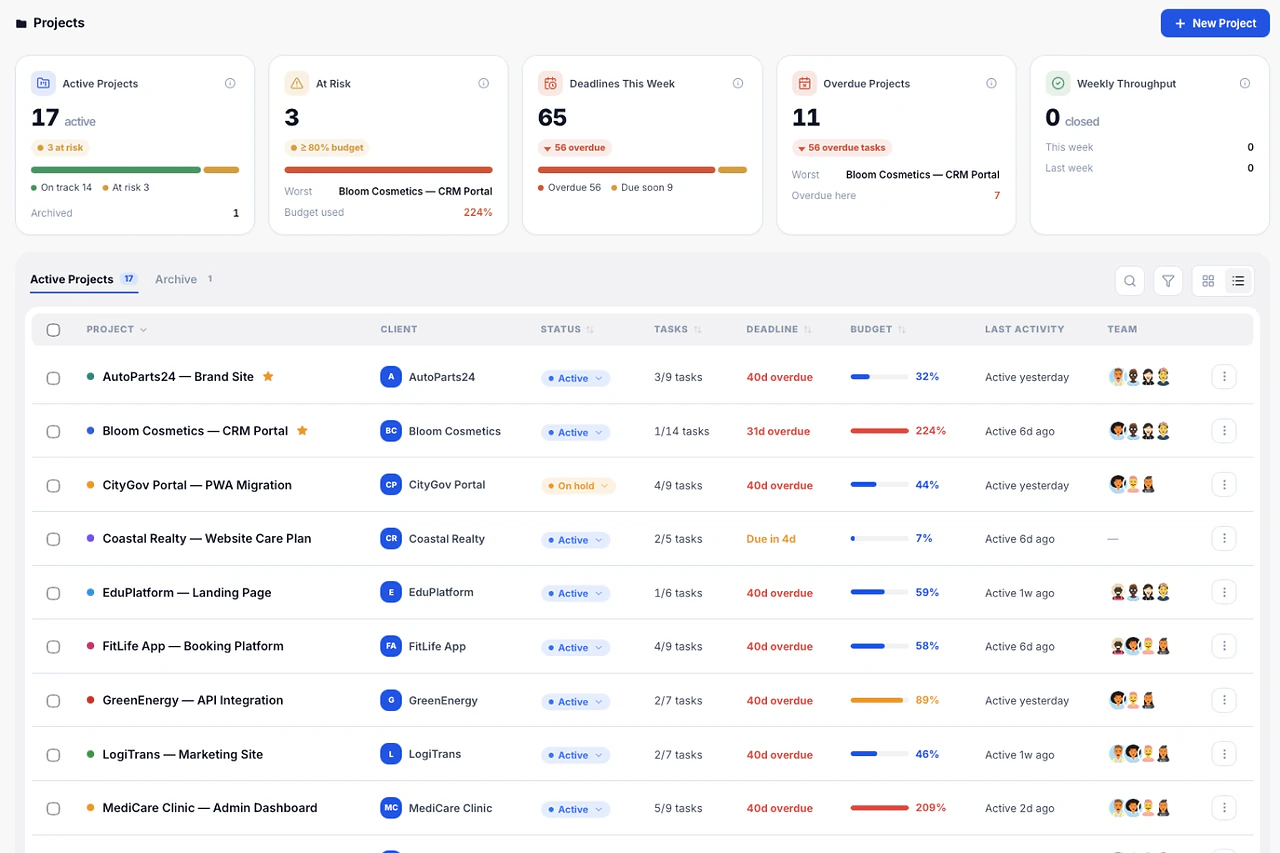
Event agencies using Melororium typically create a project per event, with Kanban columns mapping the production timeline: Pre-Production Planning, Vendor Coordination, Creative Production, Logistics Confirmation, Event Day, and Post-Event. Within each phase, tasks represent specific logistical and creative deliverables. Vendor tasks might include: venue contract signed, AV company briefed, catering confirmed, registration platform configured. Creative tasks: keynote deck reviewed, signage designed, event programme copy finalised. Logistics tasks: attendee check-in process documented, crew schedule distributed, on-site briefing prepared. Team members log time on each task. The project manager sees the real-time board view across all active events — which tasks are on track, which are blocked waiting on vendor responses, which are overdue.
Vendor and Stakeholder Management
Event projects involve more external stakeholders than almost any other type of professional services work. Melororium's CRM stores records for key vendors and partners, with communication history attached. When a vendor confirms a commitment, it is logged in their CRM record and the corresponding task on the project board is marked complete. Nothing is stored only in email threads.
Event Day Logistics and Real-Time Task Management
On event day itself, the project board becomes a live operations tool. Tasks move from the event day column to Done as each element is executed: registration opens, AV tested and signed off, speaker briefing conducted, keynote started. The team lead can see at a glance which items are still open and which team members are overloaded. Issues get logged as tasks so they are not forgotten in the post-event debrief.
Post-Event Billing and Retrospective
Post-event billing for production agencies can be complex: combining fixed production fees with hourly planning time and cost-plus for vendor services. Melororium's work reports aggregate all logged hours by team member and phase — providing the data for the hourly billing component. Fixed fees and vendor pass-throughs are added as additional invoice line items. The final invoice reflects the complete production cost clearly. The post-event retrospective is where event agencies improve their future pricing and planning. Melororium's time data shows exactly how many hours were spent in each production phase — a resource profile for that event type. After 10 similar events, the agency has benchmarks for how long venue negotiation, sponsor management, and on-site logistics actually take — data that makes future estimates significantly more accurate.
Flat-Fee Pricing for Seasonal Event Businesses
Many event agencies have seasonal revenue patterns: a busy spring and fall conference season, a corporate events surge in Q4, and a quieter summer. Staff levels fluctuate accordingly, with contractors brought in for peak seasons. Per-seat SaaS pricing is poorly suited to this model: you pay for peak season seats year-round, or you go through the administrative friction of adding and removing users every quarter. Melororium's flat-fee model provides a stable, predictable tool cost regardless of seasonal fluctuation. The Agency plan at $59/month accommodates a core team of 6–8 with room for seasonal contractors without changing the monthly bill.
Own your event operation. Flat fee.
$59/mo flat for 10 users. Event planning Kanban, task-embedded timers, client CRM, invoice generation, and financial reports — all in one workspace. No seat renewals, no seat tax, no add-on fees. Start a 14-day free demo, no card needed.