FINANCIAL CONTROL
Link your operational expenses directly to daily tasks.
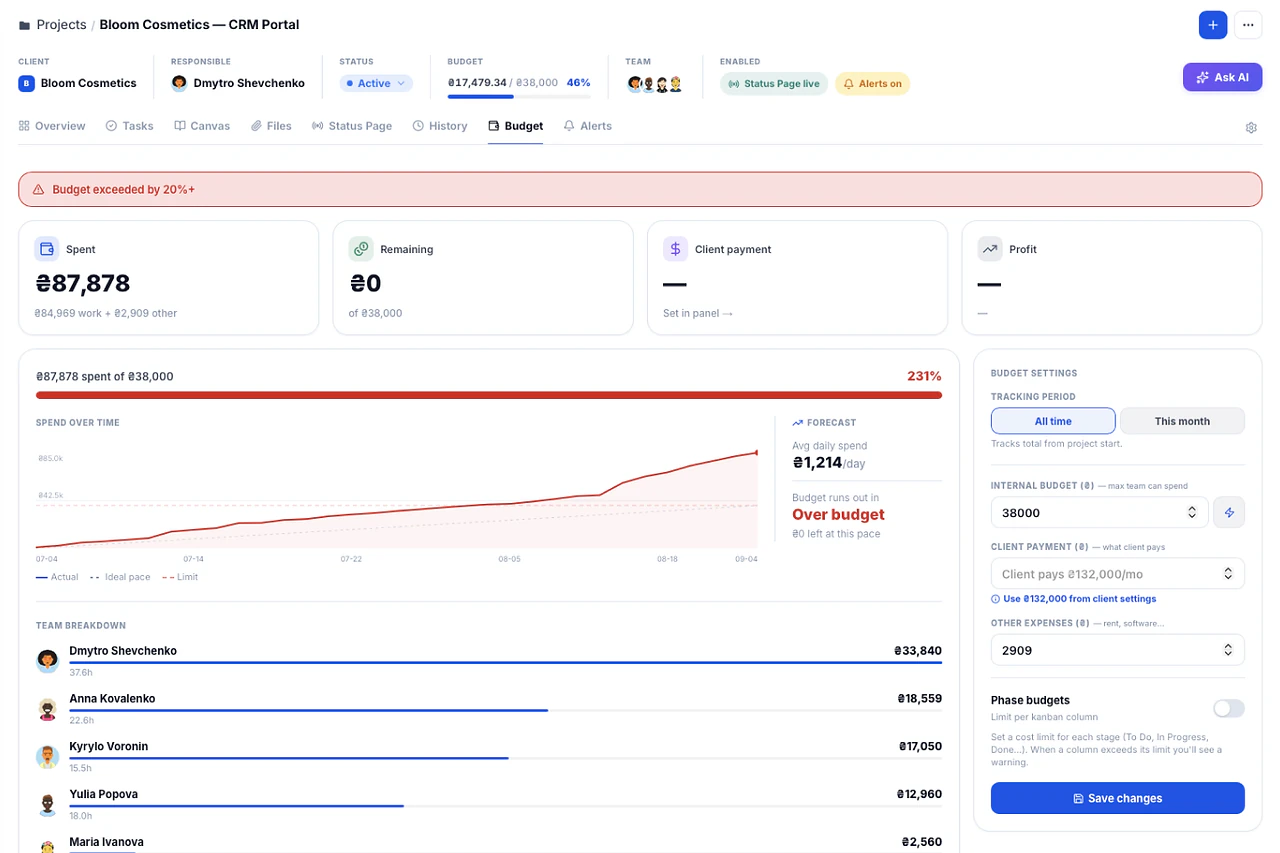
Kill manual spreadsheet assembly and month-end guesswork. Melororium connects your logged work hours, team rates, and project budgets into a single real-time financial dashboard.

CALCULATOR TAX
Financial oversight app stacks drain your annual revenue.
Merging cashflow logs, expense trackers, and invoicing matrices shouldn't require complex monthly tools. Anchor your balance books natively.
The SaaS Tax
Here is what you are paying every year to run a fragmented workflow:
Cumulative SaaS Tax vs. Flat-Fee Subscription
Equivalent to protecting your net margins from being chipped away by external billing platforms.
CASHFLOW TRACKING
Link financial records straight to daily work logs.
Erase the barrier between production and bookkeeping. Watch every task update automatically balance your studio margin ledgers.
Client Balance Definition
Set up customer profile sheets displaying monthly payment inputs and contract parameters.
Project Cost Budget Allocation
Monitor cash spend, creative ROI indexes, and estimated profits directly inside active portfolio cards.
Real-Time Cost Reconciliation
Let the engine multiply tracked intervals against employee cost-rates to automatically output itemized expense entries.
Revenue & Expense Charting
Visualize company net profit fluctuations and daily cash flows on a clean top-level calendar-bar matrix.
VALUE COMPARISON
Why pay per seat when you can go flat-fee?
Compare face-to-face. Other SaaS platforms lock your workflows and data behind endless per-seat fees. We believe professional software should be a flat fee for your whole team.
The old way
Paying monthly subscription taxes for every minor tool you use.
Scattered operational records causing workflow gaps and missed hours.
Heavy, sluggish cloud interfaces wasting your daily billable capacity.
Compiling raw timesheets manually to calculate project margins.
The Melororium way
Flat monthly fee for your whole team. Secure, scalable workspace.
Unified time logging and accounting tied directly to active tasks.
Blazing-fast local-first execution with zero interface latency.
Integrated ledger automation generating live performance reports.
ZERO LOADING SPINNERS
Local-first compilation. Zero server delays.
Melororium compiles all database transactions straight inside your client engine before pushing silent sync tasks to the server.
IndexedDB direct write — zero network dependency
React virtual DOM diff — 1 animation frame
Async worker sync — invisible to the user
Server roundtrip + JSON parse + re-hydrate
LIVE TEST
Run a latency benchmark
Simulate a real workspace action and measure local vs remote execution time.
Click run to measure local performance.
EARLY FEEDBACK
See what teams say about Melororium.
Early adopters from agencies and studios share how ditching the subscription stack changed how their teams operate.
Clara Moss
Founder, Mossglow Studio
"I had a successful shop and absolutely no idea if I was actually making money."
Tom Brauer
Founder, Linkframe
"I was paying to make my own life harder."
Marcus Webb
Founder, North Signal Studio
"Every Friday felt like an archaeology dig."
Built for modern digital operations.
Join the early adopters scaling their business layout with Melororium.
PRODUCT FAQ
Frequently
Asked Questions
Have a question that needs a human to answer?
No problem, email us at support@melororium.com
Compare alternatives
Starter ($29/mo) covers up to 4 users — ideal for small teams. Agency ($59/mo, most popular) covers up to 10 users and lets you pick 5 additional modules on top of the 12 core ones. Studio ($119/mo) covers up to 25 users and unlocks all 20+ announced modules. All plans are billed monthly or yearly (save ~30% annually).
Switch plans anytime — your data stays intact and the transition takes seconds. Upgrade is prorated automatically. No lock-in, no penalties for growing your team.
With per-seat tools, every new hire costs more. A 10-person team on ClickUp pays $1,440/yr in seat fees alone. Melororium charges one flat monthly fee for your whole team — add 1 person or 10, the price stays the same. No seat tax that eats into your margins as you grow.
Security is non-negotiable. Melororium operates on end-to-end data encryption (TLS 1.3) with enterprise-grade database separation. Our AI features use strict Bring Your Own Key (BYOK) architecture — your data is never used for model training.
Yes. Melororium supports dedicated Client Portals at no extra cost. Clients can view project timelines and download deliverables. Guest client access does not count against your team seat limit.
Every plan includes: Dashboard, Kanban, Projects, Calendar, Team management, Client CRM, Invoices, Work Reports, Live Timers, Inbox, Time Tracker, and Settings. Agency and Studio plans add extra modules on top of these.
Project Budget Tracking for Teams: Financial Project Management Without Per-Seat SaaS
Managing project budgets is one of the most consequential — and most commonly neglected — aspects of running a service business. When project costs are tracked in a spreadsheet separate from where work is happening, budget overruns are invisible until they have already damaged your margin. When team time is tracked in one tool and project financials in another, the connection between work and money is always one manual export behind reality. This guide explains how integrated project financial tracking works and why flat-fee pricing makes it accessible to teams of every size.
Why Project Budgets Go Over and How to Stop It
Project budget overruns almost always follow the same pattern. A project is scoped and priced based on an estimate of hours. Work begins. Team members log time sporadically or not at all. At invoice time, someone totals up the hours — often from memory or from partial logs — and discovers the project consumed 40% more time than estimated. By then it is too late to have a scope conversation with the client, and the margin is gone. The fix is not better estimating — estimates are inherently imperfect. The fix is continuous visibility into how actual hours compare to budgeted hours, updated in real time as work progresses. When a project manager can see at any point that a project is 70% of the way through its time budget but only 50% of the way through its deliverables, they have the information they need to act before the overrun happens.
Integrating Time Tracking With Budget Monitoring
The only way to have real-time budget visibility is for time tracking and project management to be the same system. When hours logged on tasks automatically aggregate to the project level, a budget comparison is always current. When time tracking is a separate tool, the budget view is always a manual update behind reality. Melororium's integrated architecture means budget tracking is automatic — not an additional process.
Financial Tracking Inside Melororium
Melororium connects project work to financial outcomes through a chain of integrated data: tasks have time logs, time logs have billing rates, billing rates produce invoice line items, invoice line items produce revenue. The budgeting module extends this by allowing you to set project budgets — either as a fixed fee or a time budget — and compare actual spend against the budget as work progresses. The dashboard surfaces budget health across all active projects. A project at 80% of its time budget with 50% of deliverables complete is flagged automatically. A project on track looks green. The financial summary view shows total billed to date, outstanding invoices, and projected revenue for the current period — giving founders and operations managers a clear picture of where the business stands.
Retainer Management for Recurring Clients
Many service businesses operate on monthly retainers: a client pays a fixed fee each month for a defined scope of work. Managing retainers requires tracking how many hours have been used against the retainer allowance, ensuring work does not significantly exceed the retainer without a conversation, and generating consistent monthly invoices. Melororium handles retainer tracking by linking a monthly project to the client CRM record and tracking hours against the retainer cap — a clean alternative to spreadsheet-based retainer logs.
Expense Tracking Alongside Time
Beyond time-based billing, projects often include reimbursable expenses: travel, software licences purchased for a client, contractors engaged for specific deliverables. Melororium allows expenses to be added to projects alongside time entries, ensuring they appear on the final invoice without requiring a separate expense tracking tool.
From Budget Data to Business Decisions
The most valuable output of systematic project financial tracking is not the invoice — it is the retrospective data that makes future estimates better. When you have six months of actual time data across 20 projects, you can see which project types consistently take longer than estimated, which team members work fastest on which task categories, and which clients generate the highest margin. This data is available in Melororium's Work Reports module. Export it as Excel for deeper analysis, use it to calibrate your pricing model, or present it to clients as evidence of work completed during a scope conversation. Teams that use this data systematically report that their estimates become progressively more accurate — and their project profitability improves as a result.
Flat-Fee Budgeting: The Cost of Managing Project Finances
Dedicated project financial management tools — Harvest, FunctionFox, Productive.io — charge per seat and often require additional integrations for project management or invoicing. A 10-person team using Productive.io for project financials pays $160–$240/month depending on the plan. Melororium covers the same function (plus project management and CRM) at $59/month flat for 10 users. For smaller teams, the Starter plan at $29/month for 4 users provides the full financial tracking stack at a cost lower than a single user seat on most dedicated tools. The flat-fee model means financial project management is accessible to early-stage teams that cannot justify enterprise software pricing.
Know your exact margin on every project.
No spreadsheet guesswork, no month-end surprises, no missed billables. Financial clarity built into every layer of your workspace.