Start free demo →
M
Melororium

MELORORIUM FOR WEB & DEV AGENCIES

Your dev agency tool stack costs $3,060 / year. Flat fee instead.

ClickUp, Harvest, QuickBooks, Clockify, Notion — every developer and project manager on your team is a monthly charge. Melororium replaces all five for $59/mo flat. Track billable dev hours inside each task card, manage client projects with per-project Kanban boards, and generate invoices from time logs in one click. No seat tax,

Get Agency plan — $59/mo flat

10 users included. Dev workflow, time tracking, invoicing. No seat tax.

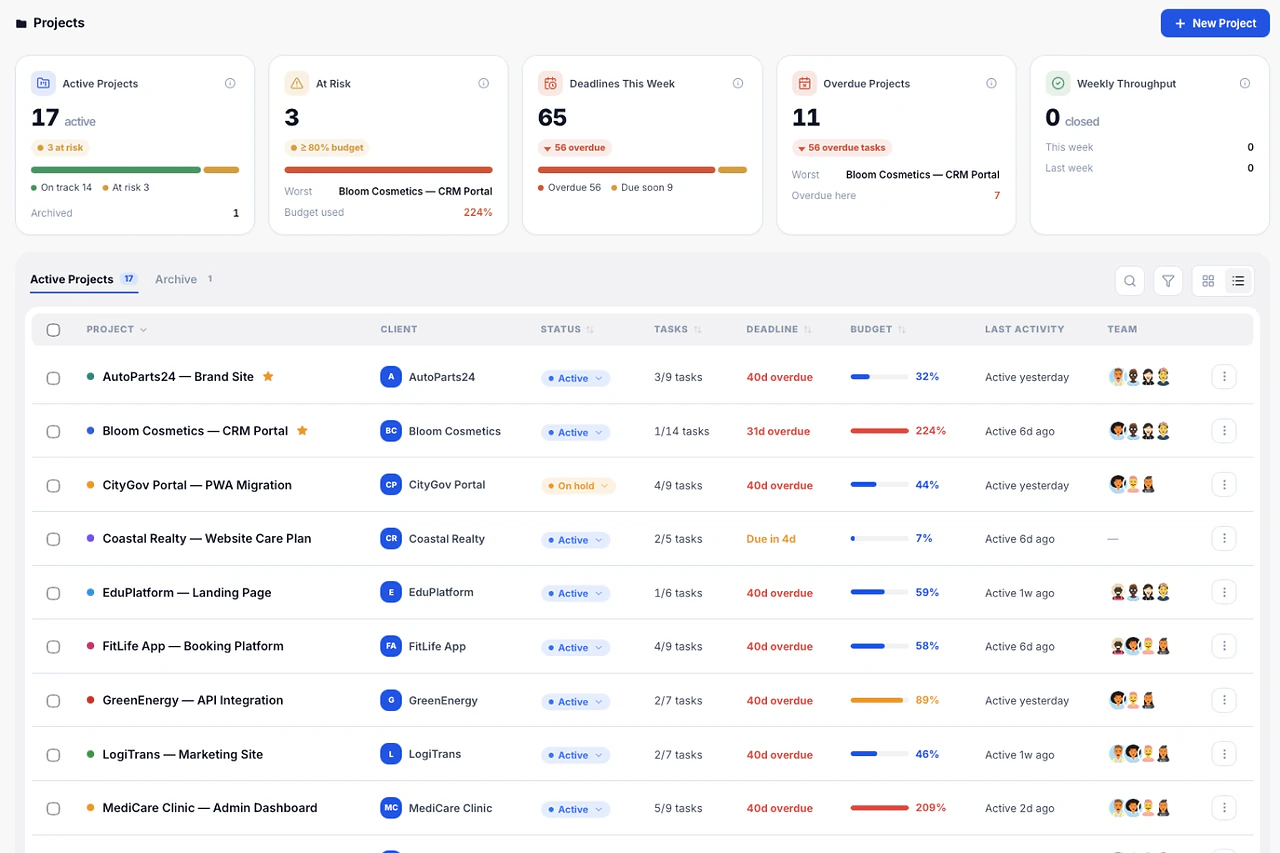
MELORORIUM FOR WEB & DEV AGENCIES — Melororium project management workspace preview

THE DEV SHOP SEAT TAX

Every new developer you hire makes your software bill worse.

Web agencies and development shops live on hourly billing — but the tools that manage that billing charge you monthly per seat. Add a backend developer, add a QA engineer, add a DevOps contractor — and your tool stack extracts more revenue every month. Melororium covers your entire delivery workflow for $59/mo flat: task management, precise time tracking, client communication logging, and invoice generation. Stop paying per seat.

The SaaS Tax

Here is what you are paying every year to run a fragmented workflow:

ClickUp Business (10 seats, project mgmt)
-$720 / yr
Harvest Pro (10 seats, time & payroll)
-$640 / yr
QuickBooks Online (invoicing)
-$420 / yr
Clockify Pro (10 seats, time audit)
-$800 / yr
Notion Teams (10 seats, project docs)
-$480 / yr
Total Annual SaaS Cost$3060 / yr
Melororium Flat-Fee Plan$59/mo
Flat-fee subscription. Save $2352 every year vs your current stack. No seat tax.
Interactive Projection

Cumulative SaaS Tax vs. Flat-Fee Subscription

-$9180
SaaS Tax
$2124
Melororium
CUMULATIVE SAVINGS+$7056

That's $15,300 saved over 5 years — enough to fund a mid-level contractor sprint or a new hardware upgrade cycle.

DEV DELIVERY WORKFLOW

From project kickoff to client invoice, in one workspace.

Stop tracking sprints in ClickUp, logging hours in Harvest, and billing in QuickBooks. Melororium merges your project Kanban, developer timers, client CRM, and invoice PDF into a single workspace. Your developers spend time writing code, not jumping between billing tools and status trackers.

Workspace Sync Pipeline4 steps
1

Staff Rate Matrix Setup

Configure hourly cost rates per developer role — senior, mid, junior, QA, DevOps. Melororium auto-calculates project cost and margin in real time as team members log hours. No spreadsheet needed, no end-of-month reconciliation surprises.

2

Sprint Kanban per Project

Each client project gets its own Kanban board with custom status lanes — Backlog, In Sprint, In Review, Done. Assign tasks to specific developers, attach story point estimates, set deadlines. Sub-100ms drag response keeps your daily standups moving fast.

3

Developer Time Logging

Every task card has a built-in stopwatch. Developers tap start when they begin a feature and stop when they context-switch. Hours accumulate against the task, client project, and developer record simultaneously — no separate time tracker, no forgotten logs, no billing disputes at invoice time.

4

Client Invoice from Timesheets

When a sprint or billing period closes, open Work Reports and select the client. Melororium shows total logged hours per developer at configured rates, calculates the invoice total, and exports a branded PDF in one click. Payment tracking syncs to your project calendar alongside upcoming sprint deadlines.

Workspace Sync Pipeline
Step 1 of 4
Employees · Rate Matrix4 Members
E
Elena R.Lead Dev
$85/hrOnline
M
Marco S.Designer
$65/hrOnline
J
Jay K.PM
$75/hrAway
P
Priya M.Copywriter
$55/hrOffline
Workflow synchronized natively

VALUE COMPARISON

Why pay per seat when you can go flat-fee?

Compare face-to-face. Other SaaS platforms lock your workflows and data behind endless per-seat fees. We believe professional software should be a flat fee for your whole team.

The old way

Paying monthly subscription taxes for every minor tool you use.

Scattered operational records causing workflow gaps and missed hours.

Heavy, sluggish cloud interfaces wasting your daily billable capacity.

Compiling raw timesheets manually to calculate project margins.

The Melororium way

Flat monthly fee for your whole team. Secure, scalable workspace.

Unified time logging and accounting tied directly to active tasks.

Blazing-fast local-first execution with zero interface latency.

Integrated ledger automation generating live performance reports.

ZERO LOADING SPINNERS

Local-first compilation. Zero server delays.

Melororium compiles all database transactions straight inside your client engine before pushing silent sync tasks to the server.

Local Cache Write< 2ms

IndexedDB direct write — zero network dependency

UI Re-render< 16ms

React virtual DOM diff — 1 animation frame

Background Sync< 100ms

Async worker sync — invisible to the user

Typical SaaS API600–1400ms

Server roundtrip + JSON parse + re-hydrate

LIVE TEST

Run a latency benchmark

Simulate a real workspace action and measure local vs remote execution time.

⚡ Melororium (Local-first)
🐢 Traditional SaaS (Server API)

Click run to measure local performance.

EARLY FEEDBACK

See what teams say about Melororium.

Early adopters from agencies and studios share how ditching the subscription stack changed how their teams operate.

Built for modern digital operations.

Join the early adopters scaling their business layout with Melororium.

$0
Per-Seat Tax
100%
Data Privacy
< 100ms
Board Latency
2026
Launch Edition

PRODUCT FAQ

FrequentlyAsked Questions

Have a question that needs a human to answer?

No problem, email us at support@melororium.com

Starter ($29/mo) covers up to 4 users — ideal for small teams. Agency ($59/mo, most popular) covers up to 10 users and lets you pick 5 additional modules on top of the 12 core ones. Studio ($119/mo) covers up to 25 users and unlocks all 20+ announced modules. All plans are billed monthly or yearly (save ~30% annually).

Switch plans anytime — your data stays intact and the transition takes seconds. Upgrade is prorated automatically. No lock-in, no penalties for growing your team.

With per-seat tools, every new hire costs more. A 10-person team on ClickUp pays $1,440/yr in seat fees alone. Melororium charges one flat monthly fee for your whole team — add 1 person or 10, the price stays the same. No seat tax that eats into your margins as you grow.

Security is non-negotiable. Melororium operates on end-to-end data encryption (TLS 1.3) with enterprise-grade database separation. Our AI features use strict Bring Your Own Key (BYOK) architecture — your data is never used for model training.

Yes. Melororium supports dedicated Client Portals at no extra cost. Clients can view project timelines and download deliverables. Guest client access does not count against your team seat limit.

Every plan includes: Dashboard, Kanban, Projects, Calendar, Team management, Client CRM, Invoices, Work Reports, Live Timers, Inbox, Time Tracker, and Settings. Agency and Studio plans add extra modules on top of these.

Project Management for Web and Dev Agencies: The Flat-Fee Stack That Replaces Five Tools

Web agencies and software development studios share a specific operational challenge: they manage complex technical projects with long delivery cycles, multiple stakeholders, hourly billing or fixed project fees, and teams that mix full-time developers with freelance specialists. The tools that work for simple task management do not handle the depth of development project management. The tools that handle development project management are either built for enterprise (Jira, Linear) or charge per seat in ways that punish team growth. This guide covers how a flat-fee workspace designed for technical agencies solves that problem.

The Operational Stack of a Web Agency

A typical 8–12 person web agency uses: a project management tool for task and sprint planning, a time tracker for logging development and design hours, a client CRM for account management, an invoicing tool for billing clients, and often a separate reporting tool to show clients project progress. The annual cost of this stack for 10 users is $4,000–$7,000, depending on which tools are chosen. Beyond cost, the fragmentation creates operational problems. When a developer logs hours in Harvest but the project board is in ClickUp, the project manager cannot see at a glance whether hours on a task are within estimate. When client communication is in the CRM but project status is in the board, account managers are always compiling status updates manually. Every context switch between tools is time that is not billed.

Why Web Agencies Over-Invest in Project Management Tooling

Web agencies are often staffed by technical people who enjoy evaluating tools. The result is a toolstack built from individually excellent components that do not integrate: GitHub for code, Linear for issues, Notion for documentation, Harvest for time, FreshBooks for invoicing. Each tool was chosen on its own merits. The integration layer between them was never built — because that integration layer would require a full-time systems administrator to maintain.

Melororium for Web Agency Project Management

Melororium covers the project management, time tracking, client management, and invoicing stack in a single workspace. Development projects are organised with Kanban boards that web agencies configure to match their delivery methodology — typically Discovery, Design, Development, Testing, Client Review, and Launch. Developers and designers work through their task queue, logging time inside tasks as they work. The project manager sees the real-time board view: how many tasks are in progress, which are blocked, how many hours have been logged against the project estimate. At billing time, the work report converts logged hours into an invoice with one action — no CSV export, no manual reconciliation.

Fixed-Price vs. Hourly Billing for Web Projects

Web agencies bill in two primary ways: fixed-price projects (a flat fee for a defined scope — redesign a website, build a mobile app) and time-and-materials (hourly billing for ongoing development or retainer work). Melororium handles both. Fixed-price projects use manually generated invoices tied to project milestones. Hourly projects generate invoices automatically from time logs. Both billing types are managed in the same workspace.

Contractor and Freelance Developer Management

Web agencies frequently bring in contract developers for specific projects or technology requirements. Melororium's workspace allows external contributors to be added to specific projects without accessing other client data. A contractor joins the project board, works on their assigned tasks, logs time, and their hours are captured in the same work report as the rest of the team. When the project ends, they are removed from the workspace.

Melororium vs. Jira for Web Agency Project Management

Jira is the standard for software development project management, but it is built for internal product teams — not client-facing agency work. Jira charges per user (Jira Standard: $8.15/seat/month, $978/year for 10 users) and does not include time tracking, client CRM, or invoicing. Agencies using Jira for project management and Harvest for time tracking and a separate invoicing tool pay $3,500–$5,000/year. Melororium at $708/year covers all three functions. The trade-off: Melororium's Kanban system is less customisable than Jira's issue tracking for teams with complex software development workflows. For web agencies managing client websites and marketing technology rather than complex product development, Melororium's boards provide sufficient depth without Jira's enterprise complexity.

Sprint-Style Planning for Client Web Projects

Web agencies often run client projects in sprints — two-week work cycles with defined deliverables and a review with the client at the end of each sprint. Melororium supports this workflow through sprint-organised Kanban boards. Create a column for each sprint, populate it with the tasks planned for that cycle, and move tasks to Done as they are completed. At the end of each sprint, the work report for that period shows hours logged by team member and by task — useful both for internal review and for generating the sprint invoice if billing incrementally. The client portal view shows the client what was completed in the sprint, without requiring a separate status document.

Stop paying per seat. Own your dev shop stack.

$59/mo flat for 10 users. Sprint Kanban, task-embedded timers, client CRM, invoice generation, and staff rate matrix — all in one workspace. No seat renewals, no seat tax, no add-on fees. Start a 14-day free demo, no card needed.

Get Agency plan — $59/mo flat 14-day free demo. No credit card required.
Stripe VerifiedTLS 1.3 EncryptionSlack Natively IntegratedBYOK ArchitectureNo Per-Seat Fees.
app.melororium.com
M
MelororiumWorkspace
Dashboard
Projects
Tasks
Clients
Employees
Work Reports
Timers
Calendar
Integrations

Main Dashboard

Active Projects
42+3
Team Members
18
Worker Payouts
$42,300
Monthly Revenue
$145,000+12%
Revenues and expenses
All Retainers Combined
Revenue YTD$ 1,240,500
Expenses YTD$ 420,100
Projects Health
Carper SaaS Redesign68%
34/50 completed
Brand Campaign Q392%
110/120 completed
Client Portal Sync15%
3/20 completed
Mobile App V245%
18/40 completed