How Much Does a 10-Person Agency Actually Spend on SaaS Tools? (We Did the Math)
Project management, time tracking, docs, communication — here's the real annual SaaS cost for a 10-person agency in 2026, and the lifetime-license comparison that changes the budget conversation.

Why This Number Matters Before Your Next Renewal
If you're an agency owner or operations lead approaching a renewal cycle, you already have a rough sense that the tool stack is expensive. What's harder to get is a precise, defensible number — one you can actually bring into a conversation with partners or a finance lead, rather than a vague feeling that 'software costs too much.' This article does that calculation in full, for a 10-person agency specifically, using the tool categories that nearly every agency runs: project management, time tracking, documentation, and team communication. The number at the end is the one worth bringing to your next renewal decision.
"If you're about to renew your agency's tool stack, here's the number to bring into that conversation — and the comparison your finance lead will want to see."
The Standard 10-Person Agency Stack in 2026
Across the agencies we've talked to and the stack we ran ourselves before consolidating, the standard 10-person setup looks like this:
- Project management: ClickUp, Asana, or Monday.com
- Time tracking: Toggl Track or Harvest
- Documentation and wikis: Notion
- Team communication: Slack (Pro tier, for searchable history)
- Budget and margin tracking: usually a spreadsheet, because none of the above does this natively
Category-by-Category Cost Breakdown
Breaking down the annual cost for each tool category:
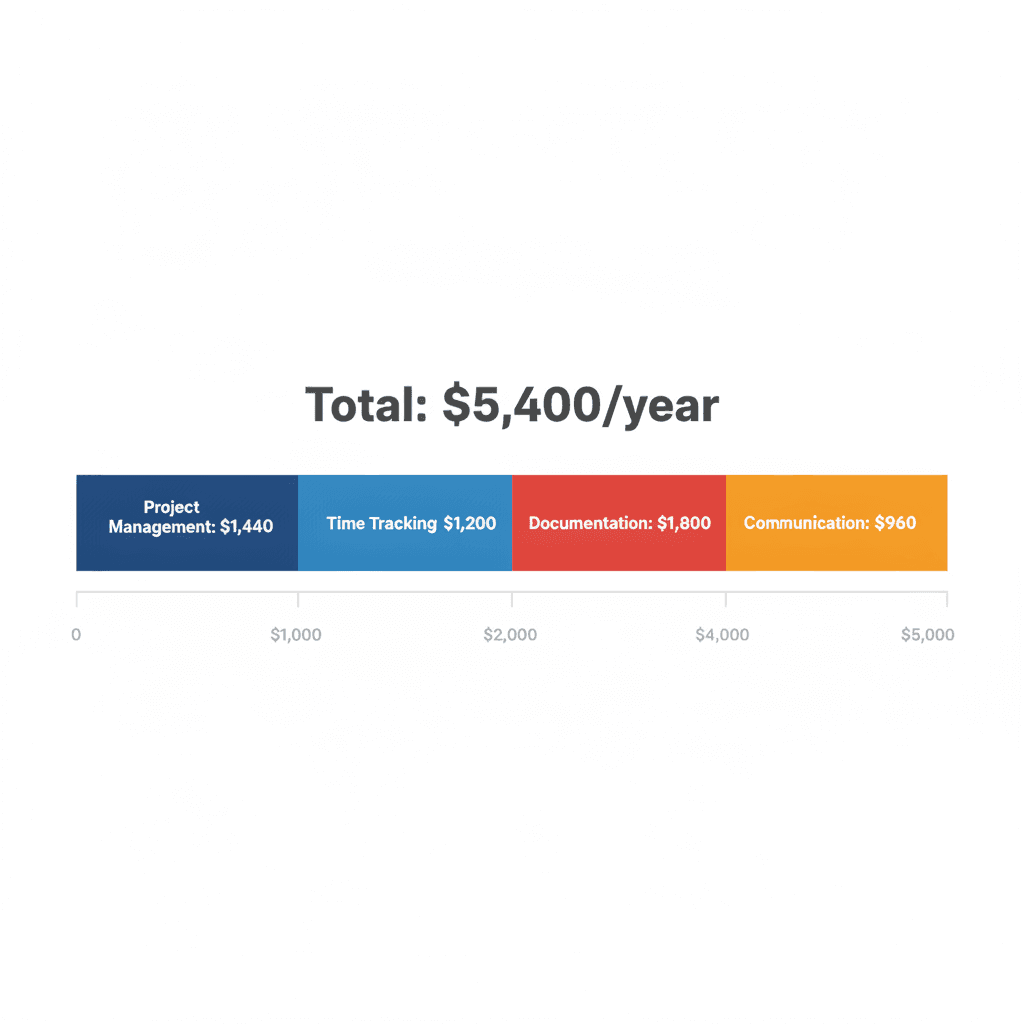
- Project management (ClickUp Business, 10 seats): ~$12/user/month billed annually = $1,440/year
- Time tracking (Toggl Track Premium, 10 seats): ~$10/user/month = $1,200/year
- Documentation (Notion Business, 10 seats): ~$15/user/month = $1,800/year
- Team communication (Slack Pro, 10 seats): ~$8/user/month = $960/year
Flat-fee · No seat tax
Done paying per seat? Melororium covers tasks, time tracking, and client CRM for teams of 4–25 — one flat monthly price.
The Per-Seat Trap: Why Costs Climb Faster Than Headcount
Per-seat pricing has a specific property that agency owners underestimate: it scales linearly with headcount, but agency revenue per head doesn't always scale the same way — especially when you're adding junior staff, contractors, or part-time specialists who don't bill at the same rate as senior team members. Adding a junior designer at $45,000/year salary also adds approximately $540/year in software costs across this stack (at roughly $54/month per the totals above). That's a small number in isolation, but it's a cost that exists regardless of whether that junior designer is billable 100% of the time — and most aren't, especially in their first few months. The trap compounds with contractors. Bring on two contractors for a three-month project and, depending on how your tools handle guest seats, you may be paying full per-seat rates for people who are with you for 90 days.
The Total Annual Number (Three Scenarios)
Not every agency runs the exact stack above. Here's the range across three realistic scenarios:
- Lean stack (core four tools only): ~$5,400/year
- Typical stack (core four plus an AI add-on and invoicing tool): ~$7,200–8,000/year
- Sprawling stack (the one most agencies actually run, with overlapping or underused tools): $9,600–14,400/year
What This Looks Like Over 3 Years
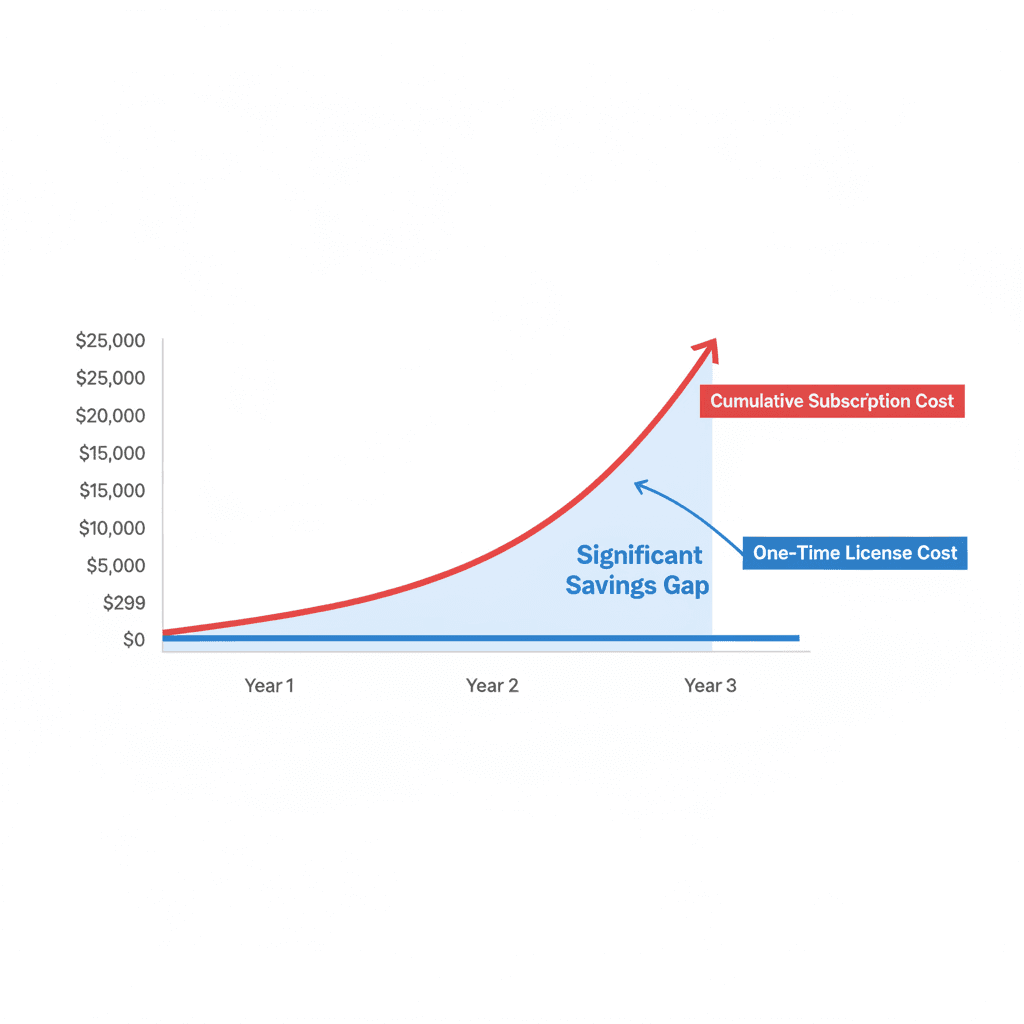
Software costs at this scale don't reset — they compound. Taking the lean stack figure of $5,400/year as a baseline, three years of the same stack costs $16,200. Taking the typical stack figure of roughly $7,600/year, three years costs $22,800. Price increases aren't factored into either number. Major project management and documentation tools have raised per-seat prices multiple times in recent years. A conservative assumption of 8–10% cumulative price increase over three years pushes the typical stack closer to $24,000–25,000 over that period.
The Flat-Fee Comparison
This is where the comparison gets concrete. Melororium's Agency plan — covering task management, native time tracking, client CRM, invoices, work reports, and Slack/Gemini integration for up to 10 users — is a flat monthly subscription at $59/mo, the same price whether you have 1 user or 10. Set against the typical stack figure of $7,600/year, a $59/mo subscription breaks even in under three weeks. Over three years, the typical-stack agency spends roughly $22,800–25,000 on software billed per seat. The same agency on Melororium's Agency plan pays $708/year and covers the whole team with no seat tax. To be fair about the comparison: this isn't an apples-to-apples feature match in every dimension. Larger SaaS platforms have feature depth built over a decade with hundreds of engineers. What a flat-fee workspace offers instead is the core functionality most agencies actually use daily — tasks, time, client visibility, and margin reporting — without the compounding cost.
Task tracking, timers, client CRM, invoices, and work reports for 10 users — $59/mo flat, no seat tax
See pricingHow to Bring This to a Budget Conversation
If you're taking this to a partner meeting or a budget review, the number that lands best isn't the annual figure — it's the three-year compounding figure, because that's the number that makes the recurring nature of the cost visible rather than abstract. The practical framing: 'Our current tool stack costs us roughly $22,000–25,000 over the next three years if nothing changes. A flat-fee alternative covering the same core functions costs $59/mo, flat, no seat tax.' That's a budget conversation with a clear, calculable answer — not a vague sense that software is expensive.
Flat-fee pricing, whole team included.
Starter $29/mo (4 users) · Agency $59/mo (10 users) · Studio $119/mo (25 users). No seat fees, no seat tax, no per-user billing.