Start free demo →
M
Melororium

PRODUCTIVITY ENGINE

Run high-speed task workflows with zero latency.

Drop overcomplicated setups designed for enterprise corporations. Melororium delivers instant local-first Kanban, native time tracking, and live budget reporting in one unified workspace.

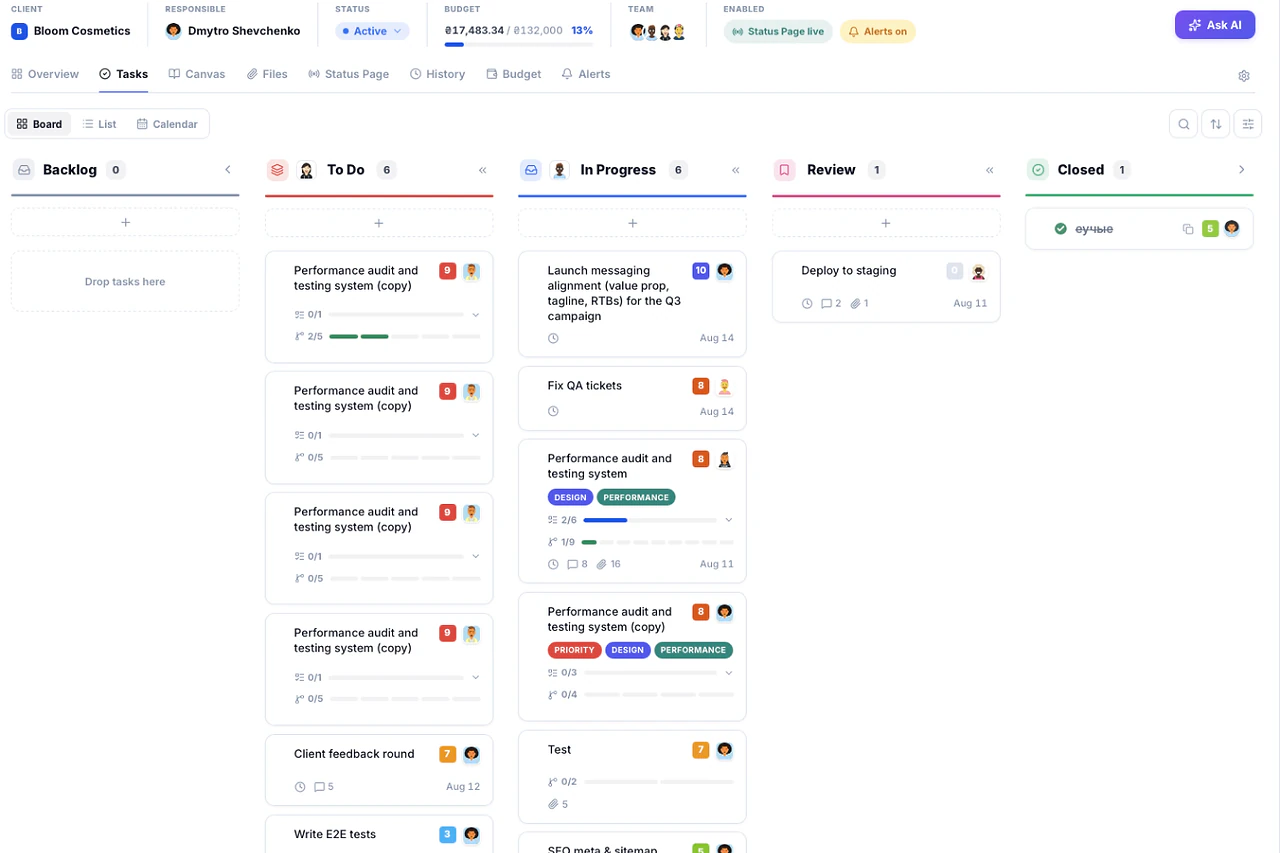
PRODUCTIVITY ENGINE — Melororium project management workspace preview

COSTLY MANAGEMENT

Standard project tracking tools enforce heavy subscription taxes.

Keeping task portfolios aligned shouldn't mean losing hundreds in recurring costs. Replace your fragmented toolstack with one flat-fee subscription — no seat tax, no per-user billing.

The SaaS Tax

Here is what you are paying every year to run a fragmented workflow:

Jira Cloud (Advanced Bug Tracking)
-$100 / yr
ClickUp (Task & Doc Folders)
-$144 / yr
Notion Plus (Team Knowledge Base)
-$96 / yr
Basecamp (Corporate Milestone Planner)
-$300 / yr
Todoist Pro (Daily Routine Lists)
-$60 / yr
Total Annual SaaS Cost$700 / yr
Melororium Flat-Fee Planfrom $29/mo
Flat-fee subscription. Save $352 every year vs your current stack. No seat tax.
Interactive Projection

Cumulative SaaS Tax vs. Flat-Fee Subscription

-$2100
SaaS Tax
$1044
Melororium
CUMULATIVE SAVINGS+$1056

Equivalent to running your task management environment for years at the cost of a two-month SaaS bill.

PERFORMANCE FRAMEWORK

Lightning-fast execution meets data clarity.

Say goodbye to heavy corporate databases and spinning loading indicators. Track your team's velocity inside a system engineered for speed.

Workspace Sync Pipeline4 steps
1

Global Vital Signs Monitoring

Inspect active project bars, total member loads, and cash balances from a single, aggregated command display.

2

Context-Rich Portfolio Navigation

Switch seamlessly between project summaries, task registers, and canvas layouts via fast dedicated workspace tabs.

3

Instant Kanban Mutation

Drag and drop operational task cards across status lanes with instantaneous sub-100ms interface response.

4

Chronological Deadline Synthesis

Check company deadlines alongside team availability on a clean, centralized chronological canvas layout.

Workspace Sync Pipeline
Step 1 of 4
Dashboard · Vital SignsLive
Active Projects24
Team Members12
Open Tasks87
Monthly Revenue$58K
Workflow synchronized natively

VALUE COMPARISON

Why pay per seat when you can go flat-fee?

Compare face-to-face. Other SaaS platforms lock your workflows and data behind endless per-seat fees. We believe professional software should be a flat fee for your whole team.

The old way

Paying monthly subscription taxes for every minor tool you use.

Scattered operational records causing workflow gaps and missed hours.

Heavy, sluggish cloud interfaces wasting your daily billable capacity.

Compiling raw timesheets manually to calculate project margins.

The Melororium way

Flat monthly fee for your whole team. Secure, scalable workspace.

Unified time logging and accounting tied directly to active tasks.

Blazing-fast local-first execution with zero interface latency.

Integrated ledger automation generating live performance reports.

ZERO LOADING SPINNERS

Local-first compilation. Zero server delays.

Melororium compiles all database transactions straight inside your client engine before pushing silent sync tasks to the server.

Local Cache Write< 2ms

IndexedDB direct write — zero network dependency

UI Re-render< 16ms

React virtual DOM diff — 1 animation frame

Background Sync< 100ms

Async worker sync — invisible to the user

Typical SaaS API600–1400ms

Server roundtrip + JSON parse + re-hydrate

LIVE TEST

Run a latency benchmark

Simulate a real workspace action and measure local vs remote execution time.

⚡ Melororium (Local-first)
🐢 Traditional SaaS (Server API)

Click run to measure local performance.

EARLY FEEDBACK

See what teams say about Melororium.

Early adopters from agencies and studios share how ditching the subscription stack changed how their teams operate.

Built for modern digital operations.

Join the early adopters scaling their business layout with Melororium.

$0
Per-Seat Tax
100%
Data Privacy
< 100ms
Board Latency
2026
Launch Edition

PRODUCT FAQ

FrequentlyAsked Questions

Have a question that needs a human to answer?

No problem, email us at support@melororium.com

Starter ($29/mo) covers up to 4 users — ideal for small teams. Agency ($59/mo, most popular) covers up to 10 users and lets you pick 5 additional modules on top of the 12 core ones. Studio ($119/mo) covers up to 25 users and unlocks all 20+ announced modules. All plans are billed monthly or yearly (save ~30% annually).

Switch plans anytime — your data stays intact and the transition takes seconds. Upgrade is prorated automatically. No lock-in, no penalties for growing your team.

With per-seat tools, every new hire costs more. A 10-person team on ClickUp pays $1,440/yr in seat fees alone. Melororium charges one flat monthly fee for your whole team — add 1 person or 10, the price stays the same. No seat tax that eats into your margins as you grow.

Security is non-negotiable. Melororium operates on end-to-end data encryption (TLS 1.3) with enterprise-grade database separation. Our AI features use strict Bring Your Own Key (BYOK) architecture — your data is never used for model training.

Yes. Melororium supports dedicated Client Portals at no extra cost. Clients can view project timelines and download deliverables. Guest client access does not count against your team seat limit.

Every plan includes: Dashboard, Kanban, Projects, Calendar, Team management, Client CRM, Invoices, Work Reports, Live Timers, Inbox, Time Tracker, and Settings. Agency and Studio plans add extra modules on top of these.

Project Management for Teams: The Case for Flat-Fee Over Per-Seat SaaS

Project management software is one of the most competitive categories in B2B SaaS — and one of the most expensive when calculated on a per-user basis. ClickUp, Asana, Monday.com, and Wrike all charge per seat per month, meaning the cost of running your team's projects scales directly with your headcount. For teams that are growing, this is a structural problem. This guide covers what teams actually need from project management software, why the per-seat model is the wrong pricing structure for most teams, and how a flat-fee workspace changes the calculus.

What Project Management Software Actually Needs to Do

Beneath the feature marketing of every major project management platform, the core requirements are simpler than they appear. Teams need to: know what work exists and who is responsible for it, understand the current status of every active project, track how much time is being spent and by whom, communicate context around tasks without losing it in email threads, and generate reports that connect work output to business outcomes. Every feature beyond that core — AI suggestions, automations, workflow triggers, 1,000 integrations — is in service of those five requirements. The question for a team choosing a project management tool is not which platform has the longest feature list, but which one handles those five requirements reliably, runs fast, and does not break the budget as the team grows.

Why Most Teams Overpay for Project Management

The per-seat pricing model in project management SaaS was designed for enterprise sales: large contracts with IT procurement, annual agreements, and volume discounts negotiated by a procurement team. For teams of 5–25 people, this model is structurally wrong. You are paying for a pricing architecture designed for companies ten times your size, while the tool itself is often over-engineered for your actual workflow needs. A 10-person agency does not need enterprise SSO, custom role hierarchies, and API rate limits — it needs reliable task management, time tracking, and billing. Melororium is built for that scope.

Melororium as a Full-Stack Project Management Workspace

Melororium's project management layer is built around the Kanban board, with global and per-project views. The global board gives managers visibility across all active projects simultaneously — useful for spotting overloaded team members or blocked tasks before they become delays. Per-project boards give teams a clean view of their specific workflow stages. Tasks support subtasks, file attachments, due dates, assigned users, priority flags, and embedded time tracking. Every task is linked to a project, and every project is linked to a client record in the CRM. This means every piece of work has a clear ownership chain from client to project to task to team member — no orphaned tasks, no ambiguous ownership.

Dashboard: The Live Pulse of Your Project Portfolio

The Melororium dashboard surfaces the most important operational data without requiring a custom report setup. Active projects and their completion percentage, team utilisation by member, tasks due in the next 48 hours, overdue items, and recent invoice status are all visible from the main view. For a project manager who needs to walk into a client call with current status information, the dashboard provides it in seconds.

Work Reports: From Project Data to Business Intelligence

Work reports in Melororium aggregate time logs, task completion rates, and project progress into structured reports that can be exported as PDF or Excel. These reports serve two purposes: internal management (understanding team capacity and project profitability) and client billing (converting tracked hours into invoice line items). The same data source serves both purposes, eliminating the double-entry that happens when time tracking and reporting live in separate tools.

Comparing Melororium to ClickUp, Asana, and Monday for a 10-Person Team

For a 10-person team, ClickUp Business costs $1,440/year for project management alone — with no built-in time tracking at billing grade or invoicing. Asana Premium costs $1,320/year with no time tracking at all. Monday Work Management costs $1,440/year. Each requires $1,200–$1,800/year in additional tools to cover time tracking and billing. Melororium at $708/year includes task management, time tracking, CRM, invoicing, and work reports. The delta is $2,000–$4,000 per year for a 10-person team — and that delta grows as the team grows, since per-seat prices compound with headcount while Melororium's flat fee does not.

Feature Parity: What You Give Up, What You Gain

Switching from a horizontal platform like ClickUp to Melororium means giving up some features: deep automation workflows, hundreds of integrations, AI-powered task suggestions, and complex custom field configurations. What you gain is a faster, more focused workspace that covers the billable work cycle end-to-end — project to task to time to invoice — without requiring additional tools. For teams whose primary need is managing client deliverables and billing accurately, the trade is clearly worthwhile.

Project Management Best Practices for Flat-Fee Teams

Running effective project management on Melororium starts with consistency in how projects are structured. Define a standard set of Kanban stages that apply to every project (Backlog, In Progress, Review, Done is a common starting point) and use them across all clients. This makes the global board readable at a glance and makes onboarding new team members to any project faster. Establish a habit of task-level time tracking from day one. The data is only as useful as the habits that feed it — a team that consistently logs time in their tasks generates accurate work reports and reliable billing data. A team that logs time sporadically generates noise. Run a weekly project review: 15 minutes with the project board open, moving stale tasks forward, re-assigning anything blocked, and flagging anything at risk of missing a deadline. This rhythm, combined with Melororium's real-time dashboard, means issues surface before they become client-visible problems.

Ship faster with a workspace that keeps up.

No cloud lag, no per-seat fees, no disconnected timers. Pure local execution for teams that value speed and clarity.

Start free 14-day demo 14-day free demo. No credit card required.
Stripe VerifiedTLS 1.3 EncryptionSlack Natively IntegratedBYOK ArchitectureNo Per-Seat Fees.
app.melororium.com
M
MelororiumWorkspace
Dashboard
Projects
Tasks
Clients
Employees
Work Reports
Timers
Calendar
Integrations

Main Dashboard

Active Projects
42+3
Team Members
18
Worker Payouts
$42,300
Monthly Revenue
$145,000+12%
Revenues and expenses
All Retainers Combined
Revenue YTD$ 1,240,500
Expenses YTD$ 420,100
Projects Health
Carper SaaS Redesign68%
34/50 completed
Brand Campaign Q392%
110/120 completed
Client Portal Sync15%
3/20 completed
Mobile App V245%
18/40 completed