The Real Cost of Context Switching: How Many Apps Does a Freelancer Actually Need?
Every time you switch apps, you lose 23 minutes of focus. Here's how many times a day freelancers actually switch — and the number that makes simplifying your tool stack an obvious decision.
Contents
One flat fee for the whole team
Tasks, timers, CRM and invoices in one workspace. From $29 a month, no seat tax.
Start free demo14 days · no credit card
The 23-Minute Recovery Cost Nobody Talks About
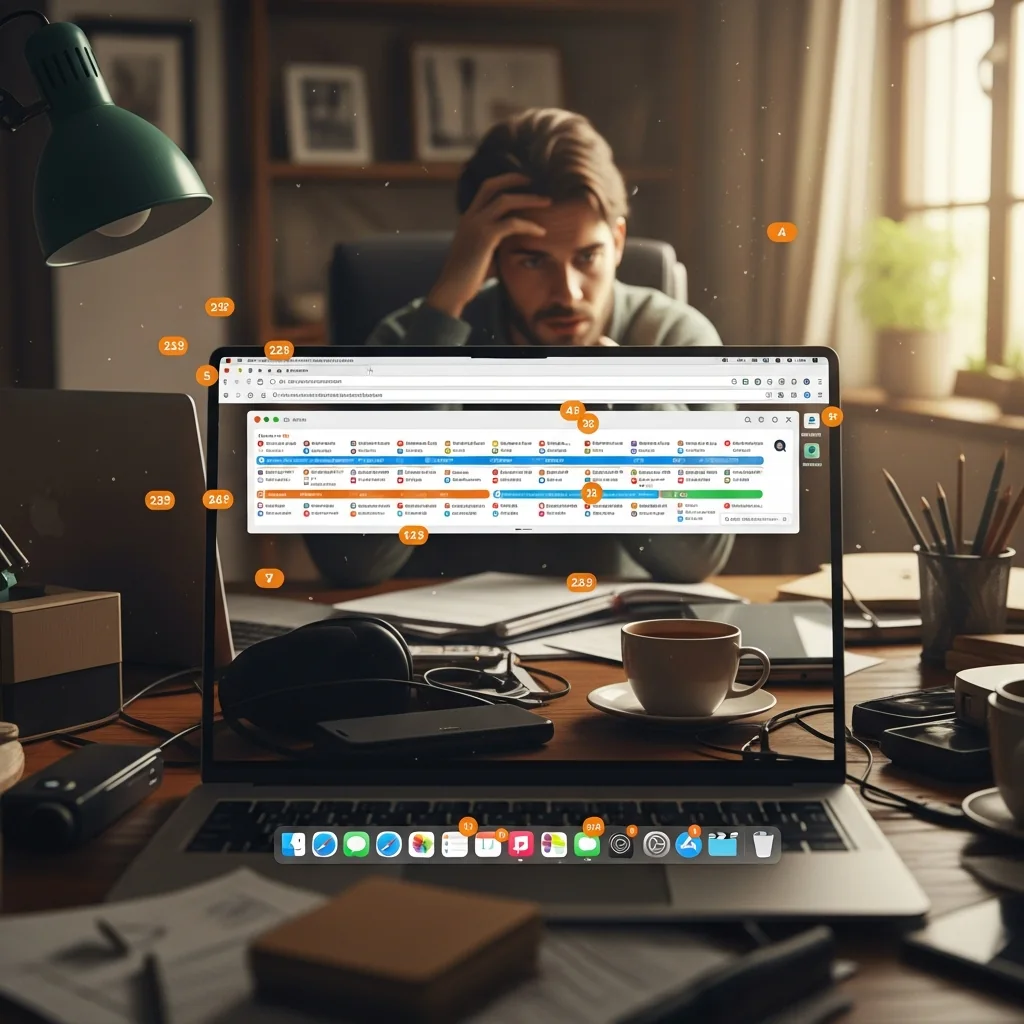
There's a statistic from productivity research that doesn't get enough attention: after an interruption, the average knowledge worker takes 23 minutes to return to the same level of focus they had before. Not 23 minutes to get back to the task — 23 minutes to get back to the cognitive depth they were operating at when the interruption happened. For freelancers doing complex work — writing, design, development, strategy — cognitive depth is the product. The quality of the output is directly proportional to the quality of the focus that produced it. Every context switch is a 23-minute tax on that focus, and it compounds. The average office worker switches tasks approximately 50 times per day. Freelancers, with their combination of client communication, project management, time tracking, and actual work, are in a similar range.
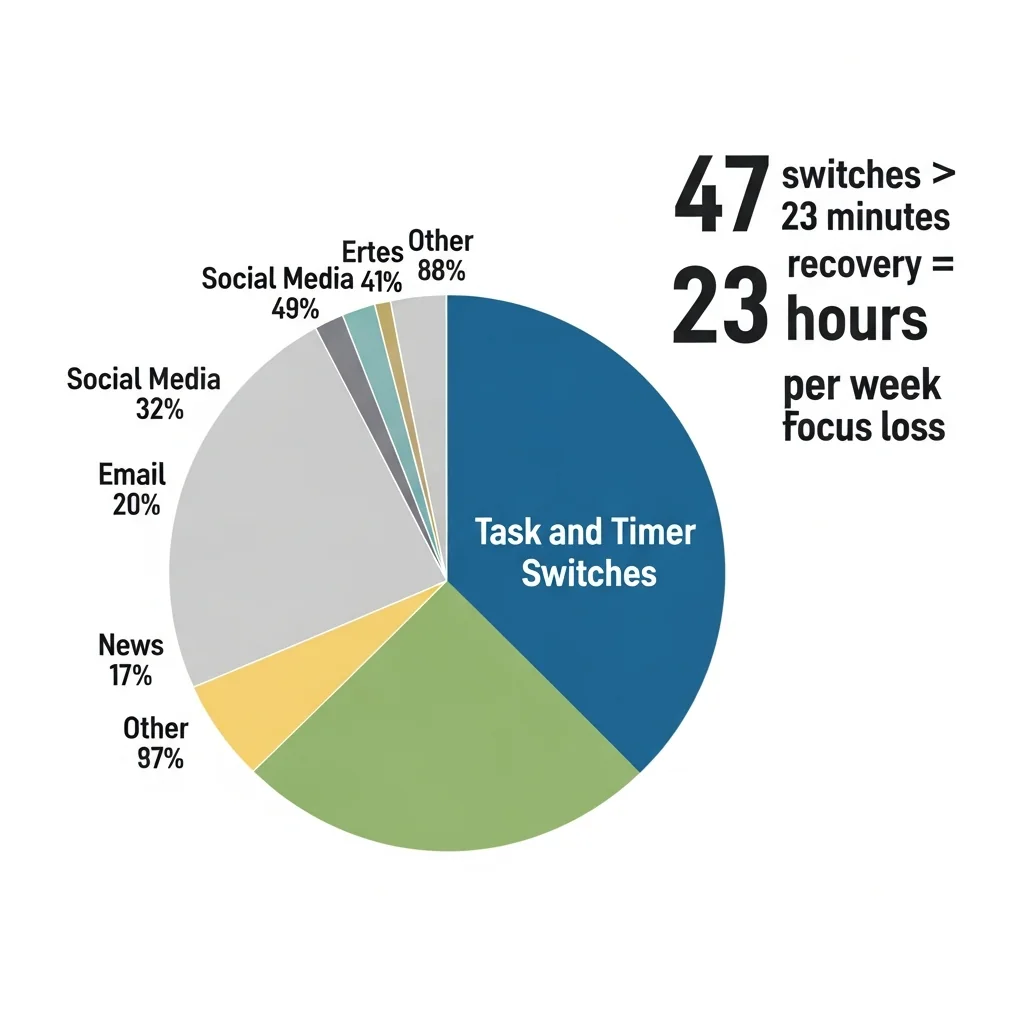
"I counted how many times I switched apps in a typical work day. The number was 47. Then I calculated what that costs in recovered focus time. That was the day I started consolidating."
I Counted My Own App Switches for a Week
I used a simple tracking method: every time I switched from one app to another with the intention of checking or doing something, I logged it. Not passive switches — deliberate switches. The daily average across five working days: 47 deliberate app switches. Broken down by category:
- Task manager to Slack (and back): 14 times
- Task manager to time tracker (and back): 8 times
- Work in progress to email (and back): 9 times
- Work in progress to task manager: 6 times
- Everything else: 10 times
The Hidden Productivity Tax of a Fragmented Tool Stack
The subscription cost of a fragmented tool stack gets discussed frequently. The productivity cost almost never does. But for most freelancers, the productivity cost is larger than the financial cost. Here's a conservative estimate. Assume 20 deliberate app switches per day that involve the task-management and time-tracking tools (the most disruptive category). Assume a 5-minute average recovery cost per switch. That's 100 minutes per day — 8+ hours per week — of cognitive transition cost from tool fragmentation. At $75/hour, that's $600/week in reduced productive capacity. Even recapturing 20% of that through consolidation is $120/week, $6,240/year, from a non-financial change.
The Minimum Viable Tool Stack for Freelancers
The minimum viable stack is the smallest number of tools that cover every job your work requires — without meaningful sacrifice in functionality. For most freelancers, this is five categories:
- Where work is managed: task and project management
- Where time is tracked: ideally inside the task management tool
- Where communication happens: email + one messaging platform
- Where files live: cloud storage
- Where money is managed: invoicing and accounting
Flat fee · no seat tax
Eliminate your highest-frequency context switch
The task manager to timer switch — and back — is the most disruptive switching pattern for most freelancers. Melororium eliminates it entirely. Tasks and timers in one place, flat-fee subscription.
Teams from $29/mo
Starter $29/mo · Studio $119/mo
What Consolidation Actually Looks Like in Practice
Consolidation doesn't mean using worse tools. It means using fewer tools that each cover more ground.
- Merge task management and time tracking — every switch between these two is eliminated. Hours attach to tasks automatically. The result is fewer switches, more accurate data, and one less subscription
- Merge project management and client communication — using Slack notifications from your task system eliminates a category of switches and a recurring communication task
- Reduce to one communication platform — the average freelancer uses email, Slack, and at least one other messaging tool. Standardizing on one channel reduces incoming interruption significantly
Melororium
Try it in Melororium
Melororium — task management with native timers and Slack integration in one workspace, eliminating the highest-frequency context switches
The Focus Dividend: What You Get When You Simplify
The freelancers who consolidate their tool stacks report a consistent set of changes within the first month: fewer dropped tasks (because everything is in one system), more accurate time tracking (because tracking happens where work happens), and — the most consistently mentioned benefit — lower ambient anxiety about whether something is being missed. That last one is harder to quantify but worth naming. A fragmented tool stack creates a background cognitive load: the nagging sense that there might be something in the other tab, the other app, the other system. Consolidation doesn't eliminate that load through discipline — it eliminates it through architecture.
How to Audit Your Own Context Switching
The one-week experiment that reveals your consolidation target:
- Step 1: For five working days, log every deliberate app switch. Just a tally mark — no detail required
- Step 2: At end of day, categorize by
- Step 3: At end of week, identify which category has the highest count
- Step 4: That category is your consolidation target — for most freelancers, it's task-to-timer
Boards that run themselves
Kanban with subtasks, priorities and a timer on every card
Demo request from Bloom Cosmetics
Website redesign · due Oct 14