Your CRM and Invoices Should Be in the Same Tool. Here's Why They're Not — And the Fix
Client in HubSpot. Invoice in FreshBooks. Tasks in ClickUp. Three browser tabs, three subscriptions, zero connection between them. Here's what happens when they live in one workspace.

Contents
One flat fee for the whole team
Tasks, timers, CRM and invoices in one workspace. From $29 a month, no seat tax.
Start free demo14 days · no credit card
CRM with Invoicing: What to Look for in 2026
Most agency teams run 3 separate tools for client management, project tracking, and invoicing. The annual cost for a 10-person team using HubSpot + ClickUp + FreshBooks runs $7,000–9,000/yr. Here is what a combined CRM and invoicing workspace solves:
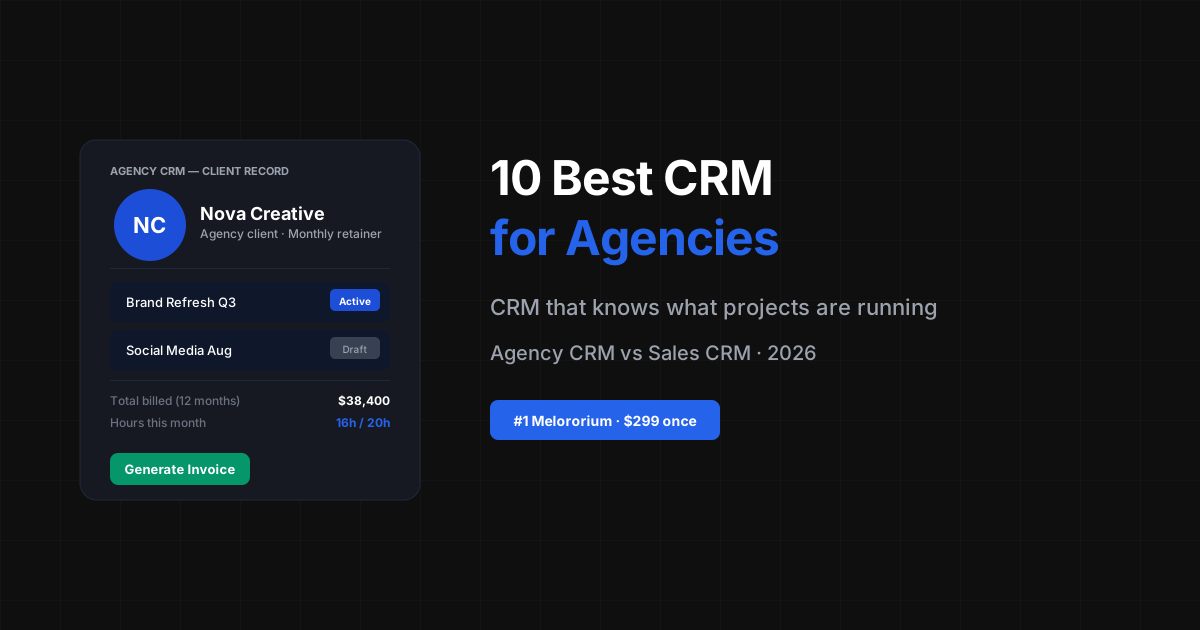
- Client data in one place: contact history, project notes, and payment records linked — no copy-paste between tabs
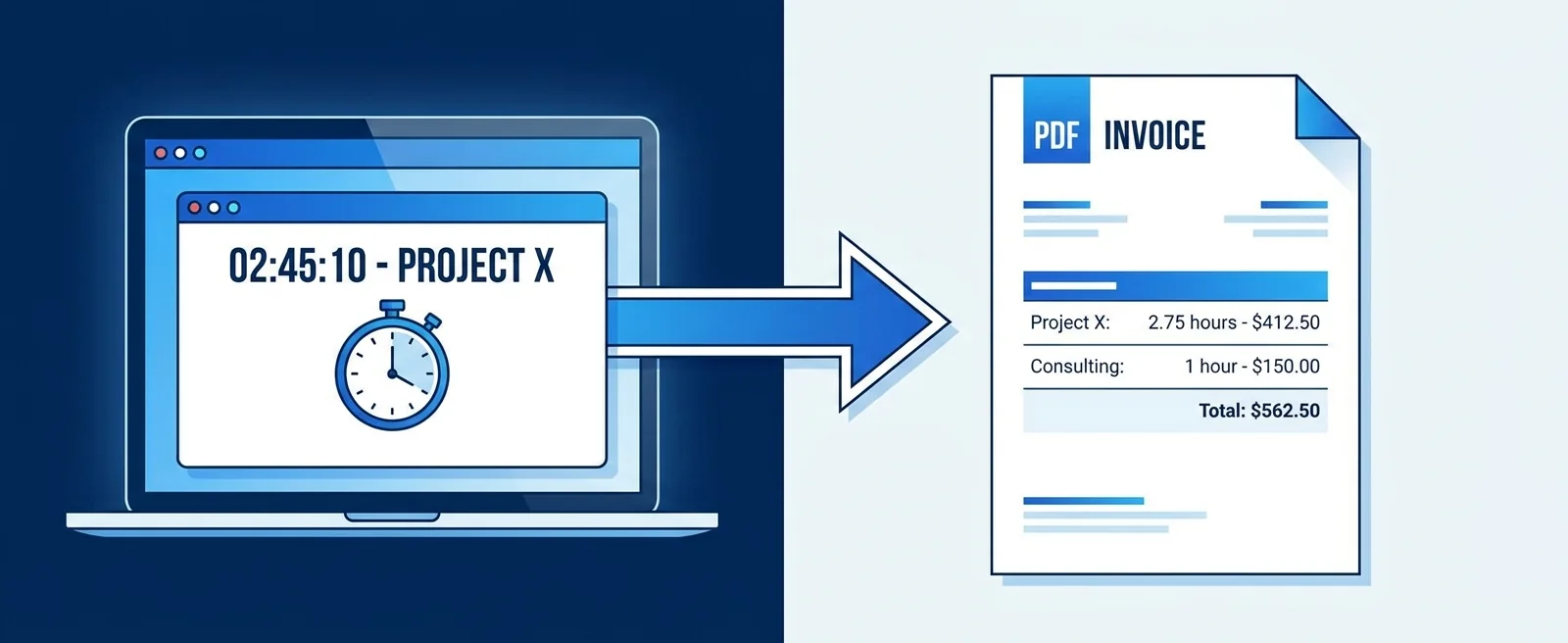
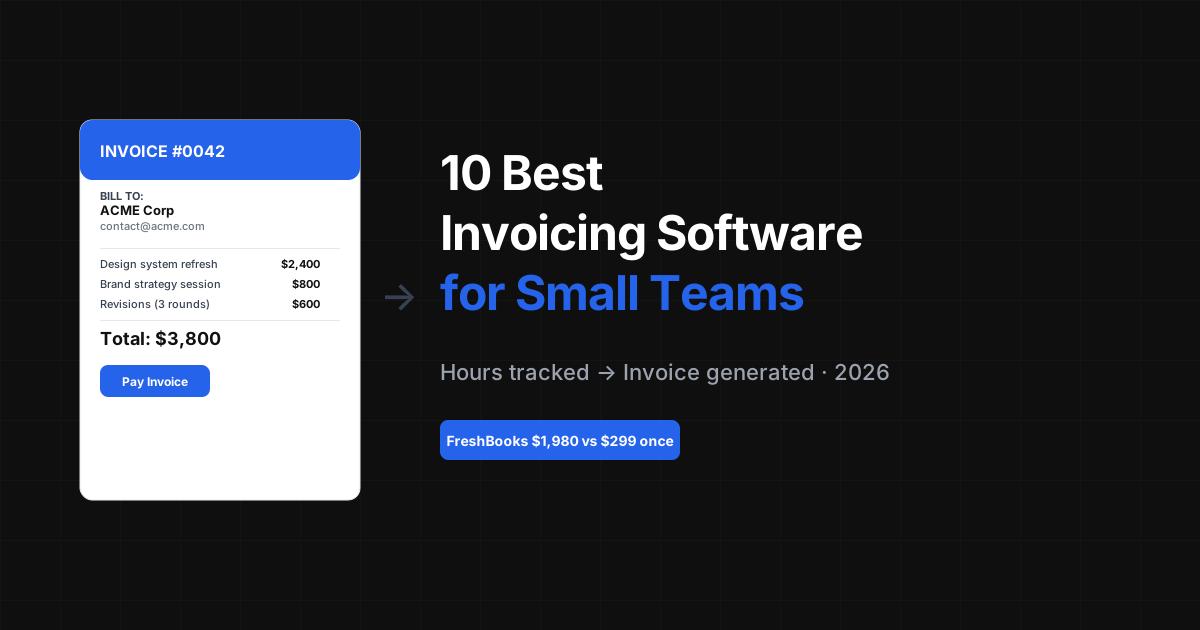
- Time logs connect to invoices: billable hours logged inside tasks generate invoice line items automatically
- Retainer tracking: remaining hours visible against client contracts without manual spreadsheet updates
- Single source of truth: project status, hours burned, and invoice status visible from the same client record
- Flat-fee alternative: Melororium Agency covers CRM, project management, timers, and invoicing for $59/mo for 15 users — vs $7,000+/yr for a HubSpot + ClickUp + FreshBooks stack
"The real cost of running HubSpot, FreshBooks, and ClickUp separately for a 10-person agency: approximately $7,000-9,000/year. Plus the invisible cost — hours spent manually connecting the information."
01. Why Client Management and Billing Got Split Into Different Tools
CRM companies built for sales pipelines. Invoicing companies built for accountants. Project management companies built for engineering teams. Each solved one piece well, and none had a financial reason to build the adjacent piece. The agency paid for all three. A CRM subscription. An invoicing subscription. A project management subscription. Three monthly charges, three separate tools, and someone spending hours every week manually connecting information that should have been in the same place.
02. The Real Cost of Three-Tab Client Management
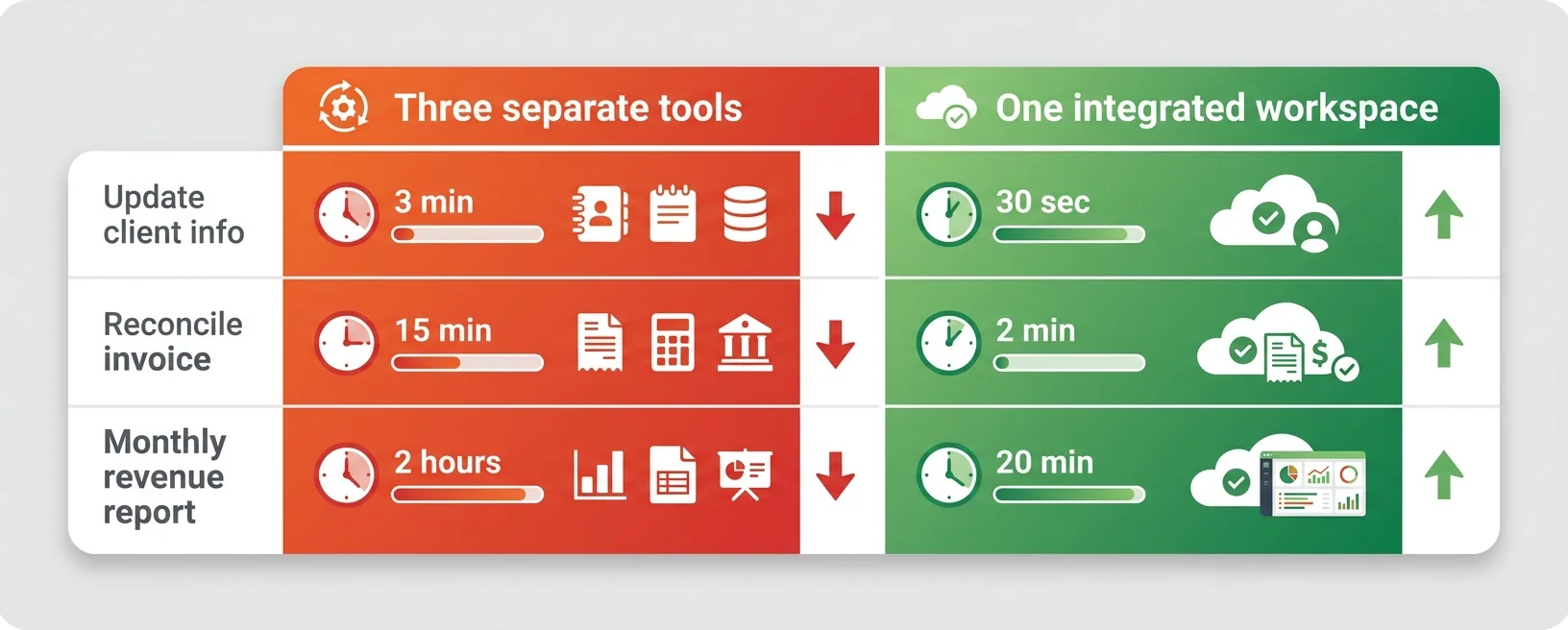
HubSpot + FreshBooks + ClickUp for a 10-person agency: $7,000-9,000/year in per-seat fees. That's the renewal email. The cost you don't get a bill for: creating a new client in three systems, updating a name in three places when someone rebrands, cross-referencing an invoice dispute against the project it came from across three open tabs, building a monthly revenue report by exporting from FreshBooks and reconciling with ClickUp task completion.
03. What Gets Lost in the Gaps Between Tools
Invoice context: An invoice in FreshBooks is a number and a line item. It has no connection to the tasks that generated the work, the client communications that shaped the scope, or the project history that explains why something took longer. When a client disputes a line item, you piece together the answer from three different tools. Client history: What a client bought, what projects delivered it, how long it took, what was invoiced, what's been paid — split across three systems. Getting the full picture means opening all three. Revenue visibility: Invoice totals in FreshBooks. Hours in the time tracker. Completion status in ClickUp. The three numbers should tell one story. Getting there requires exporting and reconciling manually.
Flat fee · no seat tax
Clients, projects, timers, and invoices — all in one place.
No tab-switching, no reconciliation, no triple entry. One workspace, one payment.
Starter: $29/mo (4 users)
Agency: $59/mo (15 users)
Studio: $119/mo (Unlimited users)
04. What CRM + Invoicing in One Place Actually Looks Like
When client management, invoicing, and project tracking live in the same workspace, one record replaces three. A new client gets a single record: contacts, project history, task data, invoice history. An invoice for a completed project pulls from actual timer data, not a manual estimate. A disputed line item links directly to the task log.
Melororium
CRM + Invoicing in One Workspace
Melororium CRM + Invoice Generator — client management, project tasks, timers, and invoicing in one workspace. No tab-switching.
05. The Client Lifecycle Without Tool-Switching
New client onboarding: Create the client record once. The project, tasks, and invoices attach to the same record. No data entry in three places. Active project: Tasks track progress. Timers track hours. Both connect to the client record. When the project closes, the invoice generates from the actual timer data. Invoice and payment: Generate from the work report. Send directly. Payment status updates on the client record. Project history and billing history live in the same place. Client review: Open the client record and see every project delivered, every hour tracked, every invoice sent, what was paid, what's outstanding.
06. When the Integration Approach Fails
Most agencies try integrations before switching: Zapier automations connecting HubSpot to FreshBooks, API connections syncing ClickUp to both. These break when any of the three tools updates its API, changes its data structure, or the Zapier quota runs out mid-month. Connections between three separate companies' products depend on those three companies maintaining compatibility indefinitely. They don't.
07. What You Actually Need vs What You're Paying For
A small agency needs a clean client record with project history and billing attached. It needs invoices that reflect what was actually worked, generated without manual entry. Three separate subscriptions to cover those two needs is the problem, not the norm.
Boards that run themselves
Kanban with subtasks, priorities and a timer on every card
Demo request from Bloom Cosmetics
Website redesign · due Oct 14