What is Agile?
Agile
Agile is a way of managing work in short cycles with regular feedback, instead of planning everything up front and building for months before anyone sees it.
Agile is a project management philosophy that delivers work in short, repeated cycles rather than one big release at the end. Instead of planning everything upfront and building for months before anyone sees results, Agile teams work in short bursts, usually 1–4 weeks, and adjust based on real feedback.
The name comes from the Agile Manifesto, published in 2001 by 17 software developers who were frustrated with heavyweight planning processes. The manifesto prioritizes working software over comprehensive documentation, responding to change over following a plan, and individuals over processes and tools.
For a 10-person agency or design team, Agile means structuring work so that clients see progress every two weeks rather than after three months. It means your team can change direction when a client changes their mind, without derailing the entire project.
The Four Core Values of Agile
The Agile Manifesto defines four values that guide how Agile teams operate. Each one is a preference, not an absolute rule: the manifesto says "while there is value in the items on the right, we value the items on the left more."
These values translate directly into how teams run meetings, write documentation, handle client requests, and structure their work.
- Individuals and interactions over processes and tools: a conversation solves problems faster than a ticket system
- Working deliverables over comprehensive documentation: show the client a working prototype, not a 40-page spec
- Customer collaboration over contract negotiation: involve the client throughout, not just at kickoff and delivery
- Responding to change over following a plan: when the market shifts, adapt instead of defending the original roadmap
Agile Frameworks: Scrum, Kanban, and Others
Agile is the philosophy; frameworks are how you practice it. The two most common are Scrum and Kanban, but there are others (SAFe, LeSS, XP) for larger organizations.
Scrum uses fixed-length sprints (usually 2 weeks), defined roles (Product Owner, Scrum Master, Development Team), and specific ceremonies (Sprint Planning, Daily Standup, Sprint Review, Retrospective). It works well when the team needs structure and the backlog changes frequently.
Kanban uses a continuous flow model with a visual board: To Do, In Progress, Done. There are no sprints or fixed roles. Work moves through the board as capacity allows. It works well for support teams, ongoing operations, and agencies with mixed inbound and planned work.
| Framework | Cycle | Best for | Team size |
|---|---|---|---|
| Scrum | 2-week sprints | Product development, defined scope | 5–9 people |
| Kanban | Continuous flow | Operations, support, agencies | Any size |
| Scrumban | Hybrid | Teams transitioning from Scrum | 5–15 people |
| XP | 1-week cycles | Software engineering focus | 3–10 engineers |
Agile vs Waterfall: When to Use Each
Waterfall is the traditional alternative to Agile. In Waterfall, you complete each phase fully before moving to the next: requirements → design → development → testing → deployment. There's no going back without significant rework.
Agile wins when requirements are likely to change, when you want client feedback throughout, or when the team is building something new. Waterfall wins when requirements are fixed, regulatory compliance demands documentation, or the project has hard dependencies between phases (like construction or manufacturing).
Most agency and product teams today use some form of Agile. Waterfall remains common in government contracting, manufacturing, and regulated industries.
How Teams of 4–25 Use Agile in Practice
For a 10-person agency, full Scrum is often overkill. Most teams adopt a lightweight version: a shared backlog, a Kanban board organized by project, weekly or biweekly check-ins instead of daily standups, and a short retrospective every two weeks.
The key Agile habit that pays off immediately: reviewing progress with the client every 1–2 weeks instead of delivering a finished product after 3 months. This eliminates the painful "that's not what I wanted" conversation at the end of a long engagement.
Time tracking matters in Agile teams. When your team logs hours per task and per sprint, you can see whether your estimates are improving over time. If you consistently underestimate by 30%, that becomes visible, and fixable.
Agile Implementation: Moving from Waterfall to Agile
The transition from Waterfall to Agile doesn't happen by running a team training and switching tools. You change how your team thinks about work, planning, and delivery. Most teams fail because they keep Waterfall behavior inside Agile ceremonies: sprint planning that treats the backlog as a fixed contract, retrospectives where nobody implements any of the action items. The result is process overhead with none of the benefit.
Start with one pilot project, not a full organizational switch. Pick a motivated team lead, run a 2-week sprint, and document what breaks. Problems from week one teach you more than any Agile handbook.
The typical transition runs 90 days. Expect the first 4 sprints to feel slower than your previous process. Sprint 5 is usually when the team starts trusting the system. Measure sprint goal completion rate in the first 60 days, not velocity. Velocity is a planning input, not a performance score.
Three failure modes consistently derail transitions: adding too many tools before the team understands the process, skipping retrospectives under deadline pressure, and managers who assign work directly to team members instead of through the sprint backlog. The third one is most destructive. When work enters through direct assignment, the sprint becomes a fiction and team members stop trusting the plan because it doesn't reflect what they're actually doing.
For an agency switching from deadline-driven project work, the hardest adjustment is treating the sprint backlog as a commitment. It means saying no mid-sprint when a client requests something that wasn't planned. That conversation is uncomfortable the first few times. It gets easier after the team sees that the sprint actually delivers what it promised.
- Month 1: Build the backlog. Break every task into 1–3 day items. Run one sprint with daily standups. Skip velocity and burndown charts for now.
- Month 2: Run sprint reviews with real output for a stakeholder. Start retrospectives using Start/Stop/Continue: 45 minutes, max 3 action items per session.
- Month 3: Measure velocity using the 3-sprint rolling average. Use it to plan future sprints, never to evaluate individual performance.
Agile for an 8-Person Design Agency: Real Example
This is how one 8-person design agency adapted Agile to fit client work. Not the textbook version. The one that survived contact with real deadlines.
Team: 1 creative director, 2 senior designers, 3 designers, 1 project manager, 1 account manager. Active client load: 5–8 projects across brand identity, web design, and campaigns.
Three adaptations from standard Agile. First, 1-week sprints instead of 2-week. Client work moves faster than software development, and 2 weeks was too long between feedback checkpoints. Second, hours instead of story points. Each designer has 32 billable hours per week after meetings and admin. Sprint planning fills that number. Third, sprint reviews as client checkpoints. Every Friday, the PM sends each client a brief showing what was completed and requesting approvals on the next batch.
Their sprint rhythm: Monday 9:30 AM sprint planning (60 minutes), Tuesday–Thursday standups at 9:30 AM (15 minutes), Friday 3:00 PM sprint review and retrospective back-to-back (60 minutes total). The retrospective runs every other week at 45 minutes using Start/Stop/Continue. One person owns each action item before the session ends.
The single rule that changed everything: nothing enters the sprint once it starts. When a client called with an urgent request, the PM added it to the next sprint's backlog or negotiated what dropped from the current one. This rule was uncomfortable for the first 6 weeks and changed the team's relationship with scope afterward.
- On-time delivery rate: 58% to 81% after 6 months
- Average client revision rounds: 3.2 to 1.8 per project
- Weekend work: stopped entirely by month 4
- Story points were tried for 3 sprints and dropped: hours were more intuitive and required no explanation to new team members
- The creative director stopped assigning work directly. All work flows through the sprint backlog. Took 6 weeks to enforce consistently.
Agile Metrics: What to Measure
Four metrics give a team enough signal to run Agile well. More than four creates reporting overhead without adding clarity.
Velocity measures how much work the team completes per sprint: story points, task count, or hours. Use the 3-sprint rolling average for planning, not the best sprint or the most recent one. Velocity that varies wildly between sprints signals poor estimation or irregular blockers. Stable velocity enables reliable forecasting.
Sprint Goal Completion Rate tracks whether the team achieved the sprint's stated objective. Calculate it as completed sprint goals divided by total sprint goals, expressed as a percentage. A healthy range is 70–85%. Teams hitting 100% every sprint are under-planning. Teams consistently below 60% have a planning problem worth investigating before adding more work.
Cycle Time measures how long individual tasks take from start to done. Track the average for your task types. An item taking 3× longer than average signals hidden complexity or a blocker that didn't surface in standup. Teams that skip cycle time consistently underestimate task duration in planning.
Escaped Defects counts issues or rework that reached the client and should have been caught internally. Track every escaped defect for one quarter. Common sources: unclear briefs, skipped internal reviews, or gaps in the definition of done.
Three metrics to skip in the first 6 months of running Agile: individual velocity per person (comparing output between team members damages collaboration), burndown chart accuracy (teams game burndowns by marking tasks done before review), and meeting count reduction (cutting standups doesn't increase productivity, it reduces coordination).
| Metric | What It Measures | Target | Review Cadence |
|---|---|---|---|
| Velocity | Work completed per sprint | Stable 3-sprint trend | Monthly |
| Sprint Goal Completion | % of sprint goals met | 70–85% | Per sprint |
| Cycle Time | Task duration from start to done | Know your team average | Monthly |
| Escaped Defects | Issues that reached clients | 0 critical | Quarterly |
Agile Misconceptions Teams Need to Unlearn
Teams that struggle with Agile usually carry wrong beliefs from their previous process. These beliefs come from oversimplified training, from managers who saw Agile as a delivery-speed lever, and from failed implementations that got abandoned before they had time to work.
Misconception: Agile means no planning. Agile means planning in shorter cycles. Sprint planning, backlog refinement, and capacity checks are all planning activities. They happen weekly or biweekly instead of at a kickoff three months in advance. Teams that skip planning inside Agile don't run sprints. They run chaos with a standup attached.
Misconception: Daily standups are status reports. When a manager asks each person for a progress update in sequence, the standup has become a status report meeting. Standups exist for the team to coordinate with each other and surface blockers. If a blocker sits unresolved for more than 24 hours, the standup is failing its core purpose.
Misconception: Agile only works for software. Agile principles apply to any work with uncertainty. Brand strategy, campaign execution, and content production all have uncertainty. The ceremonies look different from a software team, but short cycles and feedback loops apply regardless of deliverable type. An 8-person marketing team can run weekly sprints without writing a line of code.
Misconception: We tried Agile and it didn't work. In most cases, the team ran one practice (usually daily standups) and stopped when it felt pointless. Running standups without retrospectives, backlog management, or sprint planning is not Agile. It's an extra meeting. If Agile didn't work, ask what practices the team ran, for how long, and who owned the process.
Misconception: Agile means managers step back and the team decides everything. Agile changes how decisions happen, not who owns outcomes. Product Owners set priorities. Scrum Masters remove blockers. Leadership still owns business results. Decisions move closer to the work. Accountability doesn't disappear.
- "No planning": sprint planning, backlog refinement, and capacity checks ARE planning; they happen more frequently, not less
- "Standups are status reports": change the question to "What do you need from someone on this team today?"
- "Only for software": creative, marketing, and operations teams run Agile without a single line of code
- "We tried it": one ceremony running without the others isn't Agile; allow 8–12 weeks of the full framework before drawing conclusions
- "Managers step back": Agile changes decision speed, not accountability; someone still owns the outcome
In Melororium
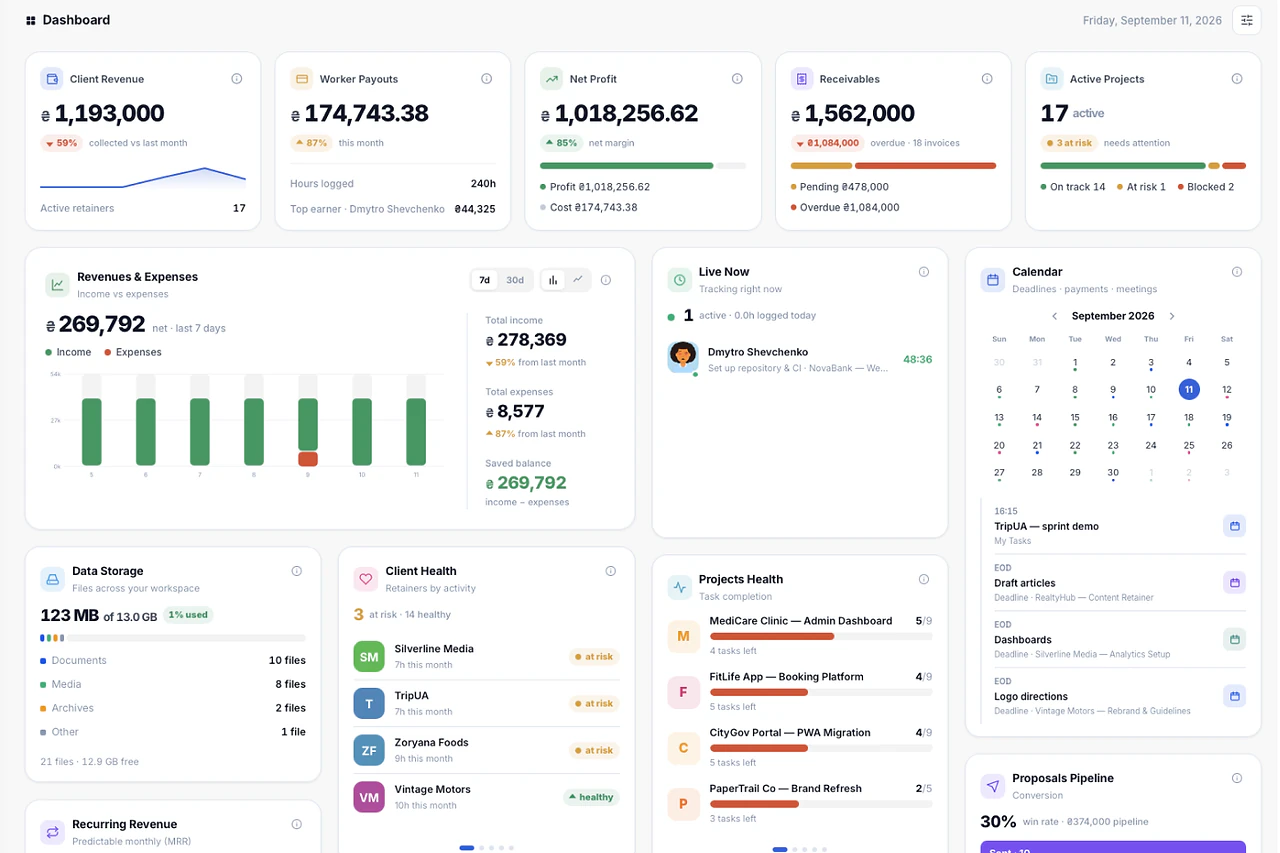
See how Melororium handles Agile-style task management
Common mistakes with agile
What teams get wrong most often, and what to do instead.
- 1
Calling any flexible process "Agile"
Dropping formal planning and calling the resulting chaos "Agile." Agile still has structure: short cycles, regular review, a backlog. Without it, it's improvisation.
- 2
No real feedback loop
Running two-week cycles but never showing the client or stakeholder what shipped. Short cycles without a review step lose their entire point.
- 3
Mixing Agile with fixed-scope contracts
Selling a client a fixed price and fixed scope, then trying to run the work Agile internally. The two models fight each other; scope has to flex for Agile to work.
- 4
A cycle length that doesn't match the work
Running one-week sprints for work that genuinely needs three weeks to show a result. Forcing an artificial cadence creates fake "done" states.
Frequently asked questions
What is Agile in simple terms?
Agile is a way of working where teams deliver in short cycles and adjust based on feedback, instead of planning everything upfront and building for months before showing results.
Is Agile only for software teams?
No. Agile started in software but is now used by marketing teams, design agencies, HR departments, and product companies. The core idea (short cycles, continuous feedback, flexibility) applies to any knowledge work.
What's the difference between Agile and Scrum?
Agile is the philosophy. Scrum is one specific framework for practicing Agile. All Scrum teams are Agile, but not all Agile teams use Scrum.
Does Melororium support Agile workflows?
Yes. Melororium's Kanban boards, project views, and time tracking align with Agile practices. Teams use Kanban boards for sprint-style work, time tracking to compare estimates vs actuals, and work reports to run lightweight retrospectives.