What is a Project Timeline?
Project Timeline
A project timeline maps every task, milestone, and deadline across the calendar, so everyone can see when work starts, how long it takes, and when it ends.
A project timeline is a visual or tabular representation of when project work will happen: which tasks start when, how long they take, when milestones are reached, and when the project ends. It's the calendar dimension of the project plan.
Timelines serve two audiences: the team uses them to coordinate and sequence work; stakeholders and clients use them to understand progress and plan their own activities around the project.
A project timeline isn't a fixed document: it's a living plan that updates as the project progresses, tasks take more or less time than estimated, and scope changes.
What a Project Timeline Shows
A complete project timeline includes:
- Task list: every task that needs to happen, at the right level of detail
- Duration: how long each task takes (hours, days, or weeks)
- Dependencies: which tasks must finish before others can start
- Start and end dates: when each task is scheduled to occur
- Milestones: key checkpoints and delivery dates
- Owners: who is responsible for each task
- Critical path: the chain of tasks that determines the project end date
Timeline Formats
| Format | Best for | Shows dependencies? |
|---|---|---|
| Gantt chart | Complex projects with many tasks | Yes, visually |
| Milestone list | High-level stakeholder communication | No |
| Kanban board | Flexible, flow-based work | Partially |
| Calendar view | Time-based planning | No |
| Spreadsheet | Simple projects, flexible | Manually |
How to Build a Realistic Project Timeline
Timeline building mistakes that consistently cause projects to run late:
Optimistic estimates: people estimate best-case duration, not average. Use historical data from past projects when available. Add 20–30% buffer to task estimates.
Ignoring non-project time: meeting time, admin, holidays, and sick days consume 20–30% of working time. A person who works 40 hours per week isn't available for 40 hours of project work.
Forget dependencies: tasks that appear to be parallel sometimes have hidden dependencies. Map all dependencies before finalizing dates.
No buffer at the end: add a 1-week buffer before the client deadline for integration issues, final review, and inevitable last-minute changes.
Not updating as you go: a timeline made at project start and never updated is fiction after week 2. Review and update weekly.
Timeline for a 3-Month Agency Project: Example
A concrete timeline example is more useful than abstract principles. Here's a realistic 12-week timeline for a full website redesign, the type of project a 6-10 person agency runs regularly.
| Week | Phase | Key activities | Milestone / deliverable | Owner |
|---|---|---|---|---|
| 1 | Kickoff & Discovery | Kickoff meeting, stakeholder interviews, site audit | Signed project charter | PM |
| 2 | Discovery | Competitive analysis, discovery synthesis | PM + Strategist | |
| 3 | Discovery | Discovery report drafting, client presentation prep | Discovery report delivered | PM |
| 4 | Design | Sitemap, navigation structure, wireframe development | UX Designer | |
| 5 | Design | Wireframes complete, client wireframe review | Wireframes approved | UX Designer |
| 6 | Design | Visual design, homepage and style tile | Visual Designer | |
| 7 | Design | Visual design, inner pages, design review | Visual design approved | Visual Designer |
| 8 | Development | Dev environment setup, front-end build begins | Developer | |
| 9 | Development | Homepage and navigation built, content integration begins | Developer | |
| 10 | Development + Content | Inner pages built, content population, QA begins | Developer + PM | |
| 11 | QA + UAT | Internal QA complete, client UAT period | Client UAT sign-off | Developer + PM |
| 12 | Launch | Final fixes, go-live, post-launch checks | Site live | Developer + PM |
Timeline Communication with Clients
The project timeline is only useful to the client if they understand it, stay aware of it, and know when their actions affect it. Most timeline communication failures happen not because the timeline is wrong, but because it was shared once at kickoff and then forgotten.
At kickoff, walk through the timeline visually. Highlight the dates where client action is required and ask for explicit confirmation that those dates work.
Weekly, send a brief status update that references the timeline: 'This week we completed wireframes. We're currently in the design phase, on schedule for the Week 7 design approval. Your next step is the design review scheduled for [date].'
At milestone completion, trigger the client's next action explicitly. 'The wireframes are attached. We need your feedback by [date] to stay on our Week 8 development start date. A delay in approval will shift development start accordingly.'
When the timeline changes, communicate immediately and in writing with new dates and recovery options if any exist.
- Present the timeline live at kickoff, highlight every date that requires client action
- Weekly status updates that reference the timeline keep clients anchored to the schedule
- At each milestone: confirm completion, trigger client's next action, state the deadline consequence
- Timeline change: communicate immediately, in writing, with new dates and recovery options
- Make delay consequences visible before the deadline, not after it's already missed
Recovering a Delayed Timeline
Projects run late. The question isn't whether it will happen but how you respond. A delayed timeline has recovery options that shrink quickly: the earlier you act, the more options you have.
First, assess the size of the gap. Is the project 3 days behind (manageable), 1 week behind (serious), or 3 weeks behind (crisis)?
Second, identify the cause. Client-side delays change the conversation: the timeline moved because of client action, and the client may need to hear that clearly. Internal delays are the agency's problem to solve.
Third, identify recovery options: schedule compression (run overlapping tasks in parallel), adding resources, scope reduction, or timeline extension.
Fourth, communicate with the client before the situation is already visible to them. A proactive 'we're running 5 days behind and here's our recovery plan' is received very differently from 'we won't hit the deadline' the week before launch.
- Assess gap size first: 3 days, 1 week, and 3 weeks each require different responses
- Determine cause: client-side delay or agency-side? The response and conversation differ
- Recovery options in order: parallel scheduling, add resources, scope reduction, extend timeline
- Communicate the delay proactively, before the client notices, not after
- Distinguish hard deadlines (external fixed events) from soft deadlines
In Melororium
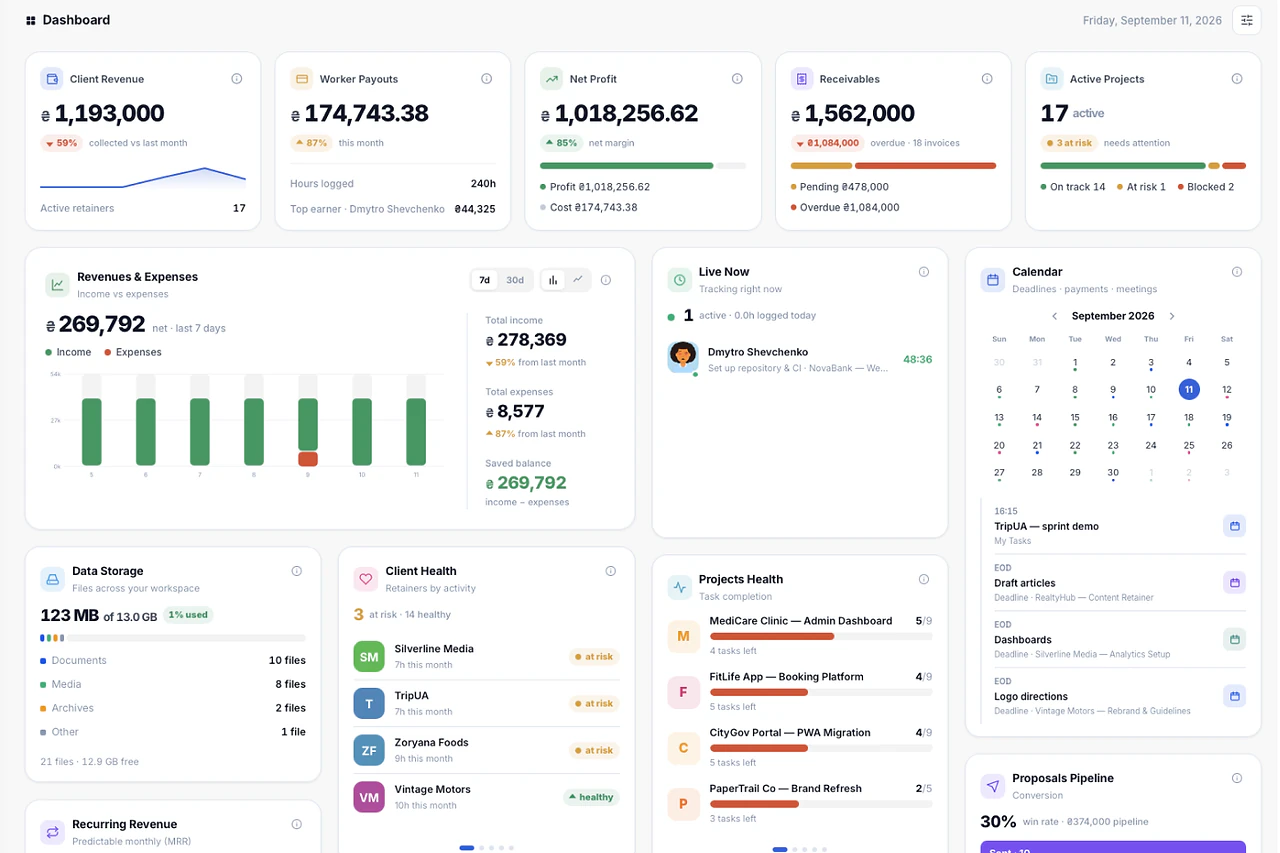
Plan project timelines in Melororium Calendar
Common mistakes with project timeline
What teams get wrong most often, and what to do instead.
- 1
Working backward from an arbitrary deadline
Setting the end date first based on what the client wants to hear, then squeezing the work to fit.
- 2
No buffer anywhere
Scheduling every task back-to-back with zero slack. One late deliverable then cascades through the entire rest of the plan.
- 3
Ignoring dependencies when scheduling
Building the timeline task by task without checking what has to finish before what else can start.
- 4
Never updating it once work starts
Publishing the timeline at kickoff and treating it as fixed. A timeline nobody updates stops being useful within weeks.
Frequently asked questions
What's the difference between a timeline and a project plan?
A project plan is broader: it includes scope, team, budget, risks, and communication plan. The timeline is the schedule component of the project plan: the calendar of when work happens. The two terms are often used interchangeably in practice.
How far out should a project timeline extend?
As far as the project scope requires. For a 6-week project, the timeline covers 6 weeks. For a rolling retainer, 4–6 weeks of rolling timeline is typically the planning horizon. Beyond that, estimates become unreliable.
What's the best tool for building a project timeline?
For simple projects: a shared spreadsheet or a project board with dates. For complex projects with many dependencies: a dedicated project management tool with Gantt view. The key isn't the tool: it's that the timeline is updated regularly and visible to everyone who needs it.