What is Time Tracking?
Time Tracking
Time tracking is the practice of recording how long tasks take, so teams can bill accurately, plan realistically, and see where the hours go.
Time tracking is the process of recording how long tasks, projects, or activities take. For individuals, it can reveal where the day goes. For teams, it's the foundation of accurate billing, fair workload management, and project profitability.
The basic form is simple: start a timer when work begins, stop it when work ends. The logged time attaches to the task or project. At the end of the week or month, you have a complete record of where every hour went and who worked on what.
For agencies and service teams, time tracking isn't optional. It's the only way to know whether a project was profitable, whether a client is being billed correctly, and whether the team is overloaded.
Types of Time Tracking
Time tracking tools work in three main ways, each with different trade-offs.
- Manual entry: team members type in hours at the end of the day or week. Fast, but accuracy degrades quickly with time. Best for simple projects with predictable tasks.
- Timer-based: a running clock attached to a task. Start it when you begin, stop it when you finish. Most accurate because it captures real time rather than memory.
- Automatic/AI tracking: software monitors active applications and infers what you worked on. Accurate but raises privacy concerns and often requires correction.
Billable vs Non-Billable Time
For agencies and client-service teams, every tracked hour is either billable (chargeable to the client) or non-billable (internal overhead). The distinction matters because it determines profitability.
A common problem: teams track total hours but don't distinguish billable from non-billable. A project appears to have taken 40 hours, but only 28 of those were billable. If you quoted 30 billable hours, you're over budget, and you won't know it until after the invoice goes out.
Good time tracking software tags each entry as billable or non-billable by project or by task. Reports then show billable efficiency: what percentage of tracked time was actually chargeable.
From Time Tracking to Invoice
The full workflow for agency billing looks like this: track time → categorize as billable → review entries → generate invoice. Most teams break this chain because their tools don't connect. They use Toggl or Harvest for tracking, then manually export hours to FreshBooks or Xero for invoicing.
Every manual step adds errors. Hours get lost in export. Entries don't match client project codes. The invoice goes out late because someone had to reconcile two different systems.
The most efficient setup is when the timer, the project, and the invoice are in the same tool. Click a timer on a task, stop it when done, and the hour logs directly to the client's billable time. Invoice generation pulls from those logged hours automatically.
The Real Cost of Standalone Time Tracking Tools
Dedicated time tracking tools look affordable monthly: $9–$14/user/month for Toggl Track, $14/user/month for Harvest. But for a 10-person agency over five years:
| Tool | Monthly (10 users) | Annual | 5-Year Total |
|---|---|---|---|
| Toggl Track | $90 | $1,080 | $5,400 |
| Harvest | $132 | $1,584 | $7,920 |
| Clockify (paid) | $79 | $948 | $4,740 |
| Melororium (built-in) | $0 extra (included in flat-fee plan) | $0 | $0 extra |
Time Tracking Reports: What to Look For
Raw hours logged aren't useful on their own. The value comes from how that data is aggregated and presented. Useful time tracking reports include:
By client: total hours per client, billable vs non-billable, budget vs actual. This tells you which clients are profitable and which are eating margin.
By team member: hours logged per person, with breakdown by project. Useful for identifying overload before someone burns out, and for performance conversations.
By project: total hours vs estimated, who worked on what. Essential for improving future estimates.
Anomaly detection: automatic flags when someone logs time on weekends, at unusual hours, or in unusually large blocks. Useful for catching both burnout and time sheet errors.
Time Tracking in Melororium
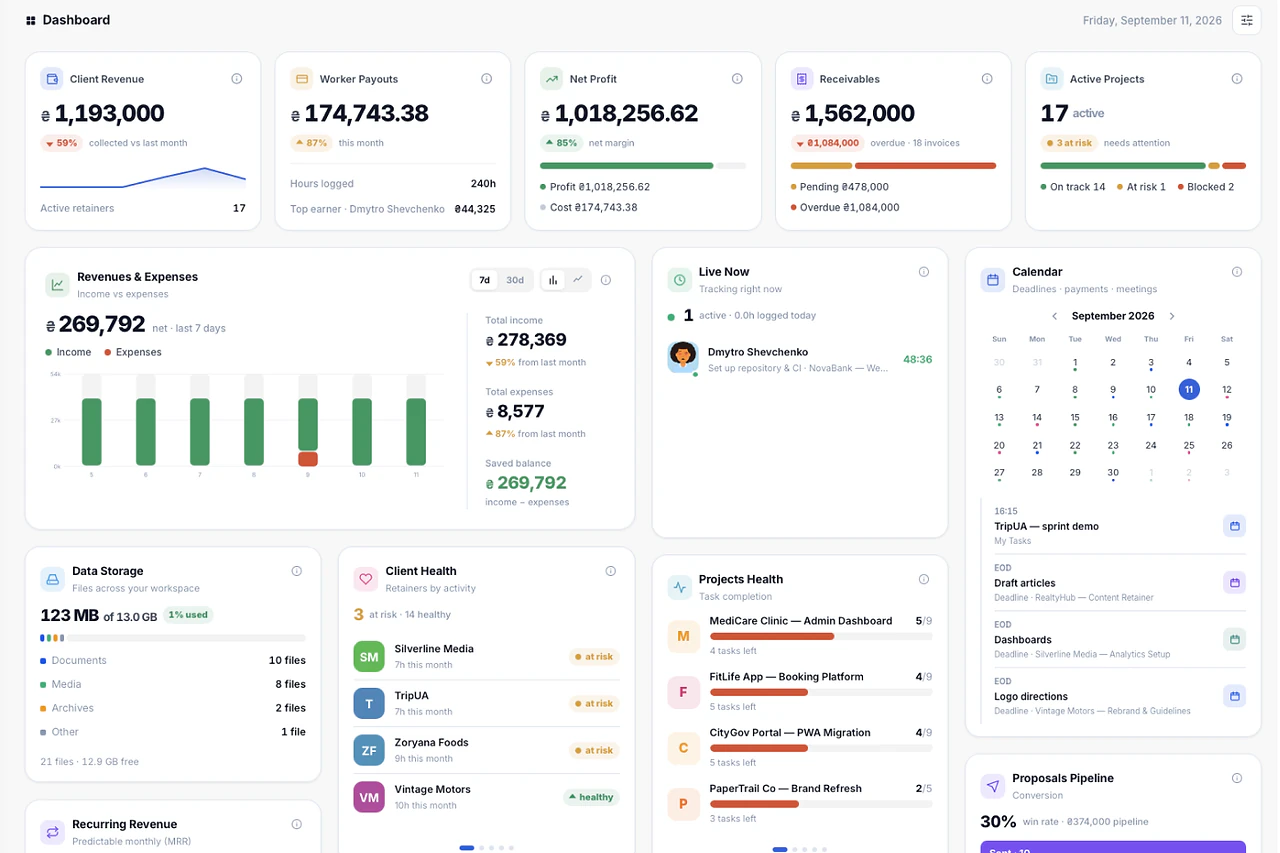
Melororium includes native time tracking in every plan: no separate subscription, no integration required. Timers run inside tasks. Stop the timer, the entry logs to the task and project automatically.
Work Reports show billable vs non-billable hours per client, per team member, and per project. Anomalies (weekend work, unusual hours) are flagged automatically. Reports export to PDF or Excel.
Invoices pull directly from logged billable hours. Select the client, set the rate, generate the invoice: no export, no copy-paste, no FreshBooks subscription needed.
Agency plan is $59/mo for 15 users. Toggl Track costs $5,400 over five years for the same team, before invoicing tools.
How to Get Your Team to Actually Track Time
The hardest part of time tracking isn't the software. It's getting everyone on the team to use it consistently. Most adoption failures come from the same two causes: the process is too friction-heavy, or the team doesn't see personal benefit from the data.
Reduce friction first. Time tracking fails when it requires opening a separate app, logging into another system, or remembering at end-of-day what you worked on. The lowest-friction setup puts the timer inside the task itself. Click start when you open the task, click stop when you finish. The entry files itself to the right project and client automatically.
Explain why it matters. Teams resist time tracking when it feels like surveillance. It isn't. The data shows whether estimates are accurate, which projects are running over budget, and whether the team is overloaded. That information protects the team from scope creep and helps managers argue for better resourcing. Share project reports with the people who log time, not just with management.
Set expectations clearly. 'Track all client work in real time' is clearer than 'track your time.' Define what counts as billable, what counts as non-billable, and what doesn't need tracking at all. Give people a decision framework they can apply without asking every time.
Run a two-week pilot with one project before rolling out across the team. Use real data from that project to show what the reports reveal. Seeing that a project estimated at 40 hours actually took 56 hours makes the value tangible.
Account for team role differences. Developers and designers who work on focused tasks adapt to timer-based tracking. Account managers and project managers, who context-switch constantly throughout the day, often do better with 15-minute end-of-session manual entries than with timers.
- Put the timer inside the task: no separate app, no separate login
- Share time reports with the people who log hours, not just management
- Define 'billable' and 'non-billable' clearly before launch: ambiguity kills consistency
- Run a 2-week pilot on one project, then show the team the resulting data
- Expect different habits for different roles: context-switchers often prefer manual entries
Time Tracking for Fixed-Price Projects
Many agencies that price projects at a fixed fee skip time tracking. The logic: 'We're not billing by the hour, so why track hours?' This reasoning costs money.
Fixed-price projects have a budget denominated in hours, even if clients never see it. When a branding project is priced at $12,000, the agency is implicitly estimating 80 hours at a $150 blended rate. If the project takes 120 hours, the agency delivered $18,000 worth of work for $12,000. Without time tracking, nobody knows this happened until the project is over and the agency wonders why the margin looks thin.
Time tracking on fixed-price projects serves three purposes. First, it shows whether the estimate was accurate. An agency that consistently underestimates branding projects by 30% needs to either raise prices or change scope. Neither adjustment is possible without data on actual hours.
Second, it enables mid-project course correction. If a project is 60% through its timeline but 80% through its budgeted hours, a PM who knows this can flag scope creep, have a conversation with the client, or reprioritize remaining work. A PM who doesn't know this discovers the overrun when it's too late to fix.
Third, it builds a pricing database. After tracking 20 branding projects, the agency knows that brand strategy takes 18-24 hours, logo development takes 12-15 hours, and revision rounds take 6-8 hours per round. Future quotes become accurate because they're based on actual historical data rather than optimistic estimates.
- Fixed-price projects have an implicit hour budget: track against it even if clients never see the hours
- Mid-project hour tracking enables scope conversations before overruns become unrecoverable
- After 10-15 similar projects, time data replaces guesswork in future estimates
- Track profitability per project type: learn which engagement types are worth pricing
- Non-billable project hours still count as cost: knowing them reveals true margin
Analyzing Your Time Data: What to Look For
Raw hours logged are a starting point. The patterns in that data are what generate actionable insight. Most teams that track time never analyze it systematically.
Start with client profitability. Sort clients by total hours logged over the past quarter, then calculate effective hourly rate for each: revenue divided by hours. Some clients who pay $5,000/month take 35 hours of service time. Others take 80 hours for the same fee. That gap reveals which client relationships to protect and which to reprice.
Look at estimate accuracy by project type. Group completed projects by type and compare estimated hours to actual hours. If website projects consistently come in at 130% of estimate, you're underpricing by roughly 30%.
Review individual utilization weekly. Healthy utilization for delivery staff runs 65-75% billable. Anyone consistently above 80% billable is overloaded and at risk of burnout. Anyone below 55% billable for more than two weeks is either under-allocated or not tracking accurately.
Check non-billable time composition. Non-billable hours fall into different categories: business development, internal admin, training, and unbilled client work. Track which category absorbs the most time. Excessive unbilled client work often signals a scope creep problem.
| Report Type | What to Look For | Action if Off |
|---|---|---|
| Client profitability | Effective hourly rate below target margin | Reprice or renegotiate scope at next renewal |
| Estimate accuracy | Consistent over or under by project type | Adjust pricing templates for that project type |
| Utilization by person | Above 80% or below 55% for 2+ weeks | Reassign work or investigate tracking gaps |
| Non-billable composition | Unbilled client work over 10% of total | Identify scope creep pattern and address it |
| Anomalies | Late-night or weekend entries, reconstruction blocks | 1:1 conversation to understand the cause |
Common Time Tracking Mistakes
Time tracking works poorly when teams set it up correctly but use it incorrectly. The most common mistakes show up in the data within the first month.
End-of-day batch entry. When team members log all their hours at 5pm, they're reconstructing the day from memory. People underestimate how long tasks take by 15-25% when recalling from memory. For a 10-person agency, end-of-day entry typically means losing 3-5 hours per person per week in unbilled time.
Logging project time instead of task time. Entries that say '4 hours on Acme Corp' tell you almost nothing useful. Entries that say '2.5 hours on homepage wireframe' and '1.5 hours on kickoff call' generate data you can actually analyze. Task-level time entries enable estimate improvement; project-level entries don't.
Skipping non-billable categories. Many teams only track billable hours and leave non-billable work unrecorded. This makes utilization rates look artificially high and hides where overhead actually goes. Track all working time, categorized accurately.
Not reviewing before invoicing. Time entries accumulate errors: a 2-hour entry for a 30-minute meeting, a task logged to the wrong client, a duplicate entry. A 30-minute review of the month's time log before generating invoices catches these errors.
Using a tool nobody checks. Time tracking tools that don't connect to project management create a data graveyard. Hours are logged in one tool, projects managed in another, and the two systems never talk. A setup where time entries, tasks, and invoices live in the same tool eliminates this gap entirely.
- End-of-day batch entry loses 15-25% of actual time to memory gaps
- Project-level entries ('4 hrs on Acme') are useless for estimation improvement
- Skipping non-billable tracking hides true overhead and inflates utilization rates
- 30-minute invoice review catches errors before they reach the client
- Disconnected tools create export overhead and reconciliation errors
In Melororium
See time tracking in Melororium
Common mistakes with time tracking
What teams get wrong most often, and what to do instead.
- 1
Treating it as surveillance
Rolling out time tracking with no explanation beyond "log your hours." Teams that don't understand why they're tracking time either resist it or fill in fake numbers.
- 2
Estimating after the fact instead of timing live
Filling in a duration once a task is finished instead of starting a timer when it begins. A guessed 90 minutes and a timed 90 minutes look identical on the sheet, but only one is real.
- 3
Collecting data nobody reviews
Logging hours every week and never looking at the patterns in them. Time data that isn't reviewed for trends never improves how the next project gets estimated.
- 4
One rate for every task type
Billing every logged hour at the same rate regardless of what kind of work it was. Strategy time and routine execution aren't worth the same to a client, and treating them as interchangeable underprices the harder work.
Frequently asked questions
What is time tracking software?
Time tracking software records how long team members spend on tasks, projects, and clients. It typically includes timers (start/stop), manual time entry, reports by project or person, and export or invoice generation. Used mainly by agencies, consulting firms, and any team that bills clients by the hour.
Why is time tracking important for agencies?
Agencies bill clients based on hours worked. Without time tracking, they either overbill (risking client relationships) or underbill (losing profit). Time tracking also reveals which projects are profitable, which clients are high-maintenance, and whether the team is overloaded before burnout sets in.
What is the difference between billable and non-billable hours?
Billable hours are time chargeable to a client: design work, development, strategy, client calls. Non-billable hours are internal overhead: internal meetings, admin, new business pitches. Tracking both reveals your team's true billable efficiency ratio.
Does time tracking software replace Toggl?
Melororium's built-in time tracking covers the same features as Toggl: per-task timers, billable/non-billable categorization, client reports, team reports, and anomaly detection. The difference: it's included in Melororium's flat monthly price rather than $9–$14/user/month on top of your project management tool.