What are Billable Hours?
Billable Hours
Billable hours are the time your team spends on client work that goes on an invoice, as opposed to internal work that doesn't get paid for directly.
Billable hours are hours of work that can be charged to a client. When an agency designer spends 3 hours revising a logo for a client, those 3 hours are billable: they appear on the invoice at the agreed rate. When that same designer spends 30 minutes in an internal team meeting, that time is non-billable: it's overhead that the agency absorbs.
The distinction seems simple, but most agencies undercharge because they don't track billable hours accurately. Work happens, time passes, and by the end of the month the team can't reconstruct exactly how many hours went to each client. Estimates get used instead of actuals, and estimates almost always favor the client.
Most agencies that start tracking billable hours carefully discover they're delivering 15–30% more work than they're charging for.
Billable vs Non-Billable Hours
Understanding the distinction is the first step to accurate billing.
| Billable | Non-Billable |
|---|---|
| Client project work | Internal team meetings |
| Client calls and emails | Pitches and proposals for new clients |
| Revisions requested by client | Training new team members |
| Research for client deliverables | Admin and invoicing |
| Project management for client | Business development |
Billable Utilization Rate
Billable utilization rate measures what percentage of a team's total working hours are billable. It's one of the most important financial metrics for any service business.
Utilization rate = billable hours / total working hours × 100
A designer who works 40 hours per week and logs 28 billable hours has a 70% utilization rate. Most agencies target 65–75% for individual contributors and 55–65% for account managers and strategists (who spend more time in non-billable client communication and internal coordination).
Low utilization rates signal one of two problems: team members have too little client work (capacity problem) or are working on client projects but not tracking the time (process problem). Both cost money, but they have different solutions.
How Agencies Lose Money on Billable Hours
The most common ways agencies undercharge:
- Forgetting to log time: a meeting runs long, a revision takes longer than expected, but the timer wasn't running. The time is worked but never billed.
- Rounding down: when entering time manually, people tend to round to the nearest hour. 2.75 hours becomes 2. Across 10 people over a year, this adds up to thousands in lost revenue.
- Scope creep absorption: extra requests get quietly handled without a change order. The team tracks the time but marks it as non-billable to avoid a difficult client conversation.
- Context loss: by end-of-day or end-of-week time entry, team members can't remember exactly what they worked on or for how long.
- Tool disconnect: time is tracked in Toggl but invoices are created in FreshBooks. The export step introduces errors, and some entries get lost.
How to Track Billable Hours Accurately
The most reliable system is a timer that runs inside the task itself. When a designer opens the task card for a logo revision, they click start on the built-in timer. When they finish, they click stop. The time logs to the task, tagged to the client and project automatically.
This works better than end-of-day manual entry because: 1. It captures time when it happens, not hours later when memory is unreliable. 2. Each entry is automatically tied to the right project and client, so no manual categorization is needed. 3. Reports are generated from actual logged time, not estimates.
Teams that switch from manual entry to timer-based tracking typically see invoiced amounts increase 15–25% because they start capturing time they were previously forgetting.
From Tracked Hours to Invoice
Efficient billing workflow: timer runs inside task → hours log to client → monthly invoice pulls logged billable hours → client receives invoice with task-level detail.
The breakdown matters. Clients pay more willingly and challenge invoices less when they can see exactly what each hour was spent on. 'Agency Services: 47.5 hours, $9,500' generates more questions than a line-by-line breakdown showing 12 hours of strategy, 22 hours of design, and 13.5 hours of revision rounds.
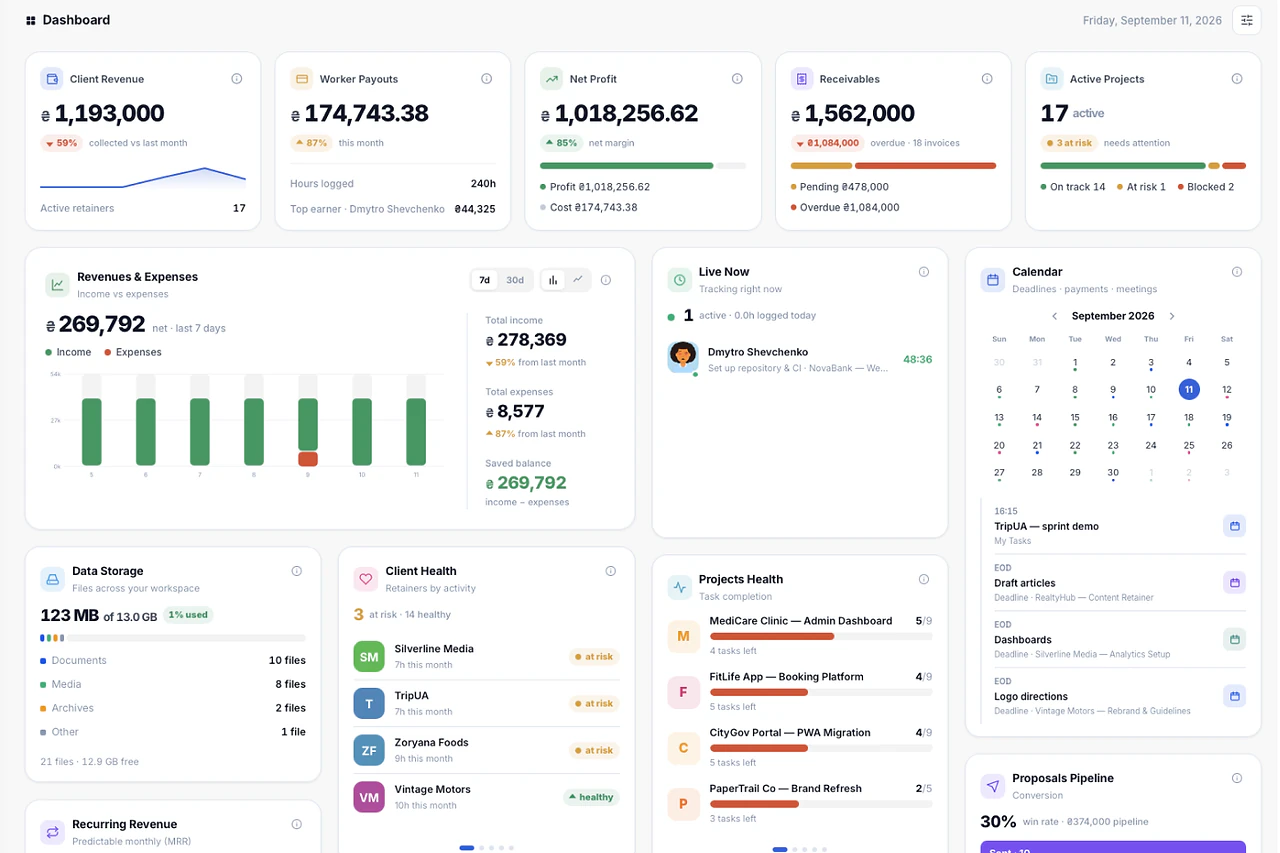
Melororium generates invoices directly from tracked time. Select the client, set the billing period, choose the rate, and the invoice builds itself from logged entries. Each line item shows the task, hours logged, and amount. Export to PDF and send.
Improving Billable Hour Ratios: Practical Tactics
Most agencies that want to improve utilization rates focus on the wrong lever. They push people to bill more hours, which produces inflated time sheets rather than genuine efficiency gains. The actual problem is almost always one of three things: time that goes unbilled, non-billable overhead that's larger than necessary, or scope that expands without a corresponding invoice.
Fix the logging gap first. Before changing anything else, audit last month's time sheets against calendar entries for two or three team members. In most agencies, logged hours fall short of scheduled hours by 15-25%. Timer-based tracking (starting the timer when you open a task) closes most of this gap without changing anyone's work habits.
Review non-billable categories. Not all non-billable time is equal. Internal meetings and process work are overhead you accept. Unbilled client work, such as additional revisions handled without a change order or extra calls not covered in the contract, is recoverable overhead. If unbilled client work exceeds 10% of total hours, the process problem is scope management, not time tracking.
Formalize change orders. Every request that falls outside the original scope gets a change order before work starts. A change order doesn't have to be a formal document. Even a brief email that says 'this falls outside our original scope, we'll add $X to the project' and gets a client response functions as a change order.
Reduce meeting overhead. Track non-billable meeting time per person over one month. For most agencies, internal meetings account for 8-12 hours per person per week. Cutting internal meetings by 25% would move several percentage points of utilization to billable work.
- Audit logged hours vs calendar entries for 2-3 people: find the logging gap before optimizing
- Separate unbilled client work from genuine overhead in your non-billable categories
- Send a change order email before starting any out-of-scope work, even a quick client reply counts
- Track internal meeting hours per person per month and target a 20-25% reduction
- Timer-based tracking typically recovers 3-5 hours per person per week vs end-of-day entry
Billable Hours by Role: What's Normal
Utilization targets vary significantly by role. Applying a uniform 70% target across all roles produces unrealistic expectations for some and complacency for others.
Delivery staff, meaning designers, developers, writers, and other practitioners who produce client work, should target 65-75% utilization. Below 60%, they're either under-allocated or not tracking accurately. Above 80%, they're overloaded and will either burn out or start cutting quality corners.
Project managers and account managers typically run 45-60% billable. Their work is client-facing but often categorized as non-billable overhead: internal coordination, client status calls not covered in the contract, proposal development.
Team leads and creative directors typically run 35-55% billable, depending on how much hands-on delivery they do versus oversight and management.
Owners and principals at a 10-person agency often run 20-40% billable. Business development, team management, financial oversight, and new business pitches occupy most of their time. This is normal for the role.
These targets assume 40-hour work weeks. For teams that regularly run 45-50 hours, adjust targets down: measuring utilization against actual hours worked rather than scheduled hours gives a more accurate picture.
| Role | Target Utilization | Non-Billable Breakdown |
|---|---|---|
| Designers / Developers / Writers | 65-75% | Meetings, internal review, training, admin |
| Project Managers | 45-60% | Internal coordination, non-billed client contact, proposals |
| Account Managers | 40-55% | Relationship management, new business support, internal reporting |
| Creative Directors / Team Leads | 35-55% | Management, review cycles, mentoring, strategy |
| Owners / Principals | 20-40% | Business development, finance, hiring, team leadership |
Non-Billable Time: How to Minimize and Track It
Non-billable time isn't waste by definition. Some of it is necessary overhead that keeps the business running. But unexamined non-billable time tends to grow until it crowds out the billable work that funds everything else.
The first step is visibility. Most agencies don't track non-billable time at all: they track billable hours and treat everything else as background noise. This makes it impossible to know whether the team spent 8 hours or 18 hours in internal meetings last week.
Track non-billable time using the same system as billable time. Create internal projects for categories like: internal meetings, business development, training, team admin, and unbilled client work. Assign time entries to these categories the same way you'd assign them to a paying client project.
With four weeks of data, patterns emerge. Common findings: internal meetings consume 15-20% of everyone's time; unbilled client revision rounds are eating 10-12 hours per project that were never discussed with the client.
Minimization tactics that actually work: cut recurring internal meetings to 30 minutes by requiring a written agenda in advance; replace status-update meetings with asynchronous board reviews; formalize change orders for the revision rounds that currently go unbilled.
Don't try to minimize all non-billable time. Training and skill development have long-term payoff. Business development is an investment in pipeline. The target is to reduce non-billable time that generates no value: primarily meetings that could be messages and unbilled client work that should be change orders.
- Track non-billable time to internal projects the same way you track billable time to clients
- Common categories: internal meetings, business development, training, admin, unbilled client work
- Required agenda before any internal meeting: reduces meeting length by 30-40% on average
- Batch admin into two daily blocks rather than handling throughout the day
- Unbilled client revision rounds over the original scope get a change order, not absorption
Billable Hours in Fixed-Price vs Time-and-Materials Projects
The billing model determines how billable hours function in your project tracking, but both models require accurate time logging, for different reasons.
Time-and-materials (T&M) projects bill the client directly for hours logged. The agreed rate is applied to actual time tracked. This model works well when scope is unclear upfront or when the client wants flexibility to adjust direction. Every logged hour is potentially a line on an invoice that a client will scrutinize. Accurate, task-specific time entries matter here because they need to be defensible.
Fixed-price projects bill a flat fee regardless of hours logged. The agency carries the scope risk: if the project takes longer than estimated, the excess comes out of margin. Billable hours in a fixed-price project are internal tracking data, not client-facing, but they're equally important for profitability measurement and future pricing.
For T&M projects: enter time at the task level with clear descriptions. An entry that says '3.5 hours, responsive design system, mobile breakpoints, component library setup' is defensible. An entry that says '3.5 hours, design' is not. Review all entries before the invoice goes out.
For fixed-price projects: track hours against the internal budget. Set the internal hour budget at project kickoff. Flag when the project hits 70% of its hour budget: that's the point where course correction is still possible.
| Aspect | Time-and-Materials | Fixed-Price |
|---|---|---|
| Hours visible to client? | Yes, appears on invoice | No, internal tracking only |
| Time entry specificity required | High: entries are client-facing | Moderate: entries are for internal analysis |
| Risk holder | Client (scope risk) | Agency (scope risk) |
| When to flag overruns | After each billing period | At 70% of internal hour budget |
| Key metric to watch | Hours billed vs contracted rate | Hours used vs internal hour budget |
In Melororium
Track billable hours in Melororium
Common mistakes with billable hours
What teams get wrong most often, and what to do instead.
- 1
Billing activity instead of value
Charging for hours spent figuring out a mistake or redoing work due to unclear scope. Clients push back hard when an invoice includes the cost of internal confusion.
- 2
No minimum increment policy
Letting every team member decide their own rounding rule. Inconsistent increments across the team make invoices look arbitrary.
- 3
Treating the estimate as a hard ceiling
Refusing to log real hours once work passes the original estimate. Hiding the overage under the quoted number hides exactly the pattern that should trigger a scope conversation with the client.
- 4
Assuming tracked time equals invoiced time
Treating every logged billable hour as money already earned. Discounts, write-offs, and forgotten entries mean the two numbers rarely match without someone reconciling them.
Frequently asked questions
What are billable hours?
Billable hours are hours of work that can be charged to a client. If your agency rate is $150/hour and you spend 10 hours on a client project, that's $1,500 in billable work. Non-billable hours (internal meetings, admin, new business) are overhead absorbed by the agency.
What is a good billable utilization rate?
Most agencies target 65–75% for delivery staff (designers, developers, writers) and 55–65% for account managers. If your team is below 60%, you're either under-staffed on client work or losing tracked time somewhere in your process.
How do you calculate billable hours?
Track all hours worked, tagged by client and project. Billable hours are those tagged to active client deliverables. Non-billable includes internal meetings, admin, and business development. Divide billable hours by total hours to get utilization rate.
What is the best way to track billable hours?
The most accurate method is a timer built into the task itself. Start the timer when you begin work, stop it when you finish. End-of-day manual entry introduces memory errors and rounding. Teams using task-level timers typically invoice 15–25% more hours than those using manual entry.
Can you create invoices from tracked billable hours?
Yes, if your tool supports it. Melororium generates invoices directly from logged billable hours: select a client, choose a date range, set the rate, and the invoice builds from actual logged entries. No export to a separate invoicing tool needed.