MELORORIUM FOR CREATORS
Streamline your multi-channel media production pipeline.
Master your content scheduling, brand deal tracking, and creator invoicing in one flat-fee workspace. Eliminate the chaos of scattered tools and missed deadlines.

CREATOR TOLL
Independent creators spend thousands on isolated software apps.
Producing multi-channel media shouldn't mean running a heavy billing pipeline. Consolidate your planning, trackers, and brand logs in one flat-fee workspace.
The SaaS Tax
Here is what you are paying every year to run a fragmented workflow:
Cumulative SaaS Tax vs. Flat-Fee Subscription
Equivalent to reinvesting your software budget directly into professional video and audio gear.
MEDIA PIPELINE
Run a synchronized multi-channel content engine.
Never lose track of sponsor deliverables, script revisions, or publishing timelines. Control your entire creator workflow from one screen.
Content Horizon Planning
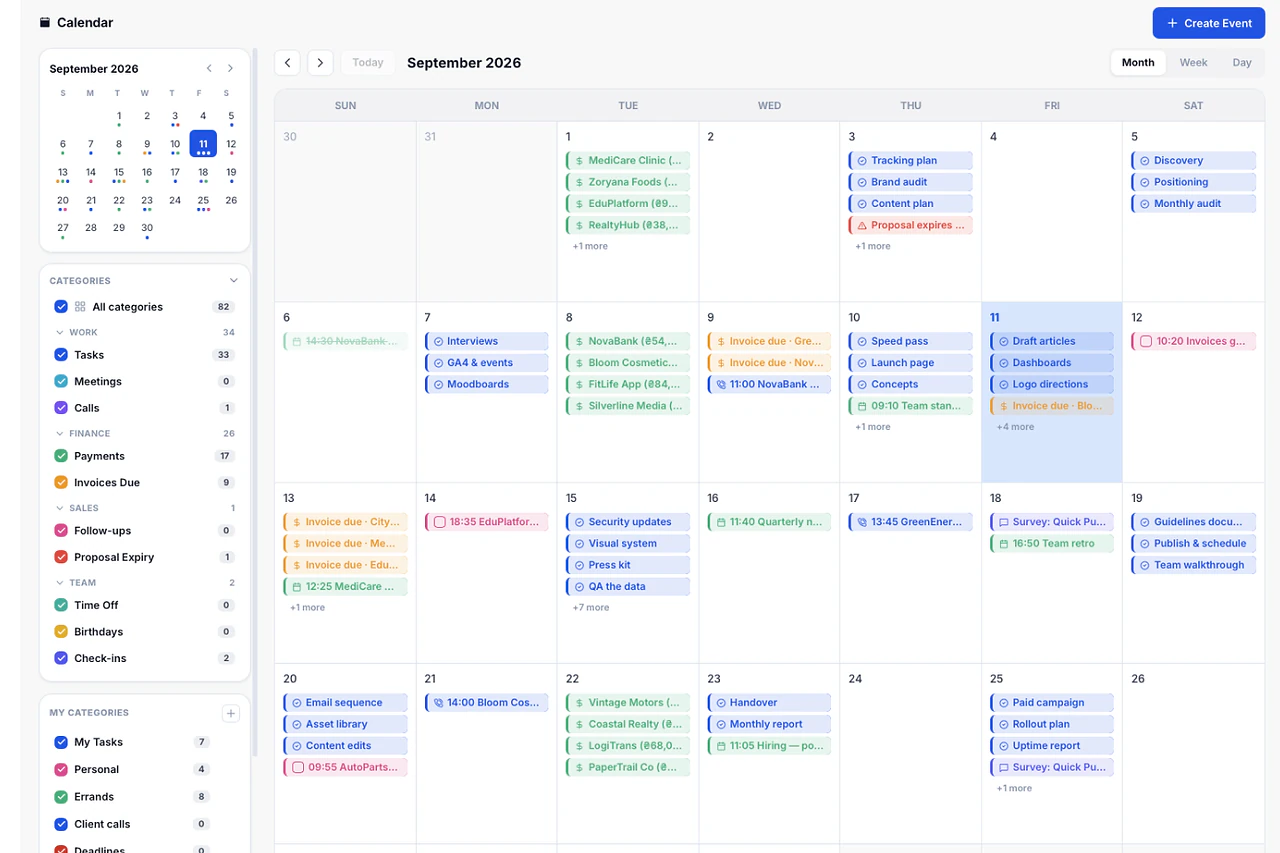
Map your publishing schedule, release deadlines, and visual channel milestones on a responsive monthly grid.
Scripting & Production Execution
Draft content tasks, arrange editing priorities, and monitor elapsed hours inside a smooth sliding details panel.
Brand Retainer Monitoring
Store brand contract specifications, specific monthly payouts, and client contact data together without separate CRM systems.
Automated Channel Alert Triggers
Route real-time production updates and milestone alerts natively to specific team channels using direct webhook connectors.
VALUE COMPARISON
Why pay per seat when you can go flat-fee?
Compare face-to-face. Other SaaS platforms lock your workflows and data behind endless per-seat fees. We believe professional software should be a flat fee for your whole team.
The old way
Paying monthly subscription taxes for every minor tool you use.
Scattered operational records causing workflow gaps and missed hours.
Heavy, sluggish cloud interfaces wasting your daily billable capacity.
Compiling raw timesheets manually to calculate project margins.
The Melororium way
Flat monthly fee for your whole team. Secure, scalable workspace.
Unified time logging and accounting tied directly to active tasks.
Blazing-fast local-first execution with zero interface latency.
Integrated ledger automation generating live performance reports.
ZERO LOADING SPINNERS
Local-first compilation. Zero server delays.
Melororium compiles all database transactions straight inside your client engine before pushing silent sync tasks to the server.
IndexedDB direct write — zero network dependency
React virtual DOM diff — 1 animation frame
Async worker sync — invisible to the user
Server roundtrip + JSON parse + re-hydrate
LIVE TEST
Run a latency benchmark
Simulate a real workspace action and measure local vs remote execution time.
Click run to measure local performance.
EARLY FEEDBACK
See what teams say about Melororium.
Early adopters from agencies and studios share how ditching the subscription stack changed how their teams operate.
Clara Moss
Founder, Mossglow Studio
"I had a successful shop and absolutely no idea if I was actually making money."
Tom Brauer
Founder, Linkframe
"I was paying to make my own life harder."
Marcus Webb
Founder, North Signal Studio
"Every Friday felt like an archaeology dig."
Built for modern digital operations.
Join the early adopters scaling their business layout with Melororium.
PRODUCT FAQ
Frequently
Asked Questions
Have a question that needs a human to answer?
No problem, email us at support@melororium.com
Compare alternatives
Starter ($29/mo) covers up to 4 users — ideal for small teams. Agency ($59/mo, most popular) covers up to 10 users and lets you pick 5 additional modules on top of the 12 core ones. Studio ($119/mo) covers up to 25 users and unlocks all 20+ announced modules. All plans are billed monthly or yearly (save ~30% annually).
Switch plans anytime — your data stays intact and the transition takes seconds. Upgrade is prorated automatically. No lock-in, no penalties for growing your team.
With per-seat tools, every new hire costs more. A 10-person team on ClickUp pays $1,440/yr in seat fees alone. Melororium charges one flat monthly fee for your whole team — add 1 person or 10, the price stays the same. No seat tax that eats into your margins as you grow.
Security is non-negotiable. Melororium operates on end-to-end data encryption (TLS 1.3) with enterprise-grade database separation. Our AI features use strict Bring Your Own Key (BYOK) architecture — your data is never used for model training.
Yes. Melororium supports dedicated Client Portals at no extra cost. Clients can view project timelines and download deliverables. Guest client access does not count against your team seat limit.
Every plan includes: Dashboard, Kanban, Projects, Calendar, Team management, Client CRM, Invoices, Work Reports, Live Timers, Inbox, Time Tracker, and Settings. Agency and Studio plans add extra modules on top of these.
Flat-Fee Creative Team Workspace: Project Management for Studios and Content Teams
Creative teams — design studios, content agencies, video production houses, social media teams — share a common operational challenge: highly variable project work, multiple simultaneous client deliverables, and a need to track creative time accurately for billing. Most project management tools are built for software teams, and the ones built for creative work charge per seat, making team growth financially painful. This guide explains how a flat-fee workspace built for creative production changes the economics of running a creative team.
The Unique Project Management Challenges of Creative Teams
Creative work does not move in straight lines. A brand identity project might involve a discovery phase, three rounds of concept development, two rounds of revisions, and a final delivery — each phase with different team members, different timelines, and different billing implications. A video production might run pre-production, shoot day coordination, and post-production as distinct workflow stages, each requiring its own task structure. Most generic project management tools handle this poorly. They are built for sequential tasks with clear dependencies — the kind of linear workflow you find in software development or manufacturing. Creative briefs, revision loops, and client feedback cycles do not fit neatly into those structures. Melororium's Kanban boards are flexible by design, allowing creative teams to define their own workflow stages and adapt them per project.
Tracking Creative Time Accurately
Creative billing typically happens one of two ways: fixed project fee or hourly rate. In both cases, accurate time tracking matters. For hourly projects, it determines the invoice. For fixed-fee projects, it determines your actual margin. Creative teams that do not track time systematically routinely discover that their profitable-looking projects are actually break-even or loss-making once hours are counted. Melororium's task-embedded timers make time tracking the path of least resistance — you are already in the task, and the timer is one click away.
How Creative Studios Use Melororium
A creative studio using Melororium typically organises work by client in the CRM, with individual projects for each active engagement. The project Kanban reflects the studio's specific creative workflow — for a branding studio this might be Discovery, Concepts, Revisions, and Final Delivery. For a content team it might be Brief, Draft, Review, and Published. Tasks move through these stages as work progresses. Design team members log time inside tasks, and the creative director can see in real time which projects have tracked hours close to the project budget — a signal to have a scope conversation before a project becomes unprofitable. At billing time, the work report shows the complete time log, and the invoice is generated directly from it.
Managing Revision Rounds Without Losing Track
Revision tracking is where creative project management most often breaks down. Feedback arrives by email, comments appear in Figma or Google Docs, Slack messages reference 'that thing from Tuesday' — and there is no single place where the revision history is logged. Melororium's task system allows revision rounds to be tracked as separate tasks or subtasks, with client feedback logged in the task notes. The result is a clear audit trail of what was asked for and when — useful for scope conversations and for protecting the team's time.
Client Portal Access for Review and Approval
Melororium allows clients to be invited to a secure portal view of their project — seeing task progress, deliverable status, and timeline without accessing the full workspace. This replaces the weekly status email or the 'where are we?' Slack message. Clients can see exactly where their project stands without requiring the project manager to compile a status update. Guest access does not consume team seats and is available to unlimited clients.
Flat-Fee Pricing for Creative Teams That Grow
Creative studios grow non-linearly. A two-person studio takes on a large project and brings in three contract creatives for six months. Then the studio scales back to its core team. Per-seat pricing punishes this model — you pay for seats whether the contract creatives are active or not, and you go through the billing friction of adding and removing users with every engagement cycle. Melororium's flat-fee structure works well for studios with this kind of fluid team composition. Your 10-user Agency plan covers your core team and leaves room for additional contributors without renegotiating pricing. When a project ends and a contractor's involvement concludes, removing them from the workspace does not change your monthly bill.
Annual Plans for Studios With Steady Client Work
For creative studios with a consistent client roster and predictable monthly revenue, the annual plan offers meaningful savings. Melororium's Agency plan at $499/year ($50/month effective) versus $59/month billed monthly saves approximately $208 per year — equivalent to several hours of a creative director's time. The Studio plan at $999/year covers 25 users, appropriate for larger studios with full production teams.
Replacing Your Current Creative Stack
A typical creative team pays for: Asana or Monday for project management ($1,200–$1,800/year for 10 users), Toggl or Harvest for time tracking ($1,200/year), a CRM or HubSpot starter for client records ($600/year), and FreshBooks or Invoice Ninja for billing ($300–$600/year). The total for a 10-person creative studio often exceeds $4,000 per year. Melororium at $708/year replaces all four of those tools. The transition does not need to happen overnight — most studios run one client cycle on Melororium alongside their existing tools to verify accuracy before fully switching. The time saving on billing reconciliation alone typically covers the annual cost within the first two months.
Setting Up a Creative Studio Workspace
Start with your client list: create a CRM record for each active client with contact details and billing rates. Then create a project for each active engagement and set up the Kanban columns to match your studio's workflow stages. Invite your full team — all 10 seats on the Agency plan are available immediately. Spend the first week running tasks and timers on one project as a test before going fully live. By the end of a billing cycle, you will have the data to generate your first automated invoice — and a clear picture of how much time each project actually consumed versus how it was estimated.
Take full control of your creator income.
No seat tax, no scattered tools, no missed deals. One flat-fee workspace for your entire creative business.