Why We Stopped Paying for AI Bundled Into Our Project Management Tool
The sparkle AI button in ClickUp and Notion costs you $10-20/month more and gets used once. Here's why we built Melororium's AI on a bring-your-own-key model instead — and why that's actually more honest.

The AI Markup We Were Quietly Paying
At some point in the last two years, nearly every project management and productivity tool added a sparkle icon next to an 'AI' feature, gated behind a tier that cost meaningfully more than the one below it. ClickUp, Notion, and others followed roughly the same pattern: a $10–20/month premium for AI summaries, suggestions, or generated content, layered on top of the base subscription. We paid that premium too, on more than one tool, for longer than we should have. The reasoning at the time felt sound — AI was clearly going to matter, and not having access felt like falling behind. What we didn't do, for longer than I'd like to admit, was actually check how often we used it.
"We were paying an AI markup on tools we barely used the AI feature in. Then we asked a harder question: why does this need to be a markup at all?"
How AI Got Bundled Into Every Tool's Premium Tier
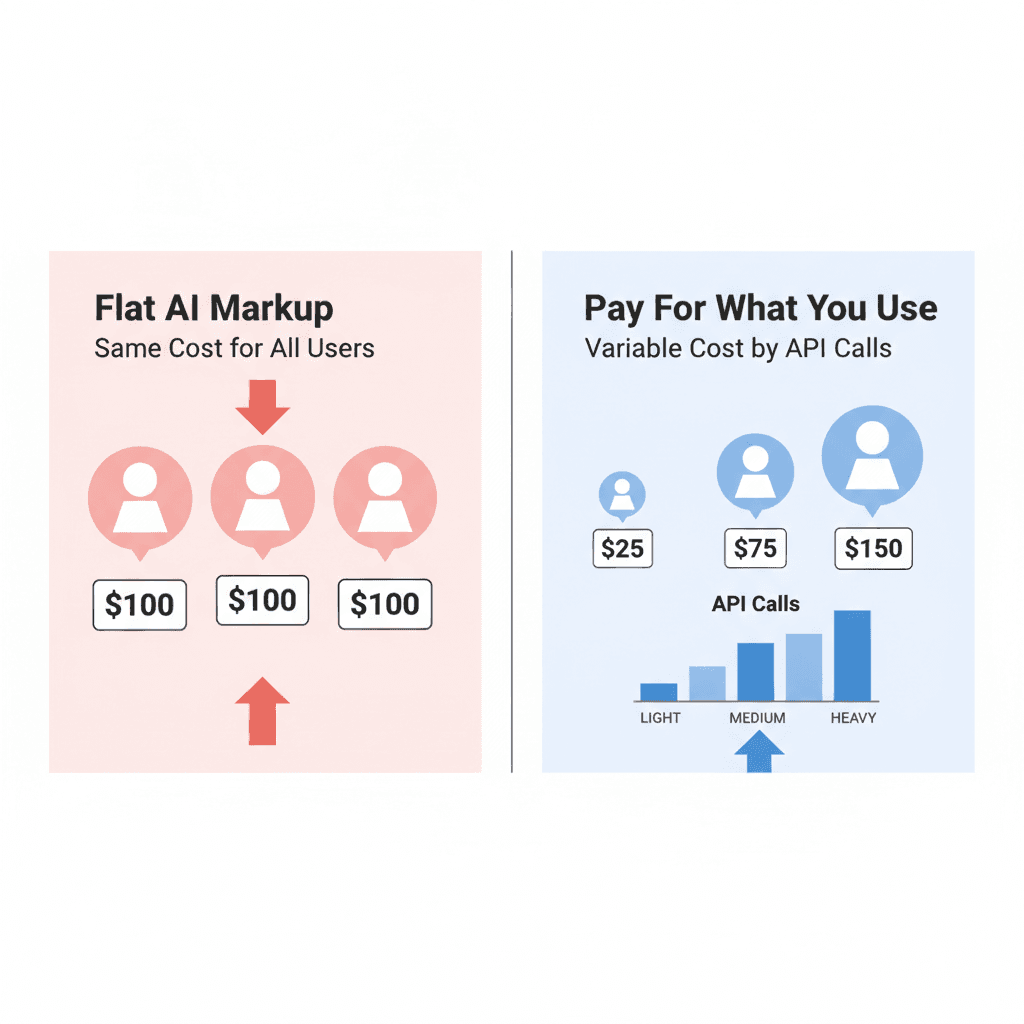
The pattern across the industry is consistent enough to name directly: AI became the justification for a new top-tier price point, regardless of how genuinely useful the specific implementation was for a given user's workflow. This isn't necessarily bad faith on the part of those companies — building and running large language model features at scale has real infrastructure cost, and someone has to pay for the tokens. But the result for the buyer is the same regardless of the company's reasoning: a flat markup, applied to everyone on that tier, whether they use the AI feature daily or never touch it. The structural problem is that flat markup pricing for a variable-usage feature is a bad match. A team that uses AI summaries on every single task pays the same premium as a team that opened the feature once, found it unremarkable, and never used it again.
The Usage Data That Made Us Question It
The moment that actually shifted our thinking wasn't abstract — it was looking at our own usage logs across the AI-tier tools we were paying for. Across the team, the AI summary feature in one tool had been used fewer than a dozen times in a month that we were paying a flat per-seat AI premium on every single license. That's not a story about AI being useless. It's a story about a pricing model that charges everyone for a feature that a minority of the team actually uses regularly. The few people who did use it heavily were getting genuine value. The majority were subsidizing a feature they'd essentially decided not to use, without any mechanism to opt out of the cost.
Flat-fee · No seat tax
Done paying per seat? Melororium covers tasks, time tracking, and client CRM for teams of 4–25 — one flat monthly price.
"We were paying for AI access across ten seats. When we actually checked the logs, maybe three people used it with any regularity. We were subsidizing seven people's unused feature."
— Internal note from our own tool audit, prior to building Melororium
The New Subscription Layer Nobody Warned You About
The conversation about AI pricing has shifted since 2024. When ClickUp added a $20/month AI upgrade, it felt like a reasonable optional add-on. A year later, most teams running a modern stack are looking at three or four tools all charging the same flat monthly premium for AI, each billing separately. A discussion gaining traction in mid-2026 captures the problem directly: whether charging a flat monthly premium per tool, regardless of actual usage, makes sense when every tool in your stack applies the same logic. This is the seat tax problem in a new form. Instead of your per-seat cost scaling with headcount, your AI cost now scales with the number of tools that have added an AI tier. Which is most of them. The math compounds fast. Five tools with a $15/month AI upgrade, ten people on your team: that's $150/month sitting on top of your base subscriptions, before you've paid a single AI provider a single dollar. BYOK flips this. One API key from Gemini, OpenAI, or Claude. Direct provider billing. For a team using AI features at a normal cadence, the direct API cost typically runs $5-15/month total. Not $150 spread across bundled tiers on every app you use.
What BYOK Actually Means (And Why It's More Honest)
BYOK stands for Bring Your Own Key. Instead of the software provider bundling AI access into a flat subscription markup, you connect your own API key from Gemini, OpenAI, or Claude, and you pay the AI provider directly for what you actually use — typically a fraction of a cent per request for routine tasks. This model shifts the cost structure from 'everyone pays a flat premium regardless of usage' to 'you pay for exactly what you consume, at the AI provider's actual rate, with no markup layered on top.' For light users, this is often close to free. For heavy users, it's typically still cheaper than a flat $20/month AI tier once you calculate the actual token cost of realistic daily usage. The other part of BYOK that matters: your data goes directly to the AI provider you chose, under their data handling terms — not through an intermediary that might be training future models on your business data without clear disclosure.
How AI Works in Melororium Specifically
We built Melororium's AI features — workflow optimization suggestions, bottleneck detection across active projects, and instant operational updates — on the BYOK model from the start, rather than adding it later as a premium upsell. You connect your own Gemini, OpenAI, or Claude API key directly inside your workspace settings. The AI then analyzes your active projects to flag things like a bottleneck in a specific phase, or suggest reassigning tasks based on current workload distribution — using your account, your key, your usage rate. Your data never leaves your account to train anyone else's model. This isn't included as a separate paid tier. It's part of every plan, because the cost structure doesn't require us to charge a flat markup — you're already paying the AI provider directly for what you use.
Connect your own Gemini, OpenAI, or Claude API key — included in every plan, no flat AI markup
See what's includedWhen Bundled AI Pricing Does Make Sense
To be fair to the companies running flat AI premiums: for consumer products with massive scale and predictable average usage per user, bundling can genuinely simplify the buying decision and may work out cheaper for a typical user than managing their own API key and billing relationship. Where it stops making sense, in our view, is for small teams and agencies with widely varying AI usage across team members — exactly the situation most 10-person agencies are in, where two or three people might use AI features heavily and the rest barely touch them. Flat per-seat AI pricing punishes that variance rather than accommodating it.
The Honest Trade-Off We're Making
BYOK isn't friction-free. Setting up an API key requires a few more steps than simply toggling on a feature inside a tool you already pay for. For someone who has never set up an API key before, there's a small learning curve — typically five to ten minutes the first time. We think that small upfront step is worth it for the alternative: not paying a markup on a feature you might use rarely, not having your usage subsidize a flat-fee model designed around average behavior, and having direct visibility into exactly what you're paying the AI provider, with no intermediary markup. If you genuinely use AI features daily and heavily, the math might occasionally favor a flat-fee tool depending on volume. For most small agencies with the usage pattern we saw in our own data — sporadic, valuable when used, but far from constant — BYOK is the more honest and usually cheaper way to access the same underlying capability.
AI that costs what you actually use.
Melororium's AI Workflow Optimization runs on BYOK — connect your own Gemini, OpenAI, or Claude key, included in every plan with no flat AI markup.