Subscription Fatigue in 2026: How Teams Are Switching to Pay-Once Tools (and Saving $564/Year)
Tired of monthly fees draining your budget? Here's how to beat subscription fatigue in 2026 with flat-fee tools — and cut $564/year in recurring costs.

Contents
One flat fee for the whole team
Tasks, timers, CRM and invoices in one workspace. From $29 a month, no seat tax.
Start free demo14 days · no credit card
You're Not Bad With Money. You're Just Paying Rent on Software.
Let me guess how your month starts. A $12 charge here. A $19 charge there. Then $30 for the 'team' plan you upgraded to once and forgot about. By the time you've added it up, you're staring at a number that makes you feel slightly sick — because none of those tools actually did more for you this month than last month. You just kept paying. That feeling has a name now. Subscription fatigue. And in 2026, it's not a vibe — it's a budget line. If you're running an agency or small team, this hits differently. You don't have a VC card or an accountant who buries the cost in 'operational expenses.' It comes out of your margin. The same margin that's already thin, already unpredictable. Every recurring charge is a bite out of the work you actually got paid for. This article is about getting that money back. I'll show you exactly what subscription fatigue costs in 2026, why it got worse, and how pay-once tools are quietly fixing it — including the math behind switching.
"Subscription pricing is engineered to feel painless per charge and brutal in aggregate. You never feel the moment it becomes too much — you just notice, one day, that 'tools' is your third biggest business expense."
What Subscription Fatigue Actually Costs Freelancers in 2026
Here's the part nobody adds up, because adding it up is depressing. A typical freelancer's stack in 2026 looks something like this:
- ClickUp (project management): ~$228/year
- Notion (notes + docs + client wikis): ~$192/year
- Harvest (time tracking + invoicing): ~$144/year
Why It Got Worse Heading Into 2026
Three things compounded to make subscription fatigue worse than it was even two years ago.
- Everything became a subscription — tools that used to be one-time purchases moved to recurring billing because investors love predictable revenue more than they love your budget
- AI features became upsells — that $10/month tier quietly became $20/month with AI, and the old tier got quietly worse. You either pay the premium or fall behind. There was no opt-out
- Bundles broke — the all-in-one promise rarely holds, so you end up subscribing to three tools to replace the one that 'did everything.' The fragmentation is profitable for tool companies and expensive for you
Why Regulators Are Going After Subscriptions (2026)
The frustration you feel as a user? Regulators are feeling it too — and in June 2026, they stopped warning and started suing. In 2024, the U.S. Federal Trade Commission finalized the 'Click to Cancel' rule, requiring companies to make subscription cancellations as easy as sign-ups. No more hidden cancel flows buried three menus deep. No more 'call us during business hours.' The rule went into effect in 2025. By June 2026, enforcement escalated: the FTC filed lawsuits directly against software and media companies using subscription trap patterns — auto-renewals without clear consent, cancellation flows designed to confuse, and billing that continued after users believed they had cancelled. These aren't warning letters. These are federal lawsuits. Separately, AI-powered subscription tools came under scrutiny for pricing transparency — specifically cases where promotional pricing converted to premium tiers without sufficiently clear disclosure, and where advertised plan limits didn't match what users experienced in practice. What this signals: subscription fatigue isn't a personal quirk or a fringe complaint. It's widespread enough that consumer protection law has now caught up to it. The FTC suing companies over subscription practices in 2026 is the regulatory equivalent of a doctor confirming what you already felt. The subscription model — as commonly practiced — treats customers as revenue to be retained by friction, not by value. For freelancers and small teams, the takeaway is simple: one-time pricing isn't just financially better. It removes the category of risk entirely.
- FTC 'Click to Cancel' rule: in force since 2025, enforcement with lawsuits began June 2026 — cancellation must be as easy as sign-up
- FTC lawsuits filed against software companies using subscription traps — auto-renewal without clear consent, buried cancellation flows
- AI subscription tools under separate scrutiny — pricing transparency and advertised limits vs actual experience
- Regulatory trend is global: EU's Digital Services Act and UK CMA both targeting dark patterns in subscription retention in 2025–2026
- Subscription cancellation complaints were a top FTC consumer category in 2024–2025 — these lawsuits are the response to millions of documented complaints
The Quiet Comeback of Pay-Once Tools
Here's the good news. The pendulum is swinging back. In 2026, 'pay once, own it' is no longer a nostalgic idea from the era of boxed software. It's a deliberate movement — partly customer rebellion, partly a handful of independent makers who decided recurring revenue wasn't worth lying to people about. A pay-once tool is exactly what it sounds like: you pay a single price, you own the license, and nobody charges you again next month. No 'annual renewal.' No 'your plan has changed.' No surprise email three years later. The audience for this has grown fast. Freelancers who got burned by price hikes, by feature lockdowns, by tools that held their data hostage when they stopped paying — they're actively looking for the exit. Pay-once is that exit.
What Hacker News Said in June 2026
This isn't marketing copy — it's what thousands of developers and founders said publicly in the same week, unprompted. In June 2026, Hacker News ran five simultaneous discussions about subscription software fatigue. Not one of them was written by a vendor. They were written by users who reached a breaking point. 'Verso — $14.99 Mac word processor with no subscription' hit the front page with 35 points. 'Your $20 subscription is a DELUSION' got 27 points and 57 comments. 'AI Subscriptions Are Dead' trended for two days. 'Why Sell Lifetime Plans, in a Default Subscription World?' sparked a genuine debate about sustainable software pricing. The common thread: people aren't just tired of the cost. They're tired of the relationship. Every subscription is a dependency. Cancel and lose access. Get acquired and lose features. Raise prices and you're stuck because switching costs are high. June 25 update: Google Trends now shows both 'subscription fatigue' (65, vs 40 avg) and 'lifetime deal software' (75, vs 40 avg) rising simultaneously — both nearly 2x above their 90-day averages. This week's HN: a Subscription Cost Visualizer tool, a pay-once novel writer, a one-time habit tracker, and a churn breakdown tool — all launched in the same 7-day window. June 29 update: The wave continues. Retirology (PWYW, no subscription), UnfoldCMS (one-time pricing, no subscriptions), and Habitflo (local-first, without the subscriptions) all launched or gained traction on HN in the same week. Simultaneously, a thread titled '$100/mo AI subscriptions about to become browser features' gained momentum — the argument being that AI tools you're currently paying monthly for will be commoditized into the browser itself. For teams still paying per-seat monthly fees, this is the clearest signal yet: the market is repricing subscription software downward while one-time tools gain legitimacy. This is no longer a niche sentiment. It's a coordinated market shift.
- Foxlore (subscription-free notes app) — featured on HN front page
- Verso ($14.99 Mac app, no subscription) — 35 HN points
- 'Your $20 subscription is a DELUSION' — 27 pts, 57 comments
- 'AI Subscriptions Are Dead' — trending for 2 days
- June 25 2026: 'subscription fatigue' 65 + 'lifetime deal software' 75 — both ~2x above 90-day avg (Google Trends)
- June 29 2026: Retirology (PWYW, no subscription), UnfoldCMS (one-time pricing), Habitflo (local-first, no subscriptions) — wave continues
- '$100/mo AI subscriptions about to become browser features' — HN thread gaining momentum, June 2026
- Same month: pay-once novel writer, habit tracker, Subscription Cost Visualizer, churn tool — all launched on HN
Flat fee · no seat tax
Done paying rent on software?
I built Melororium because I was done paying $564/year for tools that should've just been mine. Project management, notes, and time tracking — from $29/mo, instead of the $564/year you'd spend on ClickUp, Notion, and Harvest separately.
Starter: $29/mo (4 users)
Agency: $59/mo (15 users)
Studio: $119/mo (Unlimited users)
The 'Own-Nothing' Backlash — July 2026
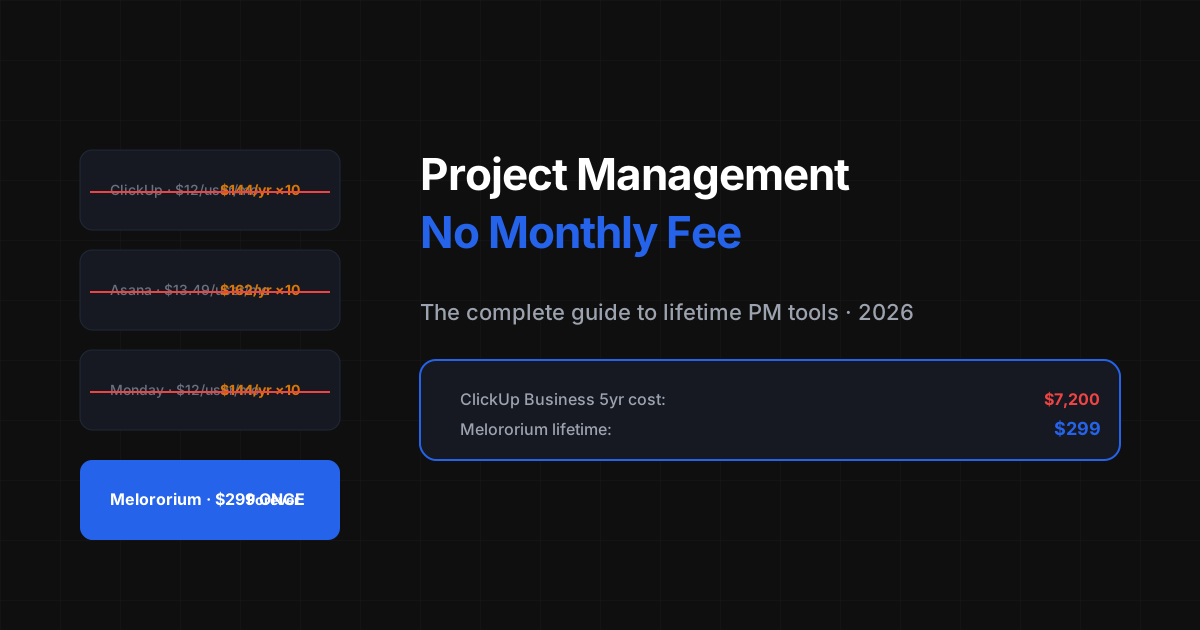
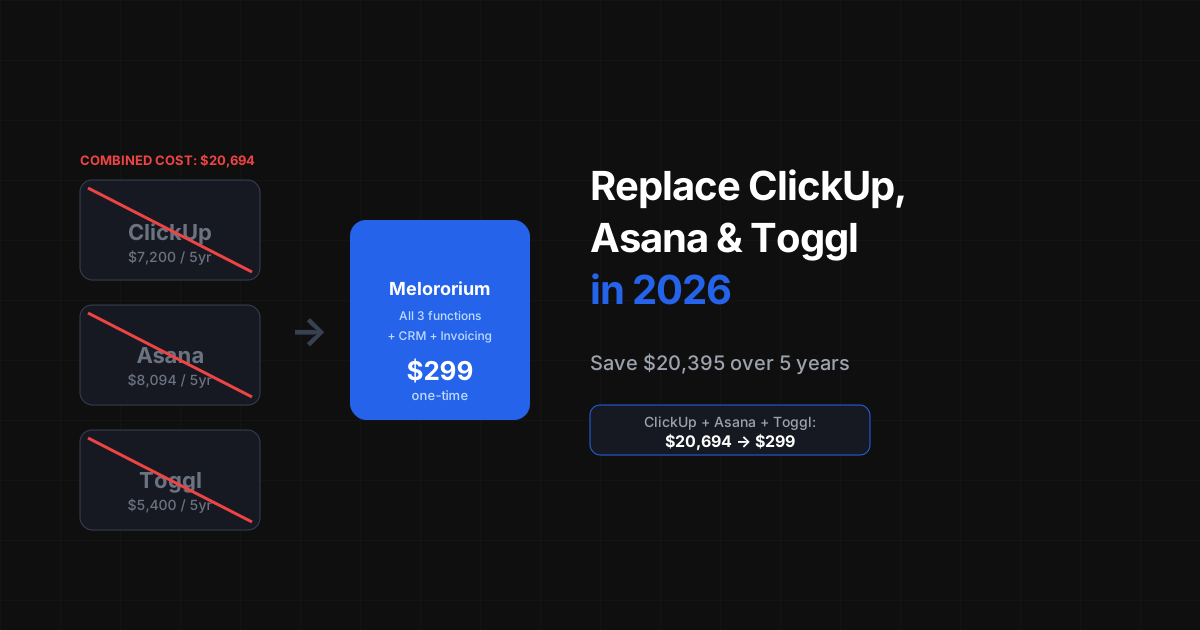
In July 2026, the subscription debate moved into mainstream tech news — and the phrase that keeps coming up is 'own nothing.' Apple and Klarna both announced new financing models this month that let you 'upgrade to the latest device every year' in exchange for never actually owning the hardware. The pitch is frictionless access. The fine print is a perpetual payment stream with no exit. Hacker News hit the top 10 with a thread titled 'own nothing, upgrade everything' — and the comments weren't celebratory. They were angry. Garmin's response was more direct. They launched a $200 no-subscription fitness wearable that competes directly with Whoop — a product that charges $30/month on top of the hardware cost. Garmin's marketing was blunt: 'Buy it. Own it. No subscription.' The product sold out within 48 hours. The pattern here is bigger than wearables. 'Own nothing' — the idea that you pay forever for access rather than ownership — has become the defining complaint of 2026's tech consumer. It spans hardware (Apple/Klarna financing), software (seat-per-user SaaS pricing), AI tools (usage-based billing with unpredictable monthly totals), and now fitness trackers. For agencies and small teams, this maps directly to seat-tax pricing. ClickUp at $12/user/month for 10 people = $1,440/year. Asana at $10.99/user/month for 10 people = $1,318/year. Add Monday at $12/user/month and you're at $2,858/year — for three tools you never actually own and lose access to the moment you stop paying. Melororium Agency: $59/month flat for the whole 10-person team = $708/year. No per-seat fee. No 'upgrade for AI'. You pay for the workspace, not per head. The 'own-nothing' backlash isn't about nostalgia for boxed software. It's about teams realising that predictable, team-wide flat fees are just a better deal — financially and structurally — than paying more as you grow.
- Apple + Klarna 'own-nothing' hardware financing — HN top 10, July 2026: 'you pay forever and never own the device'
- Garmin $200 no-subscription Whoop competitor — sold out in 48 hrs, explicit 'Buy it. Own it. No subscription.' positioning
- Whoop: $30/month on top of hardware cost — the exact model the Garmin launch was designed to defeat
- ClickUp 10 users: $12/user/mo × 10 × 12 = $1,440/year — you own nothing, lose access if you stop
- Melororium Agency: $59/mo flat = $708/year for up to 15 users — same team, 51% cheaper, no seat tax
Pay-Once vs. Subscription: The Honest Comparison
Let me be fair, because pay-once isn't magic for everything.
- Subscriptions make sense when: the product genuinely ships meaningful updates monthly, you need a tool for just one short project, or the data lives somewhere you legally must keep paying to access
- Pay-once wins when: the tool does a defined job that doesn't need to change every week — project management, notes, time tracking — most of your daily stack
- The tipping point: if you use a tool for more than ten months, pay-once almost always wins on math alone. After that, you've already saved money and the gap keeps growing
How to Actually Switch (Without Breaking Your Workflow)
Subscription fatigue is easy to feel and hard to fix, because switching feels like a project. Here's the version that doesn't.
- Step 1: Audit one month of charges — open your last bank statement and highlight every recurring software charge. Most freelancers undershoot their real total by 30-40%
- Step 2: Sort tools into 'core' and 'occasional' — core tools are the ones you open daily. They're your highest-priority targets because that's where recurring cost compounds hardest
- Step 3: Replace one core tool first — don't rip everything out at once. Prove the switch works, then do the next one
- Step 4: Do the break-even math — divide the pay-once price by your current monthly spend on that tool. A $149 tool replacing $47/month breaks even in under four months
The Math, In One Line
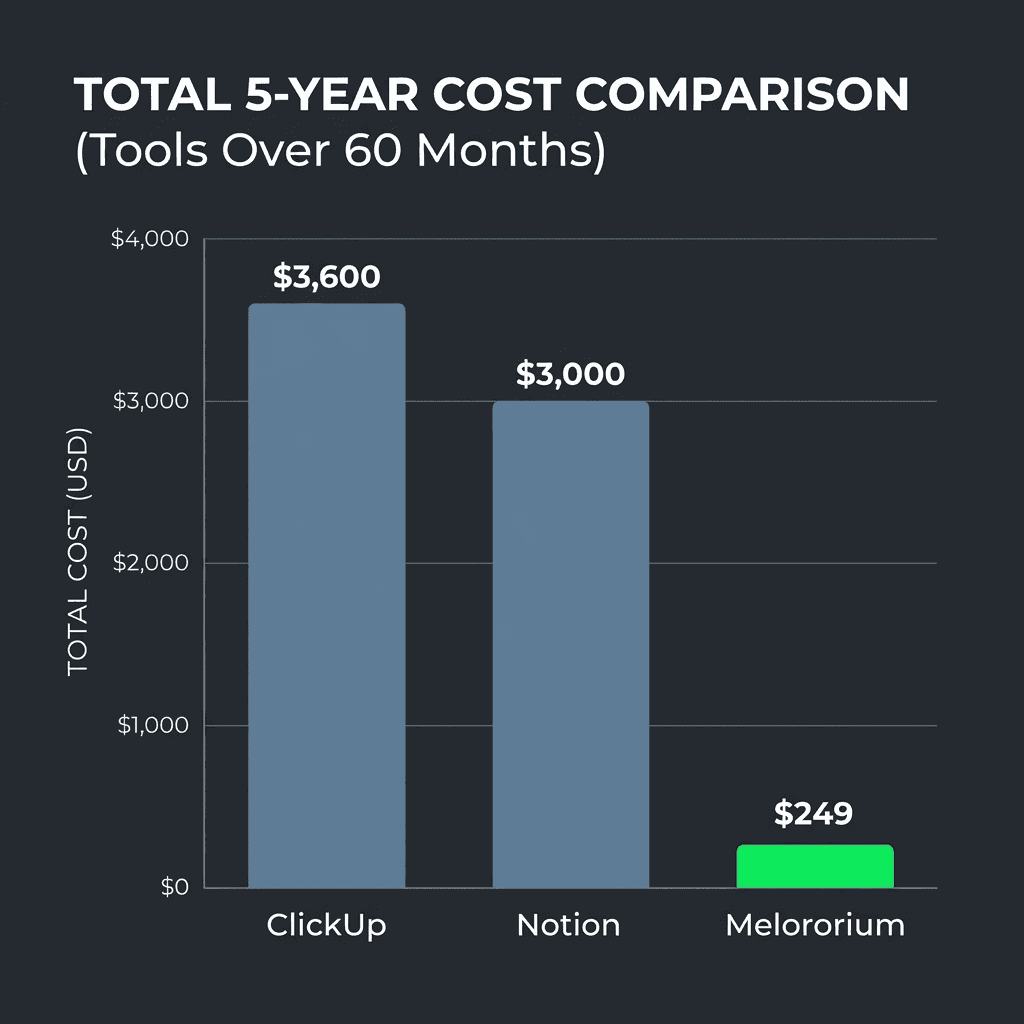
Three subscriptions at $564/year, every year, forever — versus $149 once. Over three years, that's roughly $1,692 in subscriptions against $149 paid once. That gap is subscription fatigue, expressed as a number. And it's why pay-once stopped being a niche preference and became, for a lot of freelancers in 2026, the obvious move.
Melororium
Try it in Melororium
Melororium — project management, notes, and time tracking in one workspace
FAQ: Subscription Fatigue and Pay-Once Tools
The most common questions about making the switch.
- Is subscription fatigue a real trend? — Yes. Google Trends shows 'subscription fatigue' rising through 2025–2026 while competing terms plateau. The FTC 'Click to Cancel' rule and enforcement actions against subscription traps confirm it at the regulatory level. This is a documented behavioral and legislative shift, not a vibe
- What is subscription fatigue? — The financial and mental exhaustion from paying multiple recurring software fees that individually feel small but collectively drain your budget. For freelancers in 2026, it often adds up to $500+ per year on core work tools
- Are pay-once tools actually cheaper? — For tools you use long-term — anything past ten months — yes. A $149 one-time tool replacing $47/month breaks even in under four months, then saves money every month after
- Do pay-once tools stop getting updates? — Good pay-once tools still ship updates; they just don't hold those updates hostage behind a monthly fee. Always check whether updates are included
- Which tools to switch first? — Start with your core daily tools: project management, notes, and time tracking. These cost the most over time because you never stop using them
- Is it worth switching mid-project? — Switch between projects, not during one. Finish what's in motion, then move your core stack over with the next fresh project
Boards that run themselves
Kanban with subtasks, priorities and a timer on every card
Demo request from Bloom Cosmetics
Website redesign · due Oct 14