What is Scope Creep?
Scope Creep
Scope creep is when a project's requirements grow past what was agreed, a little at a time, without the timeline or budget growing to match.
Scope creep is what happens when a project grows beyond its original boundaries, one small addition at a time, without corresponding increases in budget, timeline, or team capacity. Each individual change seems minor. Together, they add up to weeks of unplanned work and a project that's late, over budget, or both.
The word "creep" is accurate: scope creep rarely arrives all at once. It's the client who says "can you just add one more page" after the website is 90% done. It's the stakeholder who discovers a new requirement in week 8 of a 10-week project. It's the "while you're at it" requests that arrive via Slack after the SOW is signed.
For agencies and project teams, scope creep is one of the most common reasons projects become unprofitable. The work gets done, the client is happy, but the team worked 40% more hours than budgeted and absorbed the cost.
Why Scope Creep Happens
Scope creep has three root causes: unclear requirements, poor change control, and relationship dynamics.
- Vague requirements: when the original scope uses words like 'something like' or 'similar to', both sides fill in the gaps differently
- No change control process: without a formal way to evaluate and approve changes, requests slip through as 'small favors'
- Client relationship pressure: teams say yes to extra requests because they don't want to damage the relationship or seem difficult
- Evolving understanding: clients genuinely discover new requirements as they see the work develop, which is normal, but needs to be managed
- Internal gold-plating: team members add features or polish beyond what was asked because they want the work to be better
The Real Cost of Scope Creep
Scope creep is rarely free. The direct cost: hours worked beyond the estimate that reduce project margin. If a project was budgeted at 100 hours and runs to 130, you've absorbed 30% of the project as a loss, often without realizing it.
The indirect costs are worse: team burnout from constant project overruns, inability to start new projects on time because current ones are delayed, and client relationships where the client expects extras as the norm because you've delivered them without charge before.
For a 10-person agency billing $100/hour average, a 30% scope overrun on a $30,000 project is $9,000 of work done for free. Track it with time logging and the number becomes visible fast.
| Project size | 20% overrun | 30% overrun | 40% overrun |
|---|---|---|---|
| $10,000 project | $2,000 absorbed | $3,000 absorbed | $4,000 absorbed |
| $25,000 project | $5,000 absorbed | $7,500 absorbed | $10,000 absorbed |
| $50,000 project | $10,000 absorbed | $15,000 absorbed | $20,000 absorbed |
How to Prevent and Manage Scope Creep
Prevention starts with definition. The clearer the original scope, the harder it is for creep to hide. Every deliverable should be described in specific, testable terms: not "a website" but "a 5-page website with homepage, about, services, blog, and contact, built in WordPress, with mobile-responsive design".
Change control is the operational fix. When a new request arrives, evaluate it formally: what does it cost in time? Does it affect the timeline? If yes, it's a change order, not a favor. Many agencies use a simple rule: anything that adds more than 2 hours goes through a change order process.
For client relationships: frame change orders as protecting the client. "I want to make sure we deliver everything on time and to budget. This new request will take 8 hours. I can include it in a change order or we can discuss dropping something from the current scope to make room."
Scope Creep in Action: A Real Agency Story
A 9-person brand agency wins a project: visual identity for a B2B software company. Original scope: logo, color system, typography, and brand guidelines document. Budget: $18,000. Timeline: 6 weeks.
Week 1: The discovery call reveals the client wants the logo in 8 format variations instead of 3. The account lead agrees. No budget or timeline adjustment.
Week 2: The client asks for a LinkedIn banner while the team works on brand assets. "It'll only take a couple of hours." The designer spends half a day on it. No charge recorded.
Week 3: The brand guidelines document, originally scoped as a 12-page PDF, expands to 28 pages after the client requests sections on tone of voice, photography direction, and email signature templates. The copywriter spends 6 additional hours. No cost discussion happens.
Week 4: The client's CEO reviews the work and requests a different conceptual direction for the logo. "We love it but need it to feel more premium." The team runs a second round of concepting. Three designer days go into work outside the original scope.
Week 5: The project is behind. The team works evenings to hit the original deadline. The account lead sends a revised timeline but doesn't raise the budget.
Week 6: The project delivers. The client is satisfied. Invoice: $18,000.
The numbers: original estimate was 120 hours at an $85/hour blended rate, giving a $10,200 production cost and a $7,800 margin (43%) on the $18,000 project. Actual hours came to 168, pushing production cost to $14,280 and margin down to $3,720: a 21% margin on the same invoice.
The agency completed the project and earned half the margin they planned. The client didn't notice because they got everything they asked for. The agency worked 40% more hours for the same fee.
Nobody acted in bad faith. Six individually small requests accumulated to 48 unbilled hours across 6 weeks. No single request felt large enough to trigger a scope conversation. That's the pattern scope creep follows. Small additions don't feel significant until you count them.
The Change Order Process: How to Set It Up
A change order is a written document that records a change to the original project scope, the cost of that change, and client approval of both. Teams without change orders absorb scope additions silently. Teams with change orders make every scope change visible and get paid for the additional work.
Setting up the process takes one afternoon. Using it consistently is the harder part.
A change order covers six things: a description of the change in specific terms, a reference to which part of the original contract this differs from, the timeline impact (days added and new delivery date), the cost impact (amount added and new project total), any impact on other work currently in progress, and client approval via signature or written email confirmation before additional work starts.
Template structure that works: "Change Order #[number] for [Project Name]. Date: [date]. Requested by: [client name]. Description: [2–3 sentences on the specific change]. Original scope reference: [cite the relevant contract section]. Timeline impact: [X days added, new deadline: date]. Cost impact: [$X added, new project total: $X]. Authorization: by approving this change order, [client name] authorizes [agency name] to proceed and agrees to the updated timeline and cost. Client signature: ___________"
Issue a change order for any deliverable added beyond the original contract, any revision round beyond the number specified in the contract, any change in project direction that requires reworking completed deliverables, and any deliverable that expanded beyond its original description (a 12-page document becoming 28 pages).
The conversation that works: "We're glad to include this. Before we start, I'll send over a brief change order covering the addition and its impact on timeline and cost. Once you approve it, we'll get started." This frames the change order as the normal process for handling changes, not as a conflict.
For changes under 30 minutes with no timeline or budget impact, track them internally but skip the formal change order. If tracked absorbed changes accumulate to more than 10% of the project budget, issue a cumulative change order for the total.
- Every change order covers: description, contract reference, timeline impact, cost impact, client approval
- Issue before starting additional work, not after completing it
- Standard conversation: "I'll send a change order before we start"; frame it as normal process, not a dispute
- Informal threshold: under 30 minutes with no timeline or cost impact, track internally, skip the formal document
- Cumulative check: if absorbed work exceeds 10% of project budget, issue a cumulative change order for the total
Client Communication When Scope Changes
How a team communicates a scope change determines whether the client experiences it as professional service or as a surprise bill. Most scope conversations fail for one of two reasons: the team waits until invoice time to raise the issue, or the team frames the change as the client's fault.
Rule 1: Raise scope changes when they happen, not at the end. The worst time to tell a client that scope grew is at invoice time. By then, the work is done, the client expects the original price, and the conversation becomes a negotiation over completed deliverables. Raise scope changes the same week they occur. "We received your request to add email signature templates to the brand guidelines. Before we proceed, I want to flag this falls outside the original scope. Can we spend 10 minutes aligning on how to handle it?"
Rule 2: Confirm the description of the change before discussing cost. First, get agreement on what the change actually is. Then discuss cost and timeline impact. Combining both in one message creates confusion, clients push back on the price and accidentally dispute the change description. "Here's what I understand the request to be: [description]. Do we agree this is accurate?" Wait for confirmation before sending cost impact.
Rule 3: Offer options, not ultimatums. When a client requests out-of-scope work, give them two or three paths forward. Option A: add the work to the current project at additional cost. Option B: defer it to a new project after current delivery. Option C: add the new work by removing something of equivalent scope from the current project. Giving options puts the client in control of the decision.
Rule 4: Document every scope conversation in writing within 24 hours. After any call where scope was discussed: "Following our conversation today, here is what we agreed: [summary]. Please reply to confirm this is accurate." This prevents the "that's not what I said" follow-up and creates a paper trail for your change order.
Rule 5: Explain the change order process at kickoff, before any conflict arises. "When something comes up outside the original scope, we'll send a brief change order before we start the work. This keeps everyone aligned." Clients who hear this at kickoff treat change orders as expected process. Clients who hear about change orders for the first time when they receive one often push back on principle.
- Raise scope issues the same week they arise, not at invoice time
- Confirm the description of the change before discussing cost impact
- Offer 3 options: add to current project, defer to new project, or swap for equivalent in-scope work
- Document every scope conversation in writing within 24 hours
- Introduce the change order process at kickoff, not when the first change happens
Scope Creep Prevention Checklist
This checklist covers the steps that prevent predictable scope creep: the kind that comes from vague original scope, undefined processes, or questions nobody asked at project start. Review it at kickoff and at the start of each major project phase.
Before the project starts, confirm: the scope of work lists specific deliverables, not activity descriptions ("3 logo concepts, 2 rounds of revisions, final files in 5 formats" not "logo design"); the number of revision rounds is specified per deliverable type in the contract; the client's definition of "complete" is confirmed in writing, not assumed; the change order process is explained at the kickoff meeting; one client-side contact is identified who can approve scope changes and sign change orders; and all stakeholders who might request work have been introduced to the account lead before work begins.
During the project, confirm: every client request is reviewed against the original contract before work starts; requests outside scope go to the account lead within 24 hours of receipt; change orders are issued and approved before additional work begins; a weekly project status update covers completed work, in-progress work, and what's next; and absorbed changes under 30 minutes are logged internally with date and description.
At the project midpoint (for projects over 4 weeks): run a scope health check comparing current deliverables against the original contract; review the absorbed-change log and if cumulative absorbed time exceeds 10% of the project budget, have a client conversation before the next phase starts; and document any deliverable that expanded beyond its original description.
On project handoff: final deliverables match the contract scope plus any approved change orders; all change orders appear in the final invoice documentation; a post-project review captures where scope pressure originated and how the team responded.
Red flags that signal active scope creep mid-project: client emails include "while you're at it," "could you also," or "one more thing"; the client communicates directly with multiple team members while bypassing the account lead; brief documents or deliverable descriptions grow between kickoff and delivery without formal change orders; and team members work evenings to hold the original deadline on a project with expanded scope.
- Before start: deliverables specified (not activities), revision rounds defined, definition of done agreed, change order process explained at kickoff
- During: every request checked against contract before work starts, change orders issued before extra work begins, absorbed changes logged
- Midpoint: scope health check, absorbed-change log review, expanded deliverables documented
- Handoff: deliverables match contract plus approved changes, change orders in invoice documentation, post-project review completed
- Red flags: "while you're at it" requests, client bypassing account lead, briefs growing without change orders, evenings worked to hold the deadline on expanded scope
In Melororium
Track project scope and hours in Melororium
Common mistakes with scope creep
What teams get wrong most often, and what to do instead.
- 1
Saying yes without writing it down
Agreeing to a "quick addition" on a call and never logging it as a change. Verbal yeses are exactly how scope creep becomes invisible.
- 2
No defined process for changes
Having no clear path for a client to request something new, so requests arrive informally and get absorbed by default.
- 3
Confusing "small" with "free"
Assuming a small request costs nothing because it's small. Ten small requests are a large request wearing a disguise.
- 4
Not tracking cumulative impact
Approving each change in isolation without adding up what they cost together. One 2-hour add-on is fine; ten of them is two lost workdays nobody budgeted.
Frequently asked questions
Is all scope change bad?
No. Some scope changes are legitimate improvements that make the final product better. The problem isn't the change itself: it's when the change happens without adjusting budget, timeline, or both. A change order process makes change explicit and fair.
How do you say no to scope creep without damaging the client relationship?
Frame it as protecting the project, not refusing the client. 'I want to deliver everything we committed to on time. This new request would push the timeline by two weeks. I can either raise a change order for it or we can discuss swapping something out.'
What's the best way to track scope creep?
Compare estimated hours to actual hours per project, per week. When actual hours consistently exceed estimates, that's usually scope creep or poor estimation. Time tracking with per-project hour logs makes this visible immediately.
Does Melororium help with scope creep?
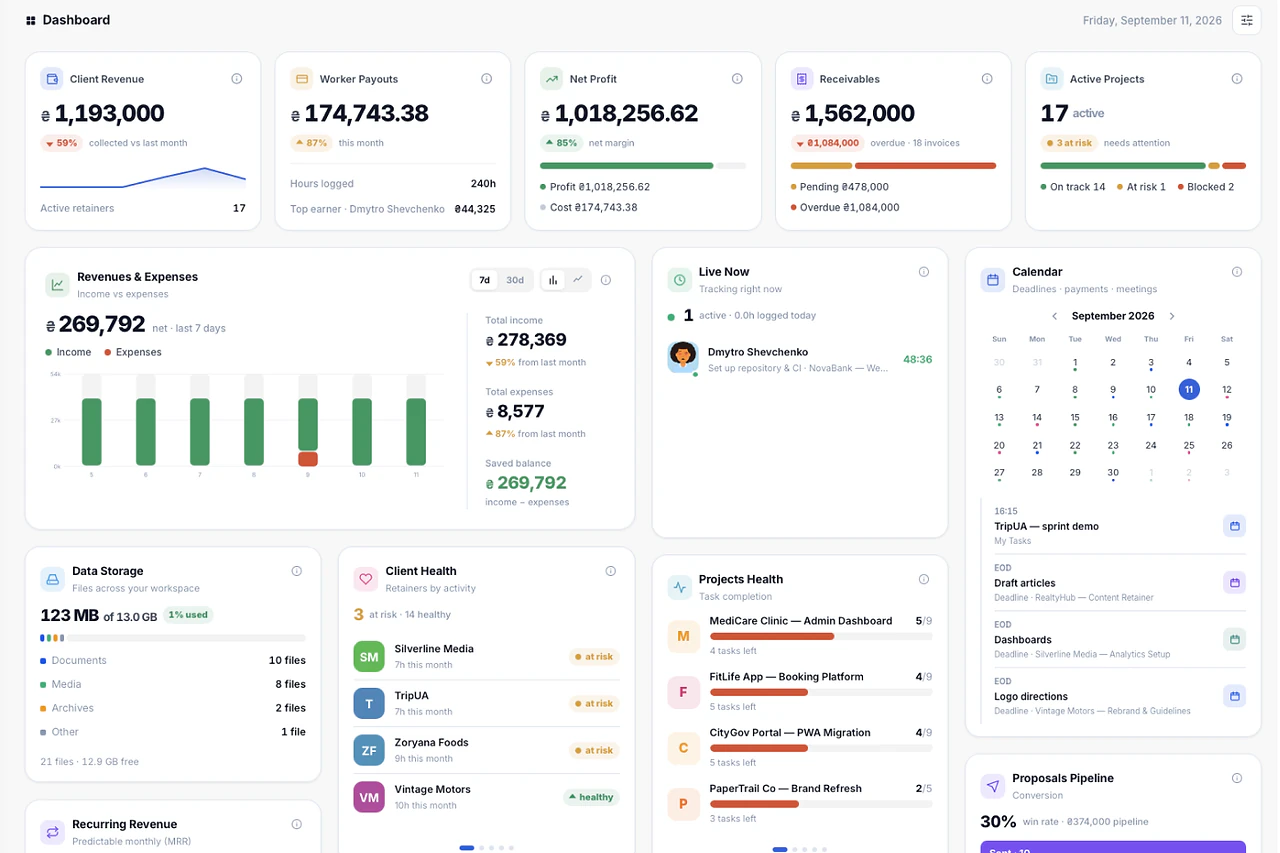
Melororium's time tracking and project views let you see estimated vs actual hours per project in real time. When you can see hours accumulating against a budget, scope creep becomes visible before it becomes a crisis.