How to Calculate Your True Profit on Etsy (The Number Most Sellers Never See)
You're making sales. But do you know what you're actually keeping? Most Etsy sellers are surprised — and not pleasantly — when they calculate their true hourly rate for the first time.

Contents
One flat fee for the whole team
Tasks, timers, CRM and invoices in one workspace. From $29 a month, no seat tax.
Start free demo14 days · no credit card
01. Why Most Etsy Sellers Don't Know Their Real Profit
The most common financial mistake on Etsy is conflating revenue with profit. A seller who makes $3,000 in a month and spends $1,200 on materials assumes they made $1,800. They didn't account for Etsy's fees, payment processing, shipping costs, packaging materials, tool subscriptions, or — most commonly ignored — their own time. When you factor everything in, the profit picture often looks dramatically different from the revenue picture. Some of your best-selling products are your worst-performing ones on a profit-per-hour basis.
"I ran my most popular product for two years before I calculated my actual hourly rate on it. It was $6.40. I was my own worst employee and didn't know it."
— Etsy seller, handmade candles, 3 years on platform
02. The Complete Map of Etsy Fees (2026)
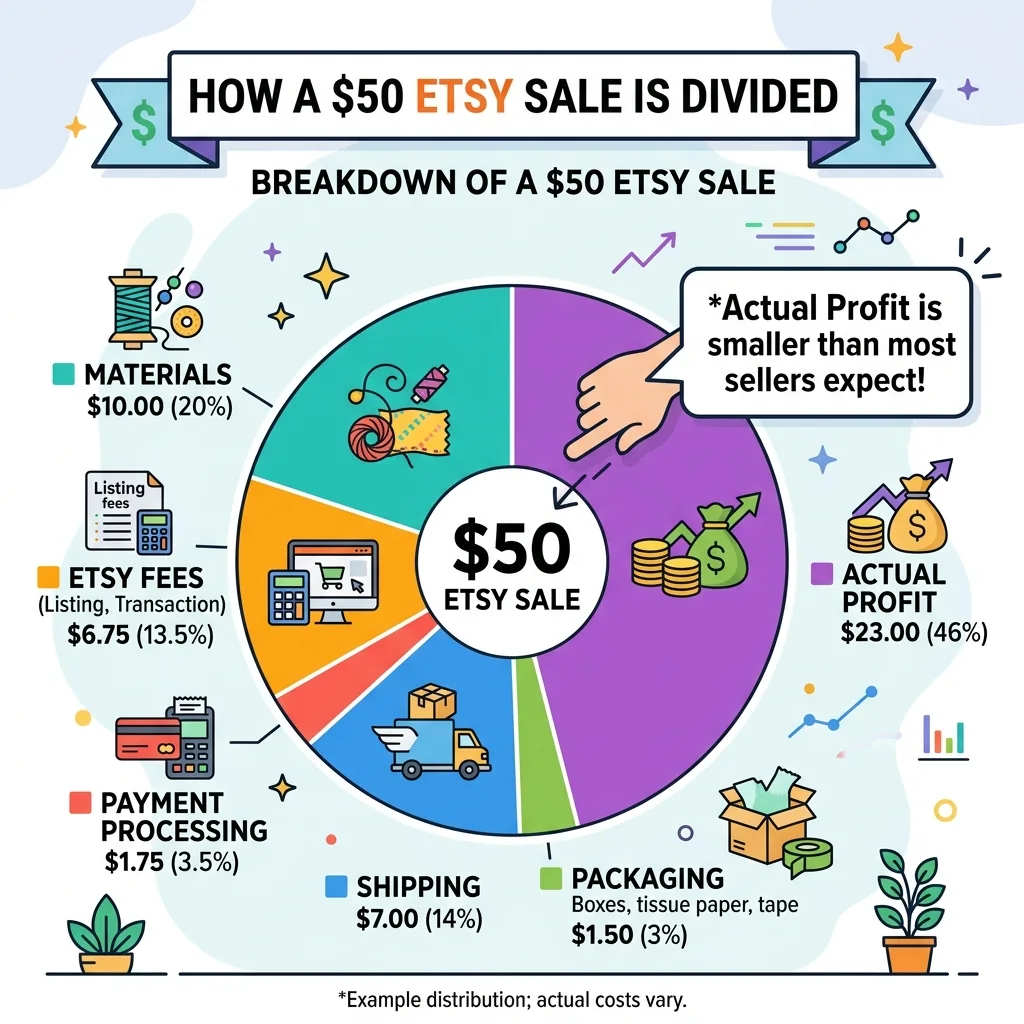
Etsy's fee structure has multiple components that combine to take a significant percentage of every sale: Listing fee: $0.20 per listing, renewed every four months or when a listing sells. For high-turnover items this is relatively minor. For slow-moving inventory, listings can cost more in fees than they generate in sales. Transaction fee: 6.5% of the total sale price including shipping. This is calculated on the full amount the buyer pays — not just your item price. If you charge actual shipping, Etsy takes 6.5% of that too. Payment processing fee: 3% + $0.25 per transaction (varies by country). Added to the transaction fee, your combined Etsy take on a $50 sale is approximately $3.25 (6.5%) + $1.75 (payment processing) = $5.00, or 10% of the sale. Etsy Ads (optional but common): Cost per click varies significantly. Sellers using Etsy Ads often don't track cost per acquisition carefully — advertising can easily eat 15-20% of the sale price on competitive items. Offsite Ads fee: 12-15% fee on sales attributed to Etsy's offsite advertising, which sellers above a certain threshold can't opt out of.
03. The Hidden Costs Most Sellers Forget
Packaging materials: Boxes, tissue paper, thank-you cards, tape, bubble wrap. For sellers who ship 50+ orders a month, packaging costs easily reach $100-300/month. Most sellers forget to include this in product pricing. Tools and equipment depreciation: The sewing machine, the cutting tools, the heat press, the photography equipment — these have a lifespan. Dividing the cost by expected uses gives a per-unit equipment cost that most sellers never calculate. Platform subscriptions: Photo editing tools, listing management software, shipping label services — small monthly fees that add up to meaningful annual costs. Your own time: This is the big one. A seller who spends 25 hours per week on their Etsy shop at a true profit of $800/month is earning $7.20/hour. That number needs to be in the profit calculation.
04. The True Profit Formula for Etsy Products
True profit per unit = Sale price - Etsy fees (10-15%) - Payment processing ($0.25 + 3%) - Material cost - Packaging cost - Shipping cost - Pro-rata equipment cost - (Production time in hours × target hourly rate) Let's apply this to a $35 handmade candle: True profit: $35.00 - $28.78 = $6.22 per candle — not the $26.50 that looks like profit before time is included. This doesn't mean the candle isn't worth making. It means the price needs to support your target hourly rate — or production time needs to be reduced through batching and efficiency.
- Sale price: $35.00
- Etsy transaction fee (6.5%): -$2.28
- Payment processing (3% + $0.25): -$1.30
- Materials (wax, wick, fragrance, jar): -$8.50
- Packaging (box, tissue, card): -$1.20
- Shipping (paid by buyer but Etsy fees apply): -$0.50 (fee on shipping)
- Production time (45 mins at $20/hr target): -$15.00
05. Calculating Your True Hourly Rate
Your true hourly rate on Etsy is: (Monthly revenue - all costs except your time) ÷ hours worked per month. For most sellers running this calculation for the first time, the number is lower than expected. That's useful information — not depressing information. It tells you which products to focus on, which to improve, and which to potentially discontinue. Melororium Timers — track production time per product type to build the data foundation for accurate profit calculations URL: melororium.com
Flat fee · no seat tax
Ready to get started?
Track every production minute with Melororium's built-in timers and manage your Etsy operations in a Kanban board — so you always know your true profit, not just your revenue.
Starter: $29/mo (4 users)
Agency: $59/mo (15 users)
Studio: $119/mo (Unlimited users)
06. Which Products Are Actually Profitable?
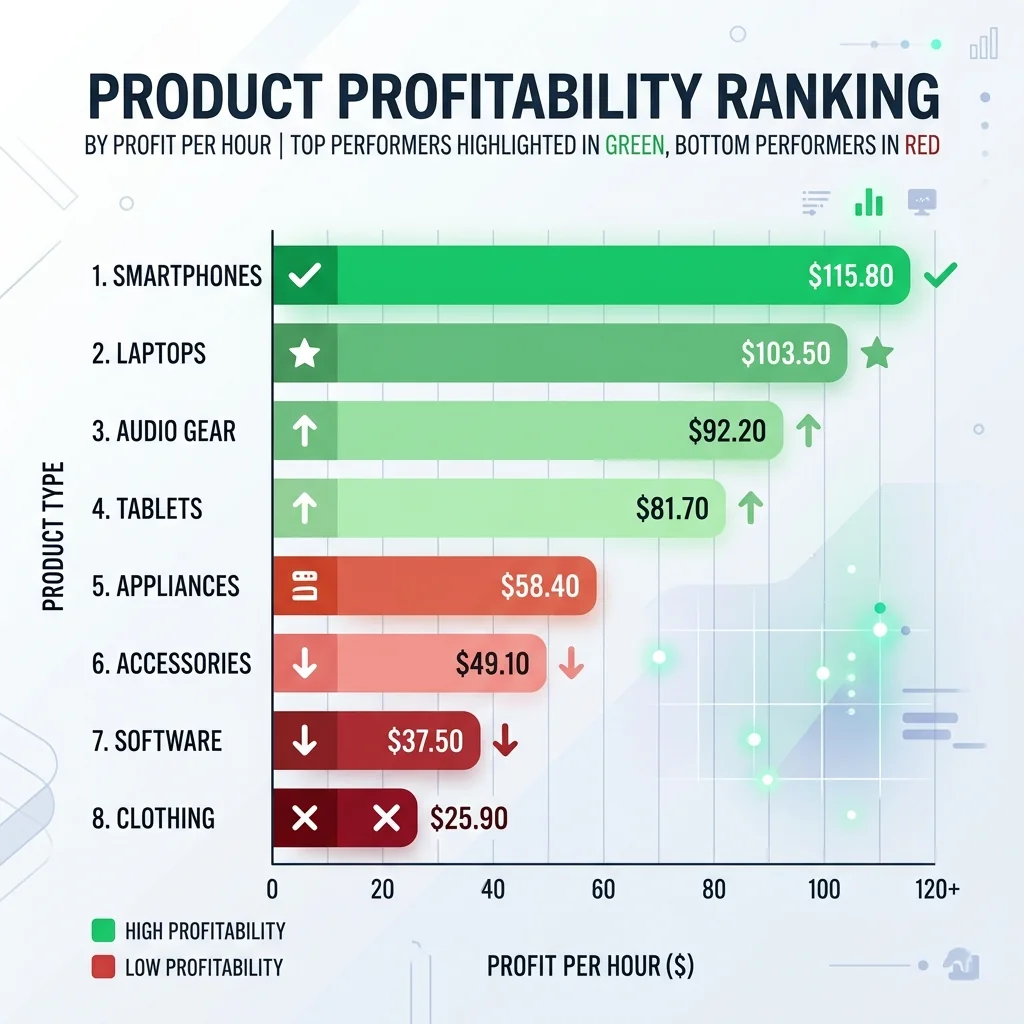
Once you have true profit data per product type, patterns emerge quickly. Typically: This analysis typically reveals that 20-30% of your products generate 70-80% of your actual profit. That's the focus list for scaling.
- Products with high material costs and long production times are your least profitable per hour
- Products with moderate material costs and high repeatability (batching-friendly) are your most profitable
- Custom orders command premium prices but often have lower hourly rates due to communication overhead
- Digital products have near-zero production time after the initial creation — highest margin in the shop
07. How to Fix a Product That's Not Profitable
When a product calculates as unprofitable or low-margin, there are four levers: 1. Raise the price — test 10-15% increases, monitor conversion rate impact 2. Reduce material cost — bulk purchasing, alternative suppliers, material substitution 3. Reduce production time — batching, jigs, templates, process optimization 4. Discontinue — if a product can't be made profitable, the time and energy is better invested in products that can
08. Building a Simple Profit Tracking System
You don't need complex accounting software to track Etsy profit. A simple monthly system works: Monthly tracking catches pricing problems before they compound over a quarter.
- Track time per product type each week using a task and timer system
- Record material costs when purchased, attributed to the product types they'll become
- Export Etsy's monthly statement for fee totals
- Calculate profit per product type monthly — not annually, monthly
09. Pricing Strategy Based on Real Numbers
With true profit data, pricing becomes a decision rather than a guess. The baseline question: at the current price, what is my hourly rate? If the answer is below your target, you have three options — raise the price, reduce costs, or accept the rate because the product serves another strategic purpose (low-cost entry product, traffic driver, complementary to higher-margin items). Most Etsy sellers price below market because they're afraid of losing sales. The data usually shows that modest price increases have minimal conversion impact — buyers who want your product will pay a fair price for it.
10. When to Raise Prices on Etsy
The signals that indicate you should raise prices: your shop has a consistent 5-star review history, you're selling out regularly, your conversion rate is significantly above Etsy average for your category, or your true hourly rate calculation comes out below your target. The mechanics: raise prices 10-15% on your highest-demand products and monitor for two to four weeks. If conversion rates don't drop significantly, the market supports the new price. If they do, experiment with smaller increases.
Boards that run themselves
Kanban with subtasks, priorities and a timer on every card
Demo request from Bloom Cosmetics
Website redesign · due Oct 14