How to Scale Your Etsy Shop to $5K/Month Without Hiring Anyone
The bottleneck in most Etsy shops isn't demand. It's the operations holding the demand back. Here's how to systematically remove that bottleneck.

Contents
One flat fee for the whole team
Tasks, timers, CRM and invoices in one workspace. From $29 a month, no seat tax.
Start free demo14 days · no credit card
01. The Real Reason Etsy Shops Hit a Ceiling
Talk to Etsy sellers who've plateaued around $1,500-2,000/month and the story is consistent: the demand is there, the products are good, but adding more orders creates more chaos rather than more income. Every new order feels like another item on an already-too-long list. The shop can't grow without the seller grinding harder. This is a systems problem, not a product problem or a marketing problem. The same volume of work organized through a proper operational system produces better outcomes with less stress.
"I went from $1,800 to $5,200 average monthly revenue in eight months. I didn't change my products. I didn't change my prices. I built systems for everything I was doing reactively."
— Etsy seller, personalised gifts, 4 years on platform
02. The Three Levers of Etsy Revenue
Etsy revenue is the product of three variables: number of orders, average order value, and repeat purchase rate. Most sellers focus almost exclusively on increasing order volume. The ones who scale most efficiently improve all three simultaneously. Increasing order volume (traffic and conversion): Better SEO in listings, more listings, photography that converts browsers to buyers. Systems help here because they free the time you're currently spending on operations to invest in listing improvements. Increasing average order value: Bundles, upgrades, add-ons, and higher-margin product variants. These require time to develop — which only becomes available when your operations are running efficiently. Increasing repeat purchase rate: Post-purchase communication, loyalty incentives, consistent product quality. These are entirely system-dependent — you can't maintain consistent post-purchase communication when you're drowning in operational tasks.
03. Systems Before Scale: Why This Order Matters
The instinct when trying to grow is to add: more listings, more marketing, more effort. Before adding, fix. A leaking system gets worse under higher volume, not better. Build your production system, your materials management, and your customer communication process before you actively drive traffic growth. A shop that runs smoothly at $2,000/month can scale to $5,000/month by increasing volume into a working system. A shop that's barely holding together at $2,000/month will collapse under $5,000 in volume. Melororium Task Tracker — build the operational foundation for your Etsy shop before scaling volume URL: melororium.com
Melororium
Systems Before Scale: Why This Order Matters
Learn more about Melororium
04. Standardizing Your Products for Volume
Custom orders at low volume are manageable. Custom orders at high volume require standardization of the customization process itself. The goal isn't to eliminate custom options — it's to make each custom option as repeatable as possible. Create production templates for your most common customizations. If 80% of your custom jewelry orders are name necklaces in three standard lengths, build a production template for that product type that reduces decision-making and speeds production time.
05. Batching Production to Multiply Output
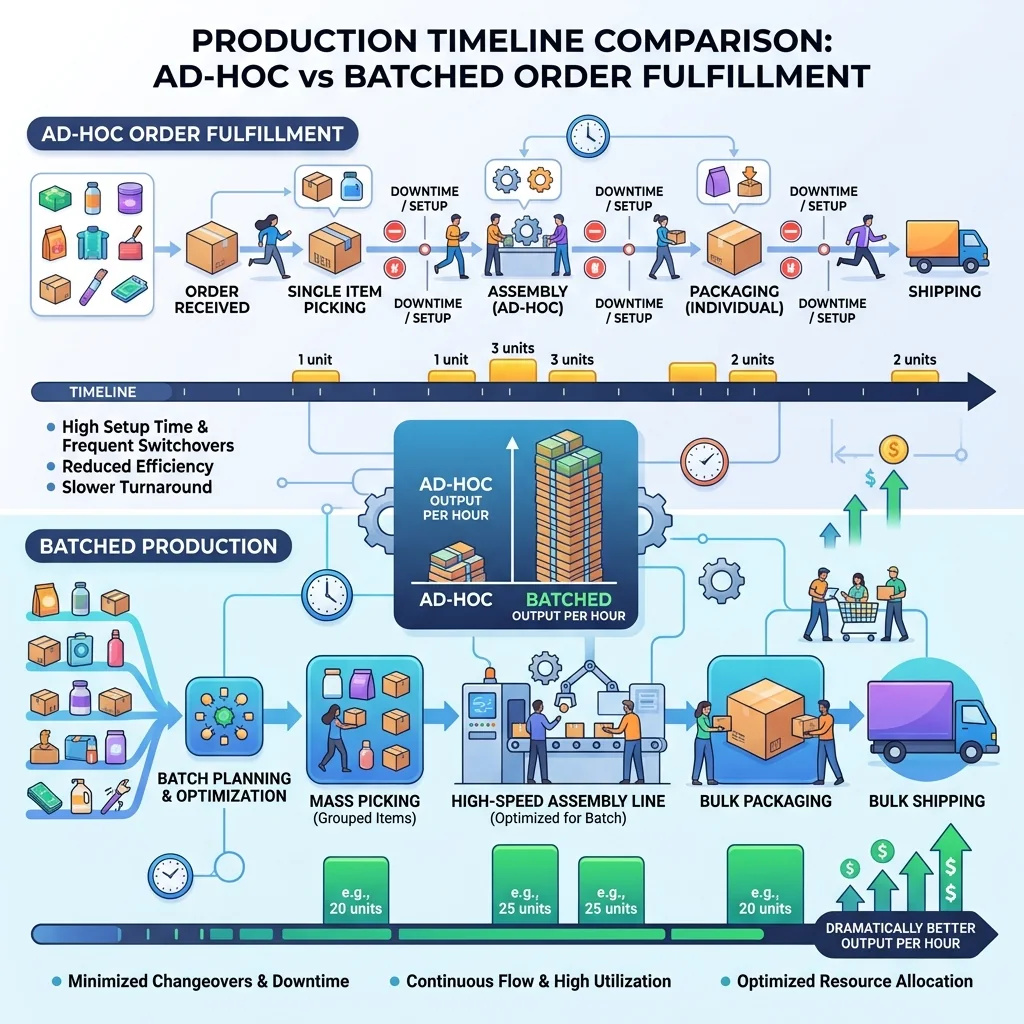
Ad hoc production — making each item as orders come in — is the lowest-efficiency approach to Etsy production. Batching — producing multiple units of the same item in a single session — dramatically increases output per hour. Batching works because setup and teardown time is amortised across multiple units. If setting up your workspace for a specific product takes 15 minutes, producing one unit means 15 minutes of overhead. Producing five units means 3 minutes of overhead per unit. The batching system:
- Collect similar orders before starting production — don't produce each order individually as it arrives
- Set a batch threshold — process orders in batches of five to ten, twice daily
- Schedule production sessions in your task system at consistent times each day
Flat fee · no seat tax
Ready to get started?
Melororium gives your team a production Kanban board, time tracking per project, and reporting for your growth tasks — one workspace, one payment.
Starter: $29/mo (4 users)
Agency: $59/mo (15 users)
Studio: $119/mo (Unlimited users)
06. Creating Repeatable Listing and Photography Workflows
New listing creation and photography are the growth activities most Etsy sellers deprioritise — because they're not urgent in the way that shipping existing orders is urgent. But new listings drive future revenue while order fulfillment only delivers present revenue. The solution: schedule listing creation as a recurring weekly task, just as you schedule production. Block two hours every Tuesday for new listings. Use a template for each listing — structure, keyword research process, photography checklist. Repeatability makes the task faster and the output more consistent. Melororium Timers — track how long listing creation actually takes so you can schedule it accurately and see its contribution to shop growth URL: melororium.com
Melororium
Creating Repeatable Listing and Photography Workflows
Learn more about Melororium
07. Managing Customer Communication at Scale
Customer communication doesn't need to scale linearly with orders. Templates, auto-responses, and clear shop policies can handle the majority of customer questions without individual responses. The communication leverage system: With these four templates active, 80% of your customer communication becomes semi-automated. You respond personally only to questions that fall outside the standard patterns.
- FAQ section that addresses the 10 most common questions — update it monthly
- Order confirmation template with processing time, shipping method, and what to expect
- Shipping notification with tracking and delivery estimate
- Post-delivery follow-up — simple, personal, review-inviting
08. Tracking the Numbers That Drive Growth
Etsy provides analytics — but the numbers that actually drive growth decisions require combining Etsy data with your operational data. Revenue per hour worked. Cost per order including materials and time. Margin by product type. The sellers who scale most effectively make decisions based on this combined data: they know which products have the highest margin per hour, which listing types convert best, and which customer segments have the highest repeat purchase rate.
09. When $5K Becomes the Floor, Not the Ceiling
Shops that reach $5K/month with proper operational systems in place don't stall there — they keep growing. Because the systems are in place, additional volume is absorbed efficiently rather than creating proportional stress. Growth compounds. The shops that plateau at $5K are the ones that achieved it through grinding harder without changing the underlying systems. They're at their personal capacity limit, not their business capacity limit. The distinction matters because it points to the solution: build systems, not just output.
Boards that run themselves
Kanban with subtasks, priorities and a timer on every card
Demo request from Bloom Cosmetics
Website redesign · due Oct 14