What is CRM?
CRM
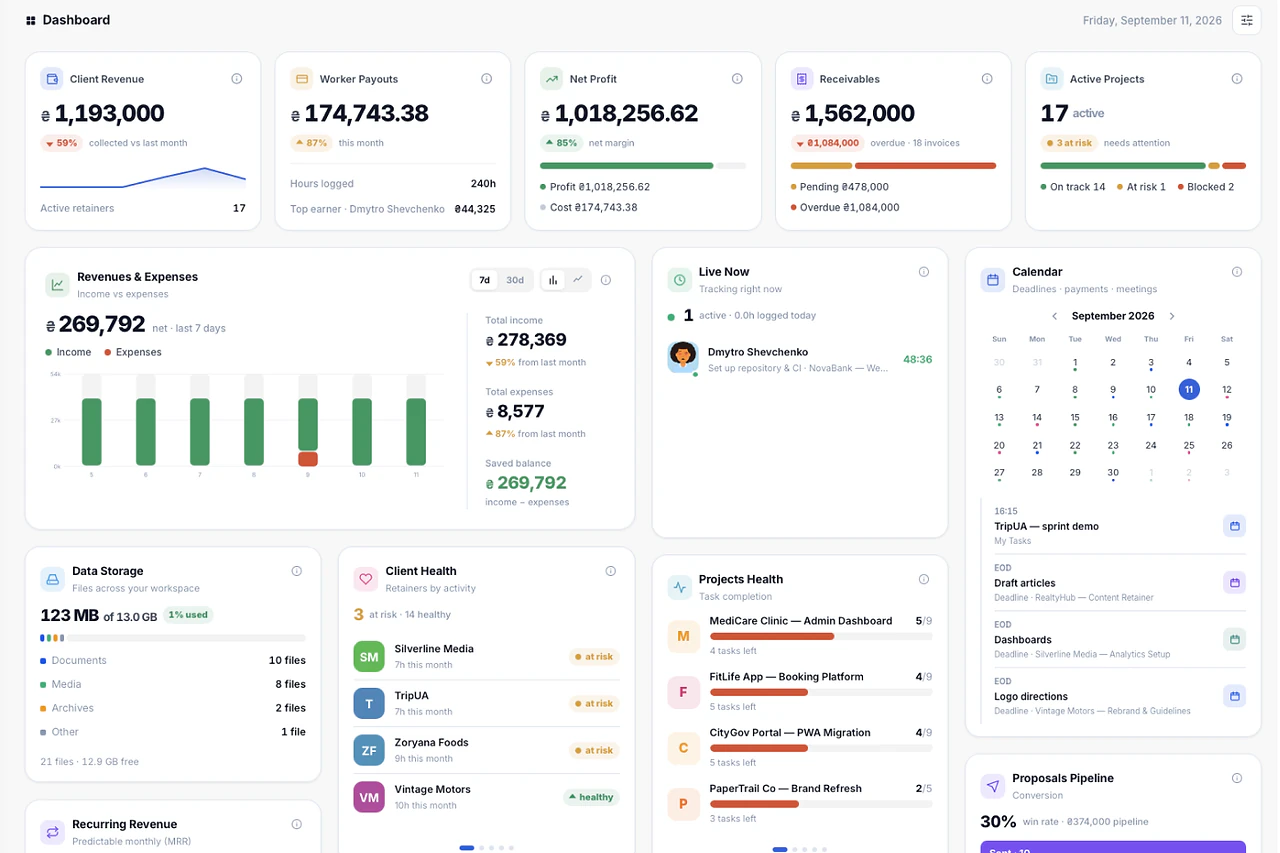
CRM software organizes every client's contact details, deals, and communication history in one place, so nothing lives only in someone's inbox.
CRM stands for Customer Relationship Management. A CRM is a software system that stores and organizes information about clients and prospects: their contact details, communication history, active projects, payment records, and deal status.
The original purpose was sales: track leads through a pipeline from first contact to closed deal. Modern CRMs have expanded to cover the full client lifecycle, from acquisition to delivery to renewal.
For agencies and service teams, a CRM isn't just for salespeople. It's the system that makes sure every team member knows who the client is, what was agreed, what's been delivered, and what's owed.
What CRM Software Actually Does
A CRM centralizes all client data in one place and makes it accessible to everyone on the team.
- Contact management: store client names, emails, phone numbers, company details, and notes in structured records
- Deal pipeline tracks prospects through sales stages: lead → proposal → negotiation → won/lost
- Communication history: log emails, calls, and meeting notes so any team member can see the full context
- Task management: create follow-up tasks tied to specific clients or deals
- Reporting: see which clients generate the most revenue, which deals are stalling, and where the pipeline stands
CRM for Agencies vs CRM for Sales Teams
Traditional CRMs (Salesforce, HubSpot) are designed for sales teams with long deal cycles. They optimize for lead conversion: tracking hundreds of prospects from cold outreach to closed deal.
Agencies have a different problem. Their client relationships don't end at the signed contract. They continue through projects, revisions, and invoices. An agency CRM needs to connect to project work, not just to the sales pipeline.
The most useful CRM for an agency shows, on a single client card: all contact info, all projects (active and completed), all invoices (paid and outstanding), all communication history, and any open tasks. That data spans what most tools treat as completely separate systems.
Why Agencies Need CRM + Project Management Together
Agencies typically split their stack: HubSpot or Pipedrive for client management, ClickUp or Asana for project execution. The problem: these systems don't share data.
When a client asks 'where are we on the project?' the account manager checks ClickUp. When accounting asks 'has this client paid?' someone opens FreshBooks. When a new team member needs background on a client, they search email threads.
A CRM that lives inside the same tool as project management solves this: the client card shows everything: relationship history, active projects, invoices, and contact details. One system of record instead of four.
| What you need to see | Separate tools | Integrated CRM+PM |
|---|---|---|
| Client contact info | Open CRM | Same window |
| Active project status | Open PM tool | Same window |
| Outstanding invoices | Open accounting tool | Same window |
| Communication history | Search email | Same window |
| Time logged this month | Open Toggl | Same window |
CRM Software Cost: What Teams Actually Pay
CRM pricing varies widely. Enterprise platforms are expensive. Small-team options are more affordable but still add up over time.
- HubSpot CRM: free tier for basic contacts; Starter plan $15/user/month = $1,800/year for 10 users; $9,000 over 5 years
- Pipedrive: $14/user/month = $1,680/year for 10 users; $8,400 over 5 years
- Salesforce Starter: $25/user/month = $3,000/year for 10 users; $15,000 over 5 years
- Melororium CRM: included in the flat-fee plan. Agency plan is $59/mo for 15 users. No additional CRM subscription.
CRM in Melororium
Melororium includes a built-in CRM in all plans. Client cards store contact details, deal stage, linked projects, invoices, and logged hours. The client portal gives clients read-only access to their project status, without giving them access to your internal board.
The CRM isn't a standalone module bolted onto a task manager. The client card is the hub that connects projects, timers, and invoices. When a task is completed and time is logged, it appears on the client card automatically. When an invoice is generated from those hours, it's visible on the same card.
Agency plan: $59/mo for 15 users. Compare to HubSpot Starter at $9,000 over five years, before project management and time tracking.
Setting Up a CRM for a 10-Person Agency: Step by Step
CRM setup fails when teams try to configure every field and pipeline stage before going live. The result: an overcomplicated system nobody uses. A working CRM beats a perfect CRM every time.
Step 1: Import your current client list. Start with every active client and every prospect you've spoken to in the past 90 days. For each, you need: company name, primary contact name, email, phone, and current status (active client, prospect, or past client).
Step 2: Set up a simple pipeline. For most agencies, five stages cover the full client lifecycle: Lead, Proposal Sent, Negotiating, Active Client, Closed. Resist adding stages for every micro-step in your sales process until you've used the basic five for at least 60 days.
Step 3: Link projects to clients. Every active client should have their current projects linked to their CRM record. When someone pulls up the Acme Corp card, they see both the contact details and the active website project status.
Step 4: Log existing communication history. For each active client, add notes covering: how the relationship started, key agreements made, any sensitivities or preferences, and outstanding items. This takes 10-15 minutes per client but means any team member can pick up the relationship without asking the account manager.
Step 5: Assign CRM ownership. Designate who updates each client record and how often. A monthly review works for most accounts. Without ownership, CRM records go stale within 90 days.
Full setup for a 10-client agency takes one focused half-day. The payoff starts the first time a client calls and the account manager pulls up their card with full context in 10 seconds.
- Import all active clients and 90-day prospects first. Don't start with a blank system
- Five pipeline stages are enough to start: Lead, Proposal, Negotiating, Active, Closed
- Link projects to client records from day one: this is what separates CRM from a contact list
- Add 10-minute notes per client on relationship history before going live
- Assign one owner per client record and schedule monthly review touchpoints
CRM Data: What to Track and Why
A CRM with too many fields gets abandoned. Fields nobody fills in accurately are worse than no fields at all: they create false confidence in incomplete data. A CRM with the right 10-12 fields per record stays maintained and generates reliable reports.
Contact information is the baseline: name, email, phone, company, title. These never change much and take 2 minutes to fill in.
Relationship data tracks how you work with this client: how the relationship started, who introduced them, what they've bought, and what rates have been agreed. This context matters when a new account manager takes over a client or when you prepare for a renewal conversation.
Project history links the CRM record to all projects this client has engaged on, active and completed. Seeing that Acme Corp has run 4 projects with you over 2 years, with a combined value of $68,000, changes how you approach that renewal conversation.
Financial data shows outstanding invoices, payment history, and average days to payment. A client with a $12,000 outstanding invoice who consistently pays 45 days late needs different treatment than a client who pays on receipt.
Skip fields your team won't fill in. If nobody on your team consistently records 'preferred communication channel,' remove that field. It creates noise in the record and makes it look incomplete.
| Field Category | Fields to Include | Update Frequency |
|---|---|---|
| Contact info | Name, email, phone, company, title | On change |
| Relationship | Source, referrer, agreed rates, contract dates | At start and renewal |
| Project history | Linked projects, total value, count | Auto-updated from project module |
| Financial | Outstanding invoices, payment days average | Monthly |
| Communication log | Decisions, agreements, scope changes | After each significant conversation |
CRM for Project-Based Work vs Recurring Revenue
CRM requirements differ significantly depending on how your agency bills clients. Project-based and retainer models need the CRM to do different things.
Project-based agencies close discrete engagements: a brand identity, a website, a campaign. Each project has a defined scope, a fixed timeline, and a clear endpoint. The CRM pipeline centers on deal management: tracking leads through proposal and close, then handing off to project execution. Once a project closes, the client might go quiet for 6-12 months before the next engagement.
For project-based agencies, the most valuable CRM data is historical project records and the re-engagement pipeline. Knowing that a client did a website 2 years ago and typically comes back every 18-24 months allows proactive outreach before they start shopping competitors.
Retainer agencies have recurring monthly relationships. Clients pay $3,000-$10,000 per month for ongoing services. The CRM pipeline is less about closing deals and more about health scoring and renewal tracking.
For retainer agencies, the critical CRM metrics are: months remaining on contract, average scope variance (are retainer clients consistently requesting more than the agreement covers?), and satisfaction data collected quarterly. A client on month 8 of a 12-month retainer who has averaged 125% of contracted scope each month is a renewal risk unless the scope is formalized before month 10.
- Project-based: focus CRM on deal pipeline and re-engagement timing for past clients
- Retainer-based: focus CRM on contract renewal dates, scope variance, and health scoring
- Mixed model: track project-to-retainer conversion rate and average time to conversion
- Set re-engagement reminders based on typical project cycle length (e.g., 18 months for website projects)
- Log scope variance monthly for retainer clients: it predicts renewal friction before it surfaces
Signs Your Team Needs a CRM
A spreadsheet handles a client list well up to about 15-20 clients. Beyond that, spreadsheets develop specific failure modes that signal it's time for a dedicated CRM.
You've lost a client because nobody followed up. A prospect went cold because the account manager who sent the proposal left the company and their email drafts went with them. A former client started a new project with a competitor because nobody remembered to reach out after 18 months. These aren't individual failures. They're system failures that a CRM prevents by making follow-up tasks visible and assignable.
Different team members have different information about the same client. The account manager knows the client hates Tuesday morning calls. The project manager doesn't know, schedules a Tuesday morning check-in, and the client is frustrated. A CRM note would have prevented this.
You can't answer basic questions about your client base. How many active clients do you have? What's the total value of open proposals? Which clients haven't been contacted in over 60 days? If answering these questions requires opening three spreadsheets and cross-referencing emails, the answer is unreliable.
Invoice chasing happens manually. Someone has to remember each month which clients have outstanding invoices and send reminders. A CRM connected to invoicing surfaces this automatically.
Onboarding new team members onto client relationships takes days. With a CRM, a new account manager opens the client card and reads the relationship history, project record, and communication log. Onboarding drops from days to hours.
- You've lost track of a prospect or past client due to team turnover or inbox dependence
- Different team members hold different versions of client information with no single source of truth
- Answering 'how many active clients do we have?' requires opening multiple spreadsheets
- Invoice follow-up is manual: nobody knows what's outstanding without checking separately
- Onboarding a new account manager onto existing clients takes more than one day
In Melororium
See CRM in Melororium
Common mistakes with crm
What teams get wrong most often, and what to do instead.
- 1
Running client info through personal inboxes
Keeping client history in someone's Gmail. When that person is out sick or leaves, the relationship's context leaves with them.
- 2
A CRM disconnected from project work
Using a CRM for sales and a separate tool for delivery. Nobody sees that the client whose invoice is overdue is also the one with the project at risk.
- 3
Only the sales team updates it
Letting client notes go stale because only sales logs activity. The people delivering the work know things sales doesn't, and vice versa.
- 4
Overloading it with fields nobody fills
Adding forty custom fields at setup. Unused fields don't get updated, and an unreliable CRM gets ignored entirely.
Frequently asked questions
What does CRM stand for?
CRM stands for Customer Relationship Management. It refers to both a strategy (how companies manage client relationships) and software (tools that organize client data, track communications, and manage sales pipelines).
Do small teams need a CRM?
Any team that manages ongoing client relationships benefits from a CRM. Even a 3-person agency should have a central place for client contact info, project history, and payment status. Spreadsheets work initially but break down as client count grows past 10–15.
What is the difference between CRM and project management software?
CRM manages client relationships and sales pipelines. Project management manages task execution and delivery. They're complementary, agencies need both. Most teams use separate tools, but all-in-one platforms like Melororium include both under one flat monthly fee.
Can CRM replace a spreadsheet?
For simple client lists, a spreadsheet works. A CRM becomes necessary when you need to track communication history, link clients to projects, manage deal stages, or give multiple team members access to the same client data without version conflicts.
Is HubSpot free for small teams?
HubSpot has a free tier for basic contacts and deals. It becomes paid when you need email sequences, reporting, deal pipelines with more stages, or more than 1 user with advanced permissions. The Starter plan is $15/user/month, or $9,000 over 5 years for 10 users.