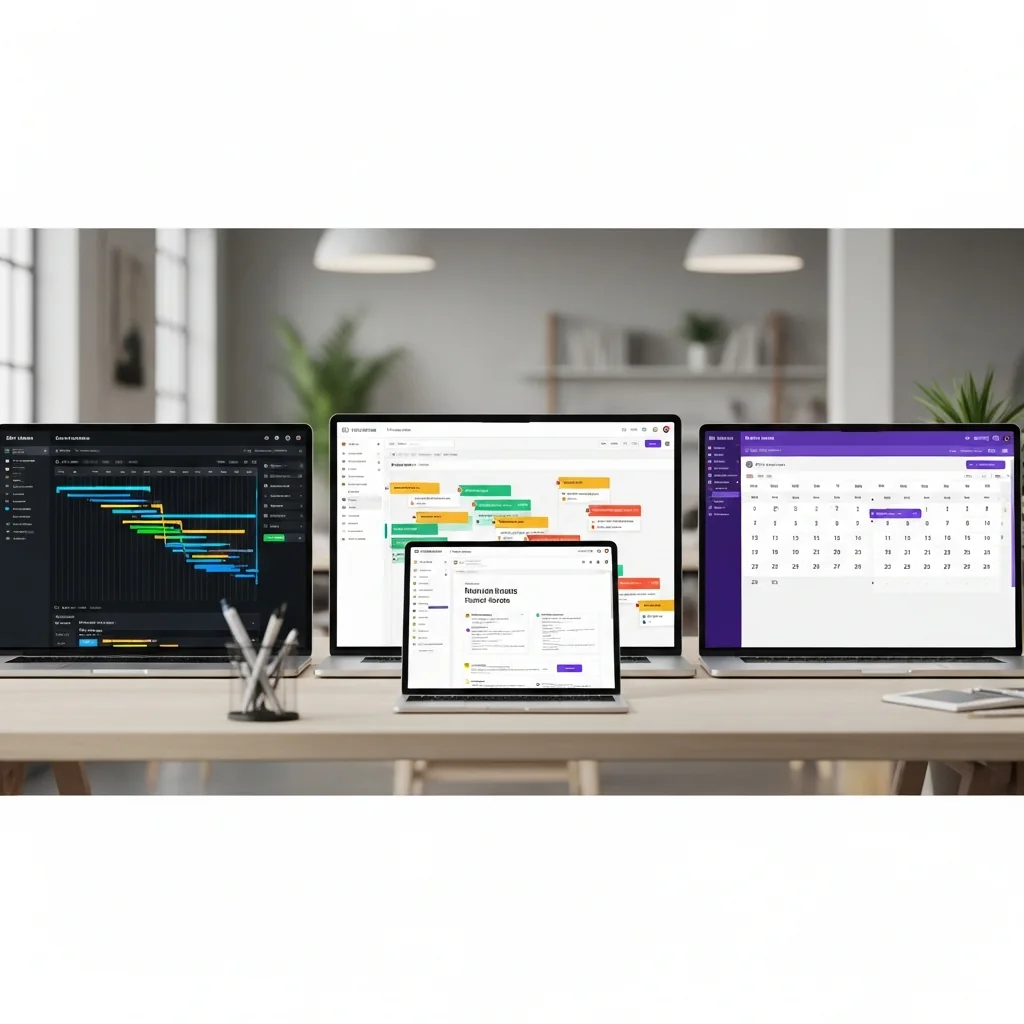
ClickUp vs Notion vs Melororium: 2026 Cost Breakdown for Teams
ClickUp: $1,440/yr for 10 users. Notion: $960/yr. Melororium flat fee: $708/yr. Here's the full 2026 comparison — pricing, time tracking, CRM, and which one actually fits your team.

Contents
One flat fee for the whole team
Tasks, timers, CRM and invoices in one workspace. From $29 a month, no seat tax.
Start free demo14 days · no credit card
Why Most Comparison Posts Get This Wrong
Search 'ClickUp vs Notion' and you'll find the same article pasted across fifty different blogs: features compared in a vacuum, tools scored out of ten, a winner declared based on integration count. A five-person agency picking a project tool doesn't need the one with the most integrations. They need a tool sized for them that doesn't charge per seat every month for functionality nobody uses. This comparison covers what actually matters for teams of 4–30 doing client work: real cost over five years, time-to-productivity, and whether the tool was designed for you or retrofitted from something bigger.
"Search 'ClickUp vs Notion' and you'll find the same article pasted across fifty blogs. They score tools out of ten and declare a winner based on integration count. That's not a buying decision."
ClickUp — Powerful, But Built for Who?
ClickUp is genuinely impressive software. It has views for everything — Kanban, Gantt, calendar, list, timeline, mind map, whiteboard — and can integrate with what feels like every tool ever built. If your 200-person operations team needs that, it's a solid choice. But here's what happens when a freelancer or five-person agency opens ClickUp for the first time: the interface shows 12 navigation items before you've created a single task. Setting up a basic project requires choosing between Spaces, Folders, Lists, and Tasks — four levels of hierarchy for work that needs two. Pricing reality: ClickUp charges per user per month. For a three-person team on the Unlimited plan, you're looking at roughly $30/month — $360/year. Over five years, that's $1,800. For ten people, that's $6,000 in subscription costs.
- Teams of 20+ people with dedicated project managers
- Businesses that need deep cross-department workflow automation
- Companies where someone's full-time job is configuring and maintaining the tool
Notion — Flexible, But Is That a Feature or a Bug?
Notion is the productivity darling of the internet, and for good reason. It's beautiful, endlessly customizable, and can technically do almost anything — notes, wikis, databases, project boards, client portals. The problem with Notion isn't what it can do. It's that doing anything requires you to build it first. Notion ships as a blank canvas. There's no native task management — you create a database and configure it as one. There's no built-in time tracking at all. For freelancers, this creates a specific trap: you spend more time building your system in Notion than actually using it to do client work.
- No native time tracking — requires Zapier or third-party integrations that cost extra
- Client portals require significant setup and paid guest seats
- No financial tracking of any kind out of the box
- Collaboration on shared databases gets confusing fast with more than three people
Melororium — Built for Teams Who Are Done Renting
Melororium was built from a different starting point than ClickUp or Notion. The question wasn't how many features to include — it was what a lean team actually needs to run client work, and how to charge a flat fee for it. The result: a modular workspace where you toggle on what your team needs today. No navigating around features you'll never use. No paying for functionality sitting dormant in a sidebar. ClickUp and Notion charge per seat. Your bill grows every time you add a team member. Melororium charges one flat monthly fee for the whole team. No seat tax, no surprise billing.
Melororium
Try it in Melororium
Explore Melororium — modular workspace for freelancers & small teams
Flat fee · no seat tax
Stop renting your workflow.
Melororium gives agencies and small teams a unified workspace — tasks, timers, and project tracking in one screen. Flat monthly fee. No seat tax.
Starter: $29/mo (4 users)
Agency: $59/mo (15 users)
Studio: $119/mo (Unlimited users)
The Real Cost: 5-Year Total Comparison
Monthly pricing feels small until you multiply it by 60 months and three team members. Here's the honest math for a small team of five people using each tool at mid-tier plans:
| Cost Scenario | ClickUp | Notion | Melororium |
|---|---|---|---|
| Monthly (5 users) | $75/mo | $50/mo | $59/mo flat |
| Year 1 | $900 | $600 | $708 |
| Year 3 | $2,700 | $1,800 | $2,124 |
| Year 5 | $4,500 | $3,000 | $3,540 |
| 5-yr savings vs ClickUp | — | $1,500 saved | $4,201 saved |
Feature-by-Feature Breakdown
Here's the complete breakdown across the features that matter most for freelancers and small agency teams:
| Feature | ClickUp | Notion | Melororium |
|---|---|---|---|
| Task Management | ✅ Advanced | ⚠️ Requires setup | ✅ Native Kanban + List |
| Built-in Time Tracking | ✅ Yes | ❌ No (plugin needed) | ✅ Live timers in tasks |
| Budget / Margin Tracking | ❌ No | ❌ No | 🔜 Coming Q3 2027 |
| Kanban Boards | ✅ Yes | ✅ Yes (manual) | ✅ Yes |
| Slack Integration | ✅ Yes | ⚠️ Limited | ✅ Native webhooks |
| Learning Curve | 🔴 High | 🟡 Medium | 🟢 Low |
| Pricing Model | 💸 $10-19/user/mo | 💸 $10-16/user/mo | ✅ $29–$119/mo flat |
| 5-Year Cost (3 users) | 💸 ~$1,800-3,400 | 💸 ~$1,800-2,880 | ✅ $1,740–$3,540 |
| Guest/Client Access | 💸 Paid seats | 💸 Paid seats | ✅ Included |
Which Tool Should You Actually Choose?
The answer depends on your team size, budget constraints, and how much time you're willing to invest in setup.
- Choose ClickUp if your team has 20+ people and dedicated project management staff who need complex cross-department automation
- Choose Notion if your primary need is documentation and knowledge management — and you enjoy building custom systems
- Choose Melororium if you're a small agency or team of 4-25 doing client work who want tasks and time tracking in one place at a flat monthly fee — no per-seat billing
"We replaced ClickUp and Toggl with Melororium in one afternoon. The unified dashboard means I never lose billable hours to context switching between apps again."
— Elena R., UI/UX Designer — Melororium early user
The Verdict
ClickUp serves large operations that need deep workflow automation. Notion serves teams that want a flexible knowledge hub and are willing to build their own task system inside it. If you're a small agency billing clients, a freelancer keeping multiple projects moving, or a team of 4-25 trying to stay lean: both tools charge per seat every month for features you may not need. ClickUp at $144/user/year, Notion at $96-180/user/year. Melororium charges one flat monthly fee for the whole team. Tasks, timers, project tracking, flat-fee subscription. No seat tax.
Boards that run themselves
Kanban with subtasks, priorities and a timer on every card
Demo request from Bloom Cosmetics
Website redesign · due Oct 14