How to Run Fewer Meetings Without Losing Team Alignment
Meetings feel productive. They rarely are. Here's the framework for cutting your team's meeting time by 60% — and improving alignment in the process.

Contents
One flat fee for the whole team
Tasks, timers, CRM and invoices in one workspace. From $29 a month, no seat tax.
Start free demo14 days · no credit card
01. Why Small Teams Meet Too Much
Small teams often have more meetings per person than large ones. The absence of formal processes means that meetings become the informal system for everything: sharing updates, making decisions, solving problems, maintaining team cohesion. The result is a meeting culture where any uncertainty triggers a call, any decision requires group presence, and the calendar fills from the top down — leaving the actual work squeezed into whatever fragments remain.
"We had a Monday standup, a Wednesday check-in, a Friday retrospective, and project calls for each client. That's a five-person team spending 10+ hours per person per week in meetings. We were meeting full-time."
— Operations lead, 5-person digital agency
02. The Real Cost of a One-Hour Meeting
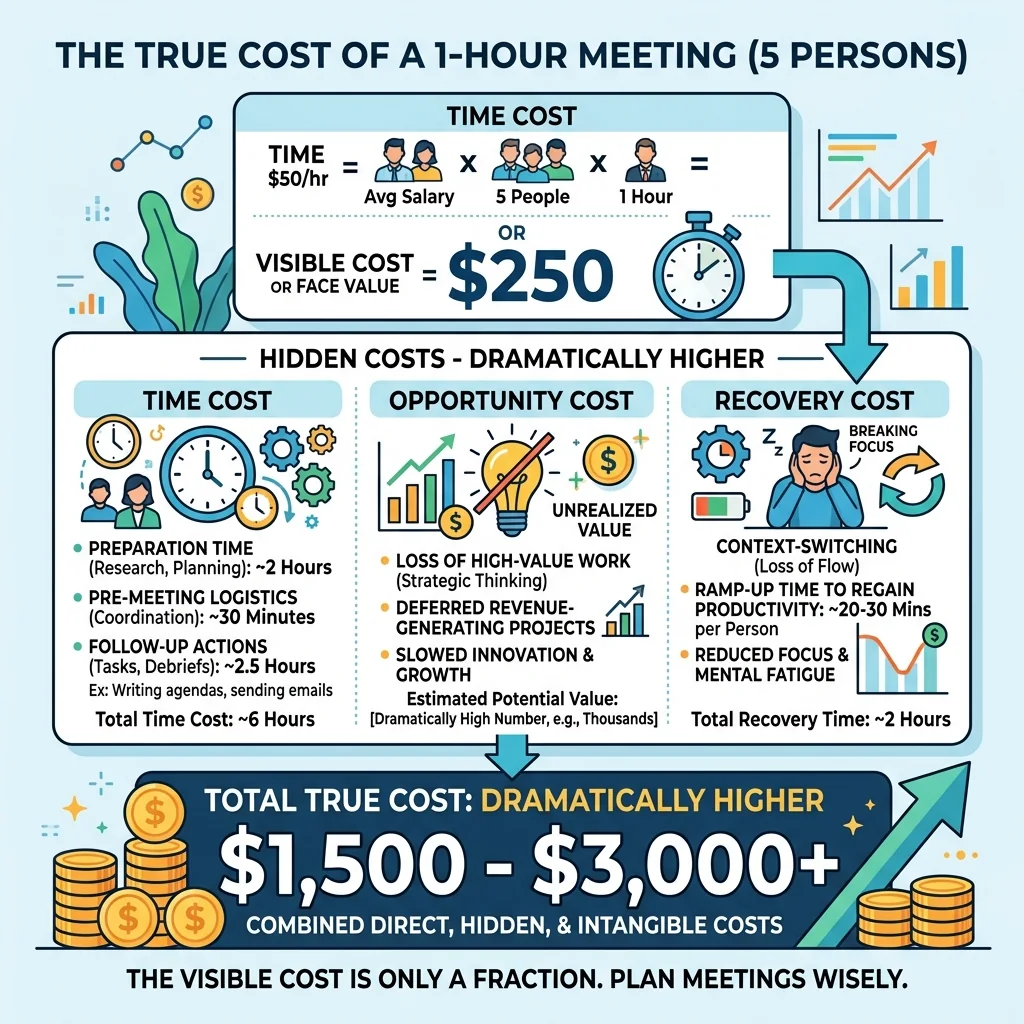
A one-hour meeting with five people doesn't cost one hour. It costs five hours of collective time — plus the context-switching recovery for each participant. Plus the preparation time. Plus the follow-up. For a small agency billing at $100/hour blended, a five-person one-hour meeting costs $500 in billable time — before accounting for the 20-30 minutes of focus recovery each person needs afterward. This isn't an argument against all meetings. It's an argument for treating meeting time as the expensive resource it is, rather than the free default it's treated as in most teams.
03. The Meeting Audit — What to Cut First
Before building a new system, audit your current meetings ruthlessly. For each recurring meeting ask three questions: 1. What decision or outcome did this meeting produce in the last four weeks? 2. Could this have been achieved asynchronously with a written update? 3. If this meeting were cancelled, what would actually break? Most teams find that 40-60% of their recurring meetings produce no unique outcomes that couldn't be achieved through a structured written update or a task system update.
04. The Four Types of Meeting and Which to Keep
Type 1: Decision meetings — Keep, but shorten When a decision requires real-time discussion and multiple stakeholders, a meeting is often the right tool. But most decision meetings are too long because the decision hasn't been properly framed beforehand. Send the proposal, the options, and the recommendation in writing before the meeting — then the meeting confirms or redirects, it doesn't start from scratch. Type 2: Status update meetings — Replace If the primary purpose is 'everyone share what they're working on,' this is a task board update wearing a meeting costume. Replace with a shared project system where status is always visible. Type 3: Problem-solving meetings — Keep, but qualify Complex problems with multiple unknown variables benefit from real-time collaborative thinking. Before scheduling, ask: is this problem genuinely complex enough to require synchronous discussion, or would a well-framed written question get a better answer? Type 4: Relationship meetings — Keep, but schedule intentionally Team cohesion, client relationships, and trust-building benefit from face-to-face (or video) time. These meetings serve a real purpose — but they should be scheduled as relationship investments, not mixed into task-focused contexts where they dilute both. Melororium Task Tracker — replace status update meetings with a live project board where everyone can see what's happening at any time URL: melororium.com
Melororium
The Four Types of Meeting and Which to Keep
Learn more about Melororium
05. Building an Async-First Communication Culture
Async-first doesn't mean no real-time communication — it means that real-time is a deliberate choice for situations that genuinely benefit from it, not the default for everything. The async communication hierarchy: The hierarchy matters because it creates shared expectations. Team members know when to expect a response and what channel to use — which eliminates the anxiety of unanswered messages that drives people back to meetings.
- Task comment or update: for information relevant to a specific piece of work
- Slack or chat message: for questions with a short answer or non-urgent information
- Voice memo or Loom: for complex explanations that would take longer to write than to say
- Video call: for decisions requiring real-time discussion or relationship-building
Flat fee · no seat tax
Ready to get started?
Replace status meetings with Melororium's live project board — everyone sees what's happening, no meeting required. Built-in Slack notifications keep the team aligned without pulling them into another call.
Starter: $29/mo (4 users)
Agency: $59/mo (15 users)
06. The Standing Meeting Structure That Actually Works
Some meetings are genuinely valuable and should be kept. The ones that work in small teams share structural characteristics: The weekly team sync that follows this structure can cover everything meaningful in 20-25 minutes. The one that doesn't follow it expands to fill 90.
- Fixed duration with a hard stop — 15 or 30 minutes, no overrun
- Pre-distributed agenda sent at least an hour before — no agenda, no meeting
- One facilitator who controls timing and progression
- Action items assigned in the meeting, not afterward
- Written summary sent within 30 minutes of completion
07. Decision-Making Without Meetings
Many decisions that get escalated to meetings can be made asynchronously — if the decision framework is clear and the decision-maker is identified. The async decision protocol: 4. The decision-proposer writes up the situation, options, and recommendation 5. A response deadline is set — typically 24-48 hours 6. Stakeholders respond asynchronously with input or approval 7. The decision-maker makes the call and documents the decision This works for 80% of the decisions currently handled in meetings. The remaining 20% — genuinely complex, high-stakes, or emotionally charged — deserve a meeting.
08. Status Updates Without Meetings
The most common meeting replacement is the visible task board. When every project's status is accessible to everyone in real time, the question 'where are we on the X project?' gets answered with a 30-second look at the board rather than a meeting.
09. Client Meetings — How to Run Them Efficiently
Client meetings deserve the same discipline as internal ones. The clients who feel best served aren't the ones who get the most meeting time — they're the ones who get the most focused, well-prepared meeting time with clear outcomes. Client meeting principles:
- Always send an agenda and the relevant project status before the meeting
- Open with the specific decision or outcome the meeting needs to produce
- Manage time explicitly — 'we have 30 minutes, let's make sure we cover X and Y'
- Close with written action items sent within an hour of the call
10. The No-Meeting Day That Changes Everything
One of the highest-leverage changes a small team can make is designating one full day per week as meeting-free. Wednesday is the most common choice — it creates a mid-week deep work island that balances the meeting-heavy Monday and Friday. The no-meeting day works because it creates a guaranteed protected space for the work that requires sustained attention. It also forces the team to develop async communication skills for the days around it.
Boards that run themselves
Kanban with subtasks, priorities and a timer on every card
Demo request from Bloom Cosmetics
Website redesign · due Oct 14