7 Signs Your Team Is Working in Chaos (And How to Fix Each One)
Missed deadlines, duplicated work, and constant firefighting aren't bad luck — they're symptoms of a system that needs fixing. Here are 7 warning signs and what to do about each.

Contents
One flat fee for the whole team
Tasks, timers, CRM and invoices in one workspace. From $29 a month, no seat tax.
Start free demo14 days · no credit card
Sign 1: Nobody Knows What Anyone Else Is Working On
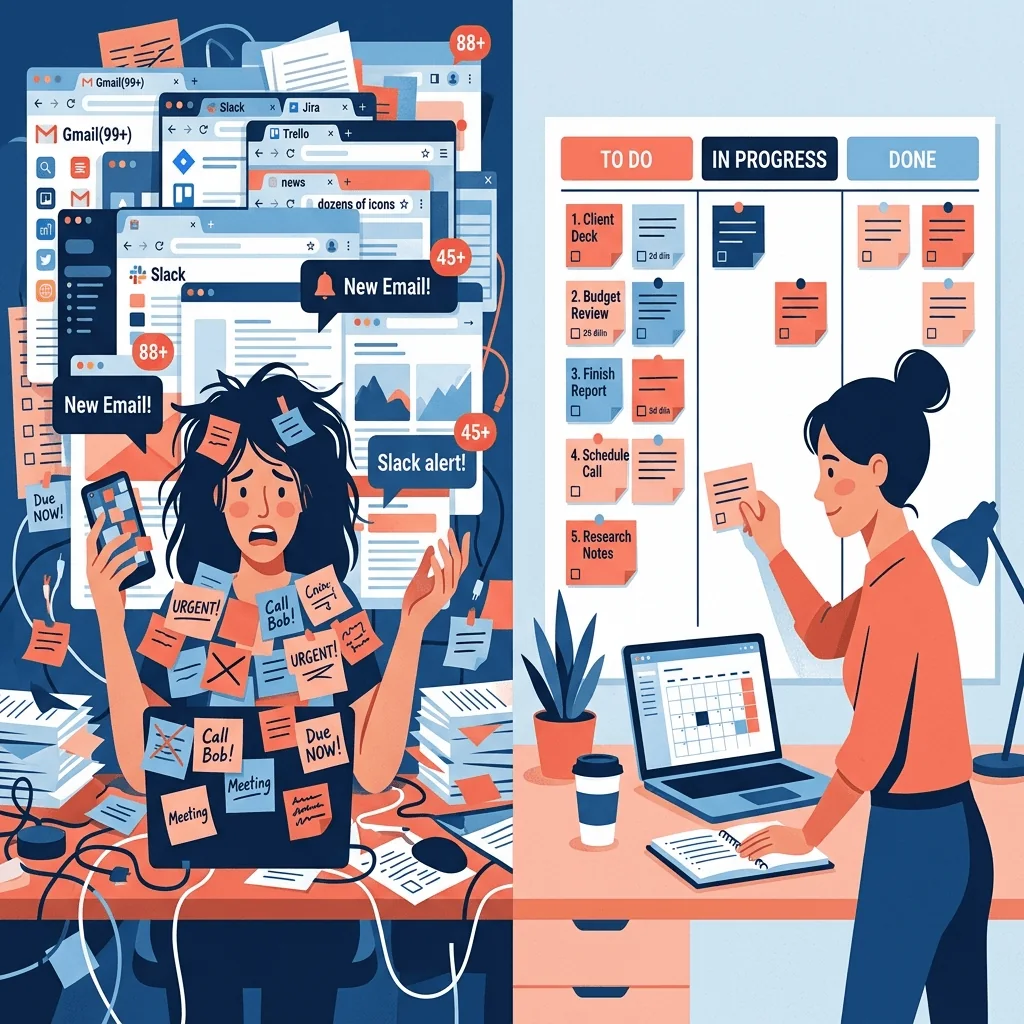
If someone on your team gets sick today, can anyone else pick up their work without a lengthy handover call? If the answer is no — or 'probably not' — your team's knowledge is siloed. The fix: every task in the system, every task visible to the team. Not just the manager's tasks. Everyone's. A shared task board isn't about micromanagement — it's about collective awareness that keeps projects moving even when individuals are unavailable.
"The second time a mistake happens in a team, it's a system failure. The first time you get a pass. After that, you need a checklist."
Sign 2: Tasks Fall Through the Cracks Regularly
If your team regularly says 'I thought someone else was handling that' — you have an ownership problem, not a people problem. Tasks without a single named owner get treated as everyone's responsibility and nobody's priority. The fix: every task has exactly one owner and one deadline. No exceptions. Shared ownership is no ownership.
Melororium
Try it in Melororium
Melororium — assign ownership to every task, set deadlines, and track status across all active projects
Sign 3: Meetings Are the Only Way to Get Status Updates
If your team needs a meeting to find out what's happening on a project, your system is the meeting — and meetings are expensive, slow, and create dependency on everyone being available at the same time. The fix: project status should be visible at any time, to anyone, without a conversation. A well-maintained task board means a 30-second look replaces a 30-minute meeting.
Sign 4: The Same Mistake Keeps Happening
Repeated errors — missed client briefings, incorrect deliverable formats, misunderstood requirements — indicate that your team is relying on memory and verbal instructions instead of documented processes. The fix: the first time something goes wrong, build a checklist or template that prevents it from happening again. Good systems encode institutional knowledge so individuals don't have to carry it in their heads.
Flat fee · no seat tax
Own your team workflow, sustainably.
Melororium brings task management, live timers, and project health dashboards into one workspace — so your team always knows what's happening, who owns what, and whether you're on track.
Starter: $29/mo (4 users)
Agency: $59/mo (15 users)
Studio: $119/mo (Unlimited users)
"The second time a mistake happens in a team, it's a system failure. The first time you get a pass. After that, you need a checklist."
— Operations lead, 10-person creative agency
Sign 5: Clients Ask for Updates Before You've Checked In
When clients are chasing you for status updates, it signals that they don't trust the project is being managed actively. This erodes confidence and creates extra communication overhead at exactly the moments when you're most busy. The fix: proactive client communication. Brief weekly update emails — even just two sentences — sent before the client thinks to ask. It takes two minutes and changes the relationship dynamic completely.
Sign 6: Team Members Are Burning Out Unevenly
In chaotic teams, workload distribution is invisible. Some people are overloaded while others have capacity — but without a shared task system, nobody can see the imbalance until someone burns out or leaves. The fix: workload visibility. When all tasks are in one system with assignees and deadlines, a five-second scan shows who's overloaded and who can take more. Redistribution becomes a management decision, not a guessing game.
Sign 7: You Can't Answer 'Are We Profitable?' Without Spreadsheets
If understanding your project margins requires pulling data from multiple apps, exporting CSVs, and building a spreadsheet from scratch — your tools are working against you. The fix: time tracking connected to tasks, connected to projects. When every hour logged is automatically attributed to the correct project, profitability becomes a dashboard stat — not a monthly archaeology exercise.
Boards that run themselves
Kanban with subtasks, priorities and a timer on every card
Demo request from Bloom Cosmetics
Website redesign · due Oct 14