The SaaS Subscription Calculator: How Much Are Your Tools Really Costing You?
Most freelancers are paying 30-40% more in SaaS subscriptions than they think. Here's the full cost breakdown — and the 5-year number that makes the one-time switch obvious.

Contents
One flat fee for the whole team
Tasks, timers, CRM and invoices in one workspace. From $29 a month, no seat tax.
Start free demo14 days · no credit card
Why Freelancers Consistently Underestimate SaaS Costs
Ask a freelancer how much they spend on software tools each month and they'll give you a number. Then ask them to itemize it and the number grows — typically by 30-40%. The gap isn't dishonesty; it's the fundamental design of subscription pricing. Individual charges are small and forgettable. $12 here. $9 there. The auto-renewal happens on a Tuesday and nobody checks Tuesday's bank statement with particular attention. The annual total only becomes visible when you deliberately sit down to calculate it — which most people do once, feel bad, and then don't do again for two years. This article makes you do that calculation. Deliberately. With category-by-category numbers that reflect what freelancers actually spend in 2026.
"Individual charges are small and forgettable. $12 here. $9 there. The annual total only becomes visible when you deliberately sit down to calculate it — which most people do once, feel bad, and don't do again for two years."
The Average Freelancer's Tool Stack in 2026
Based on what freelancers actually use — not just the tools they mention in surveys, but the tools that show up on their bank statements.
- Project management (ClickUp/Asana/Monday): $84-$228/year
- Note-taking and docs (Notion/Obsidian): $0-$192/year
- Time tracking (Toggl/Harvest/Clockify Pro): $0-$144/year
- Communication (Slack Pro for history): $0-$105/year
- Design tools (Figma if designer): $144/year; Adobe Creative Cloud
- Invoicing/accounting (FreshBooks/Wave): $0-$228/year
- AI assistant (Claude/ChatGPT Plus): $240/year
Category-by-Category Cost Breakdown
Where the real savings opportunities are by category:
- Core productivity stack (tasks + notes + time): typically $300-$564/year — highest room to cut, most one-time alternatives exist
- Design tools: less negotiable — Figma and Adobe are industry standards with no meaningful one-time alternatives. Budget as fixed costs
- Business operations: Wave offers genuinely free invoicing; Calendly's free tier covers most freelancer scheduling needs — easiest to reduce
- AI tools: at $20/month, the fastest-growing line item — hard to cut given productivity gains, but be intentional about which one earns the fee
The 5-Year Number Nobody Calculates
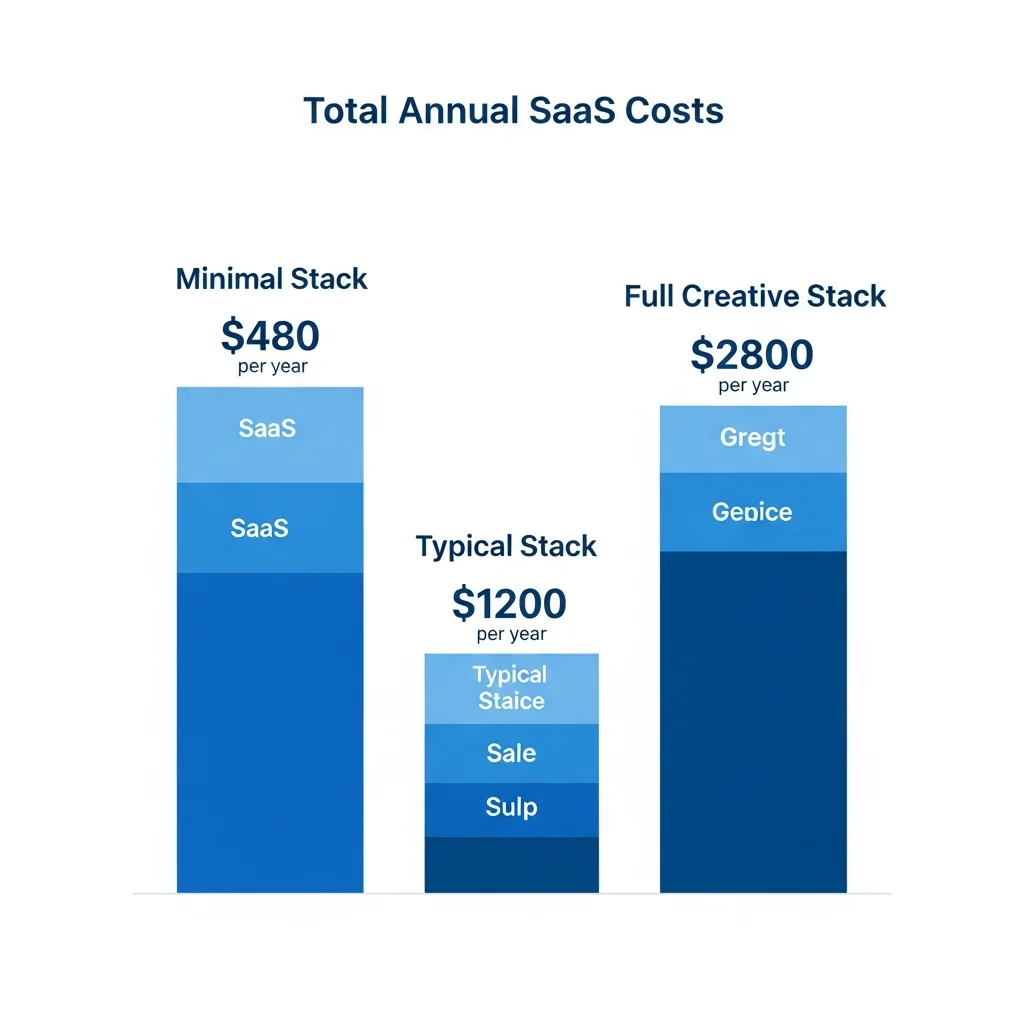
Here's the exercise worth doing even if you do nothing else with this article. Take your current annual SaaS spend — your real number, including all the small ones — and multiply by five. The typical freelancer on a standard productivity stack ($1,200/year) is on track to spend $6,000 over five years on software. Not on equipment. Not on business development. On recurring access to tools they've already learned to use. The specific number for the core productivity stack (tasks + notes + time at $564/year): $2,820 over five years. A one-time tool covering the same three jobs at $149 saves $2,671 over the same period. That's a camera, a laptop upgrade, a significant course, or three months of reduced client pressure.
Stack Comparison: $564/Year vs $149 Once
Here's the exact math on the most common freelancer productivity stack versus a one-time alternative covering the same three jobs:
| Tool | Job | Annual Cost (subscription) | One-Time Alternative |
|---|---|---|---|
| ClickUp Business | Project management | $228/yr | |
| Notion Plus | Notes + docs | $96/yr | |
| Harvest | Time tracking + invoicing | $144/yr | |
| **Total (solo)** | 3 tools, 3 subscriptions | **$468/yr** | **$29/mo** (Melororium Starter) |
| ClickUp Business × 10 | Project management | $1,440/yr | |
| Notion Plus × 10 | Notes + docs | $960/yr | |
| Harvest × 10 | Time tracking | $1,440/yr | |
| **Total (10-user team)** | 3 tools, 3 subscriptions | **$3,840/yr** | **$59/mo flat** (Melororium Agency) |
Flat fee · no seat tax
Did the 5-year calculation feel uncomfortable?
Melororium replaces your core productivity stack from $29/mo. The math is straightforward from there.
Starter: $29/mo (4 users)
Agency: $59/mo (15 users)
Studio: $119/mo (Unlimited users)
Calculate Your Actual Cost
Enter your team size and your current per-seat tool to see the real 1–5 year cost vs a one-time alternative.
Interactive calculator
How much is your SaaS stack really costing?
Your main tool
Team size
5 peopleTime period
That's a 3561× return on your flat-fee subscription
How to Actually Audit Your Subscriptions
Four steps that make the audit actually happen:
- Step 1: Export the last three months of bank/card statements. Look for Stripe charges, PayPal, and company names you don't immediately recognise — unfamiliar names are often subscriptions you forgot about
- Step 2: Categorize by job, not by tool name. Group by function
- Step 3: Apply the 80/20 test. For each tool
- Step 4: Calculate the break-even on one-time alternatives. Divide the one-time price by your current monthly spend on that tool. Below 12 months
What the Switch to One-Time Tools Saves Over Time
For the core productivity stack specifically — the tasks, notes, and time tracking that most freelancers pay $300-$564/year for — a one-time switch pays back within the first year and compounds every year after. The freelancer who switches their core stack to a one-time tool at $149 and then directs the $47/month savings into a business fund accumulates $2,600+ over five years. This isn't financial advice — it's arithmetic.
July 2026: Usage-Based AI Billing Is Even Worse Than Per-Seat
Per-seat billing is predictable — at least you know what you'll pay each month. The new problem in 2026 is worse: usage-based AI billing that changes every month based on how much you actually used the tool. Moonshot paused subscriptions in July 2026 because demand exceeded their capacity — users locked out mid-project with no warning. Claude Code users on Hacker News reported cancelling after hitting unexpected usage limits during client work. Five AI subscriptions compared side-by-side on HN surfaced the same complaint: the features advertised at each tier are not actually available at the tier you pay for, and hitting the limit means either paying more or stopping work. This is a category of billing risk that did not exist 18 months ago. Usage-based AI tools create a new kind of subscription fatigue: not just the cost, but the unpredictability. Your August bill depends on how busy your team was in August. You cannot budget it. You find out at the end of the month. For agencies, this creates a specific problem: client projects spike. A deadline week means 3x normal tool usage. With usage-based billing, that deadline week also means a surprise invoice — precisely when you are most stressed and least able to deal with it. Flat-fee pricing eliminates this category of risk entirely. One number. Every month. Your busiest deadline week costs the same as your quietest week.
- Moonshot paused subscriptions July 2026 — demand exceeded AI capacity, users locked out mid-project
- Claude Code usage limits hitting teams mid-month — cancellations trending on HN
- AI subscription features unavailable at the tier advertised — only accessible at higher usage levels
- Usage-based billing means your bill spikes exactly when your team is busiest (deadline weeks)
- Melororium: Starter $29/mo (4 users), Agency $59/mo (15 users), Studio $119/mo (25 users) — same price every month, no usage surcharges
Boards that run themselves
Kanban with subtasks, priorities and a timer on every card
Demo request from Bloom Cosmetics
Website redesign · due Oct 14