What is Capacity Planning?
Capacity Planning
Capacity planning means checking whether your team has enough available time before committing to a new deadline or project.
Capacity planning is the process of determining how much work your team can take on in a given period, and matching that against what's planned. It answers the question "do we have enough people with the right skills at the right time to deliver what we've committed to?"
Without capacity planning, teams overcommit. A project manager says yes to a new client engagement based on gut feel, not data. The team is already at 90% capacity with existing projects. The new project starts late, existing projects slip, and people work overtime trying to cover the gap.
For an agency of 8–15 people managing 5–8 simultaneous client projects, capacity planning is one of the highest-leverage management activities. Getting it right means hitting deadlines. Getting it wrong means chronic firefighting.
How to Calculate Team Capacity
Capacity calculation starts with gross available hours, then subtracts non-project time:
- Gross capacity: team size × working hours per week (e.g., 8 people × 40 hours = 320 hours/week)
- Subtract meetings and admin: typically 20–25% (320 × 0.75 = 240 hours available for project work)
- Subtract leave and holidays: account for planned time off per person per period
- Subtract ramp-up time for new projects: first week on a new project is rarely full productivity
- Net capacity: the realistic hours available for committed project work
Matching Capacity to Demand
Once you know capacity, compare it to the planned work (demand). If demand exceeds capacity, you have three options:
Reduce demand: push a project start date, reduce scope, or decline new work.
Increase capacity: bring in contractors, redistribute work from overloaded to underloaded team members, or authorize overtime (short-term only).
Renegotiate timelines: extend deadlines on lower-priority projects to create room for higher-priority ones.
Capacity planning works best as a rolling process, reviewed weekly as new projects are added and existing timelines shift. A weekly 15-minute capacity check is worth more than a monthly deep-dive that's already stale by week two.
| Scenario | Demand vs Capacity | Action |
|---|---|---|
| Overcommitted | >90% | Delay starts, reduce scope, or add resources |
| Healthy | 70–85% | Accept new work, maintain buffer |
| Underutilized | <60% | Proactive new business, internal projects, training |
| Critical | >100% | Immediate rebalancing, escalate if needed |
Tools for Capacity Planning
Effective capacity planning requires two data sources: planned work (what projects are coming and how many hours they need) and actual utilization (how much time the team is currently spending per project).
Time tracking provides the actual utilization data. Without it, capacity planning is guesswork: you can plan 200 hours of project work but if you're not tracking, you won't know if 200 hours or 280 hours were spent.
Work reports that show hours per person per week, per project, make it possible to compare planned vs actual and catch overloads before they become crises.
Weekly Capacity Review Process
Capacity planning only works if you do it consistently. A monthly review is too infrequent: by the time you spot an overcommitment, it's already a crisis. A weekly 15-minute review is the right cadence for most teams running 3-8 simultaneous projects.
The review has three steps. First, pull available hours for the coming two weeks: account for any planned time off, public holidays, or known non-project days.
Second, sum up all committed project work for those two weeks. Use task estimates from your project board, not gut feel. If you don't have estimates, the review won't work.
Third, compare the two numbers. If committed work exceeds 85% of available hours, you have a problem to resolve before the week starts, not after people start missing deadlines. Resolution options: push a lower-priority project's tasks to the following week, reassign tasks from overloaded to underloaded team members, or have a conversation with a client about timeline adjustment.
- Pull gross available hours for the coming two weeks per team member
- Sum all committed project hours from task estimates on the board
- Flag anyone over 85% capacity and resolve before the week starts
- Document every rebalancing decision made during the review
- Run the review at the same time each week: Friday morning works well for many teams
Capacity Planning for a Growing Team
Adding a team member changes your capacity math in ways that aren't immediately obvious. The raw numbers look good: 8 people becomes 9, that's a 12.5% capacity increase. But a new hire at a 10-person agency typically delivers at 40-60% productivity for the first 4-6 weeks. Onboarding takes time. Pairing them with a senior team member pulls that person's capacity down too.
This means the first month after hiring, your effective capacity might actually decrease slightly before it increases. Don't commit new projects expecting immediate full capacity from a new hire.
Capacity planning also changes when the team grows past 10 people. Below 10, one person can usually hold team capacity in their head. Above 10, you need a system: a spreadsheet, a resource management module, or work reports showing hours per person per week.
- New hires typically deliver 40-60% productivity in weeks 1-4
- Senior pairing for onboarding reduces that person's capacity temporarily
- Expect a 2-4 week capacity dip before a new hire adds net capacity
- Teams above 10 people need a system, not memory, to track capacity
- Build capacity tracking habits early: retrofitting them at 15+ people is painful
Capacity Planning Mistakes
Most capacity planning failures come from the same set of mistakes.
Using gross hours, not net hours. A team member working 40 hours per week is not available for 40 hours of project work. Subtract meetings, internal admin, email, and non-project obligations. Realistic project capacity is 28-32 hours, not 40.
Ignoring the planning fallacy. People consistently underestimate how long tasks take. Buffer your estimates by 20-30% on tasks with high uncertainty.
Not accounting for context switching. A team member assigned to five projects simultaneously is not working at full speed on any of them. Context switching can consume 20-40% of productive time.
Treating the plan as a contract. Capacity plans are forecasts, not commitments. New client requests, tasks taking longer than estimated, unexpected absences: all of these change the capacity picture. Update the plan weekly.
Not involving the team. Capacity planning done only by managers misses what team members know about their own workloads.
- Using gross hours (40/week) instead of net project hours (28-32/week)
- No buffer for estimation errors: add 20-30% to uncertain task estimates
- Ignoring context switching costs when someone is on 4+ projects
- Treating the plan as fixed rather than updating it weekly
- Planning without input from the team members doing the work
In Melororium
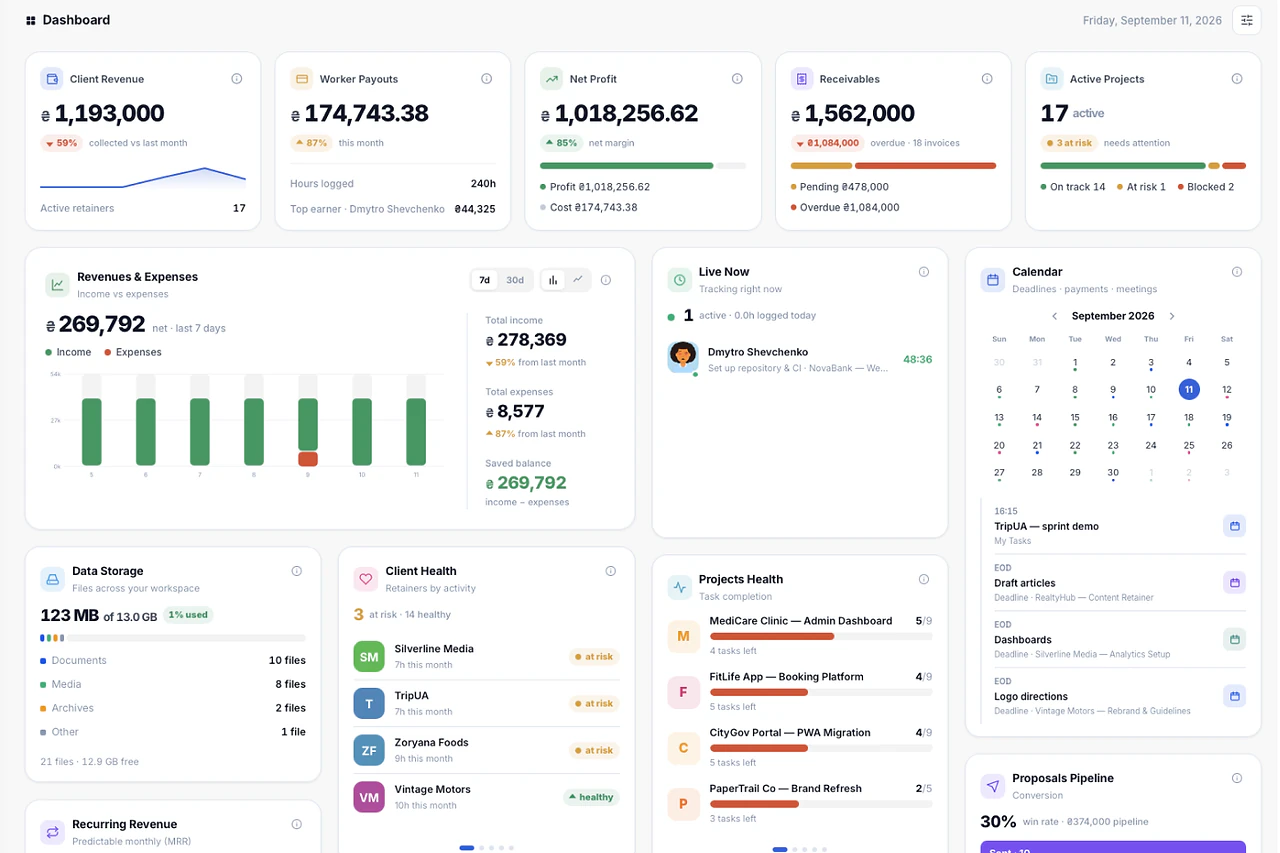
Monitor team capacity in Melororium
Common mistakes with capacity planning
What teams get wrong most often, and what to do instead.
- 1
Planning against job titles, not real availability
Assuming a developer has 40 hours free because that's their contract. Existing commitments, meetings, and time off all eat into that number before new work starts.
- 2
No visibility across simultaneous projects
Approving a new project without checking what else that person is already committed to this month. Overcommitment usually happens one "yes" at a time.
- 3
Treating 100% as available
Planning as if every hour is billable capacity. Real teams need slack for admin, learning, and the inevitable urgent fire.
- 4
Reacting after someone's already overloaded
Noticing the overload from a missed deadline instead of catching it two weeks earlier, when the commitment was made.
Frequently asked questions
What's the difference between capacity planning and resource management?
Resource management is the broader practice of planning, allocating, and tracking team resources. Capacity planning is specifically about determining available hours and matching them to planned work. Capacity planning is a component of resource management.
How far ahead should you capacity plan?
4–6 weeks is the practical planning horizon for most teams. Beyond 6 weeks, too many variables change. Less than 2 weeks and you can't respond to overcommitment before it's already a problem.
Does Melororium support capacity planning?
Melororium's Work Reports show hours per team member per week and per project, which provides the utilization data you need for capacity planning. Live Timers show current work in real time. Combined, these give you the visibility to spot capacity issues before they become crises.