What is Resource Management?
Resource Management
Resource management means matching your team's real capacity, who has time and the right skills, to the work that's coming, before you commit to a deadline.
Resource management is the process of planning, allocating, and tracking the people, time, and capabilities needed to deliver projects. In a team context, "resources" usually means people: who has capacity, which skills are needed, and how to match them to the work.
For a 10-person team running 5 simultaneous client projects, resource management is the difference between a functioning operation and constant firefighting. Without it, work gets assigned to whoever seems available, people quietly become overloaded, and projects start missing deadlines because the bottleneck wasn't visible until too late.
Resource management doesn't require complex software. At its core, it's answering two questions continuously: what work is coming, and does the team have capacity to do it?
The Four Components of Resource Management
Effective resource management covers four areas:
- Resource planning: identifying what skills and capacity each project needs before it starts
- Resource allocation: assigning specific people to specific tasks based on skills, availability, and workload
- Resource scheduling: mapping work across time, ensuring no one is overbooked and no project is understaffed
- Resource monitoring: tracking actual hours vs planned to spot overloads and underutilization early
Capacity Planning: The Core of Resource Management
Capacity is the maximum work a team can output in a period. For a 5-person team working 40 hours per week, gross capacity is 200 hours per week. But not all hours are billable or project-facing: meetings, admin, business development, and overhead typically consume 20–30% of capacity.
Available capacity for project work is usually 70–80% of gross capacity. For that same 5-person team: 140–160 hours per week.
When projects are planned without considering capacity, teams become overcommitted. The work gets done, but through overtime, rushed deliverables, or by dropping lower-priority tasks. Time tracking makes capacity visible: you can see exactly how hours are being spent and where the gaps are.
| Team size | Gross capacity/week | Available for projects (~75%) | Safe to commit |
|---|---|---|---|
| 4 people | 160 hours | 120 hours | 100–110 hours |
| 8 people | 320 hours | 240 hours | 200–220 hours |
| 12 people | 480 hours | 360 hours | 300–330 hours |
| 20 people | 800 hours | 600 hours | 500–550 hours |
How to Track Resource Utilization
Utilization rate is the core metric: what percentage of available capacity is spent on billable or project work? A healthy utilization rate for creative and professional service teams is 70–80%. Above 85% consistently and the team is burning out. Below 60% and you're paying for capacity you're not using.
Calculation: (billable hours ÷ available hours) × 100. If a designer works 40 hours in a week and 30 are billable, utilization is 75%.
Weekly work reports that show hours per person per project make this visible without anyone needing to do manual math. When utilization spikes above 85% for two consecutive weeks, that's a signal to either shift work, extend timelines, or bring in support.
Resource Management for a 10-Person Agency: Weekly Process
A 10-person agency has enough complexity to need a real resource management process, but not enough overhead budget for dedicated operations staff. The process needs to fit inside one hour per week.
Monday morning: Check capacity for the week. For each team member, confirm allocated hours versus available hours. Flag anyone over 80% capacity. The flag doesn't need to be a formal report: a quick scan of the week's task assignments is enough.
Monday review: Identify gaps. If a project needs 20 hours of design this week but the designer has 12 available, you either delay the project or find an alternative. Make that call Monday morning, not Thursday afternoon.
Wednesday check-in: Are projects running on schedule? A task that should have been done by Tuesday and is still in progress will hit someone else's capacity downstream.
Friday update: Log actual hours. Compare planned versus actual. If a task took 8 hours instead of 4, update your estimates for similar tasks in future projects.
- 80% capacity is the target ceiling, not 100%: the 20% gap absorbs unexpected tasks
- Monday morning decisions are cheap. Thursday afternoon decisions are expensive
- Planned vs. actual hour comparison is your single best input for improving project estimates
- The weekly process works only if capacity data is current: stale data produces stale decisions
Skills Matrix: Knowing What Your Team Can Do
A skills matrix maps each team member's capabilities against the skills your work requires. For a 10-person agency, this is the difference between knowing you have '3 designers' and knowing which one handles motion graphics, which does UX research, and which is strongest in brand identity.
How to build one: List the 15-20 skills that appear most often in your project work. Rate each team member on each skill using a 1-4 scale: 1 (no experience), 2 (some experience), 3 (competent independently), 4 (can teach others).
What you use it for: staffing decisions, hiring gap identification, development planning, and risk assessment. If your only level-4 person in a critical skill leaves, you know before it happens.
Update the matrix once per quarter or after any team change. A skills matrix that's 6 months out of date is worse than no matrix.
| Team Member | Brand Design | Motion Graphics | UX Research | Frontend |
|---|---|---|---|---|
| Alex | 4 | 2 | 3 | 1 |
| Jordan | 3 | 4 | 2 | 1 |
| Sam | 2 | 1 | 4 | 3 |
| Riley | 3 | 3 | 2 | 4 |
Resource Management When Someone Leaves
Team departure is the resource management scenario most agencies handle badly, because they wait until it happens to think about it.
When notice comes in, the first question is not 'who do we hire' but 'what does this person actually own.' Map every active project, recurring task, client relationship, and piece of institutional knowledge they hold.
Week 1 after notice: Document. Have the departing person write down their processes, logins, client context, and status on every active deliverable. Don't wait for the final week.
Redistribute active projects immediately. Don't leave work in limbo. Transfer ownership now and use the notice period for handoff and questions.
Client notification: For client-facing roles, contact clients early. A proactive introduction of the new point of contact is far better than a client discovering the change on their own.
Post-departure: Run a retrospective 30 days after someone leaves. What processes broke? What knowledge was lost? Every departure is a signal about what you haven't systematized yet.
- Documentation request goes to the departing person in week 1, not week 4
- Transfer project ownership immediately: the notice period is for questions, not ongoing ownership
- Start hiring on day one of notice, not after the person is gone
- 30-day post-departure retrospective: what broke reveals what isn't documented
In Melororium
See team utilization in Melororium Work Reports
Common mistakes with resource management
What teams get wrong most often, and what to do instead.
- 1
Assigning by availability, not skill
Giving a task to whoever's free instead of whoever's right for it. It fills the calendar but often costs more time in rework than it saves.
- 2
No visibility across projects
Tracking each project's workload separately, so nobody sees that one person is double-booked across three of them at once.
- 3
Planning at 100% capacity
Scheduling every hour of every week with billable or planned work. Zero slack means one sick day or one urgent request breaks the whole plan.
- 4
Reacting instead of forecasting
Noticing someone's overloaded only after they say so. Capacity planning should catch the conflict two weeks before it happens, not the day it happens.
Frequently asked questions
What's the ideal utilization rate for a project team?
70–80% is the sustainable sweet spot for professional service teams. Below 65% is underutilization: the team isn't generating enough output relative to payroll. Above 85% consistently leads to burnout, declining quality, and team turnover.
How do you handle resource conflicts between projects?
Prioritize projects by business value and deadline, then allocate the constrained resource to the highest-priority work. Communicate the impact to affected projects' stakeholders early. Long-term: build cross-functional skills so more people can cover each other.
Does Melororium support resource management?
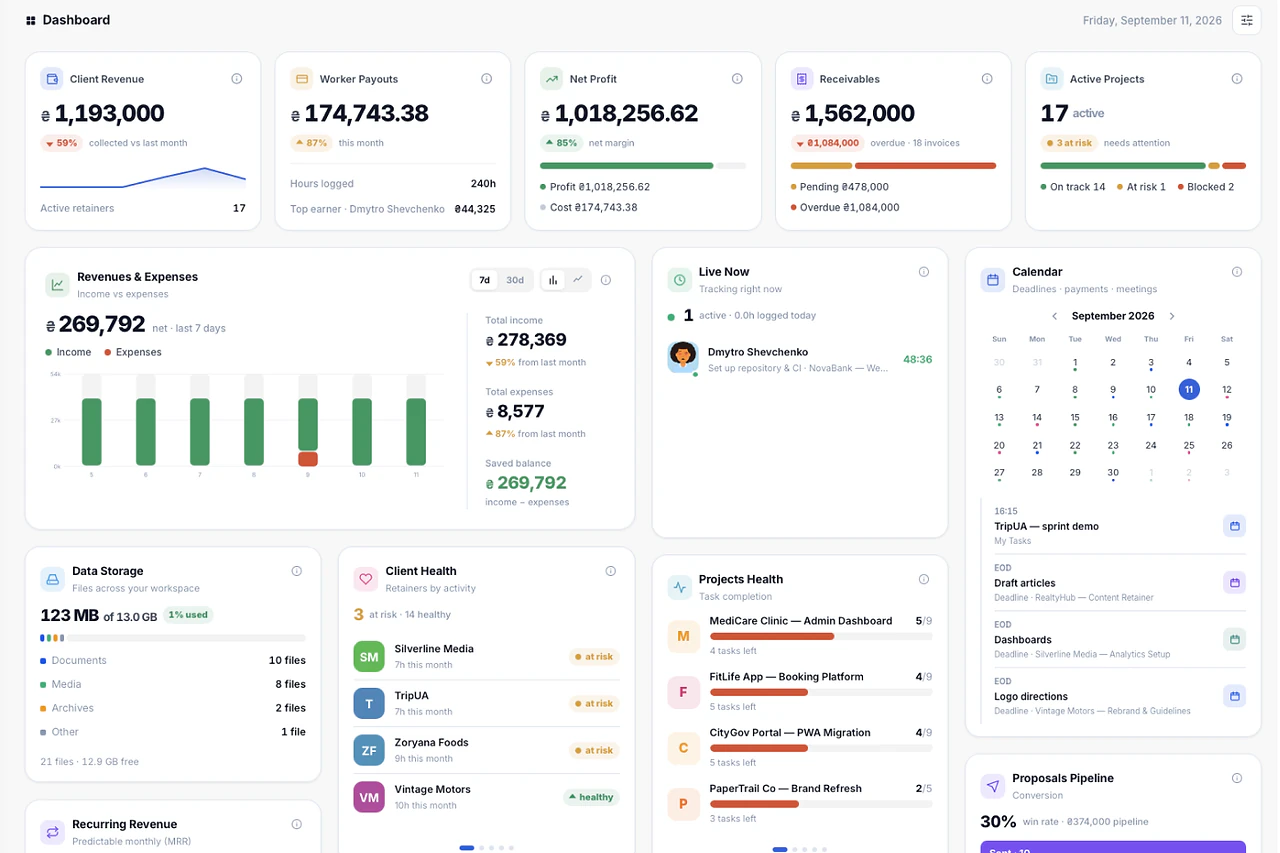
Yes. Melororium's Work Reports show hours per team member per project in real time. Live Timers let managers see who's working on what right now. Combined, they give you the visibility needed to spot overloads and rebalance workload before it becomes a problem.