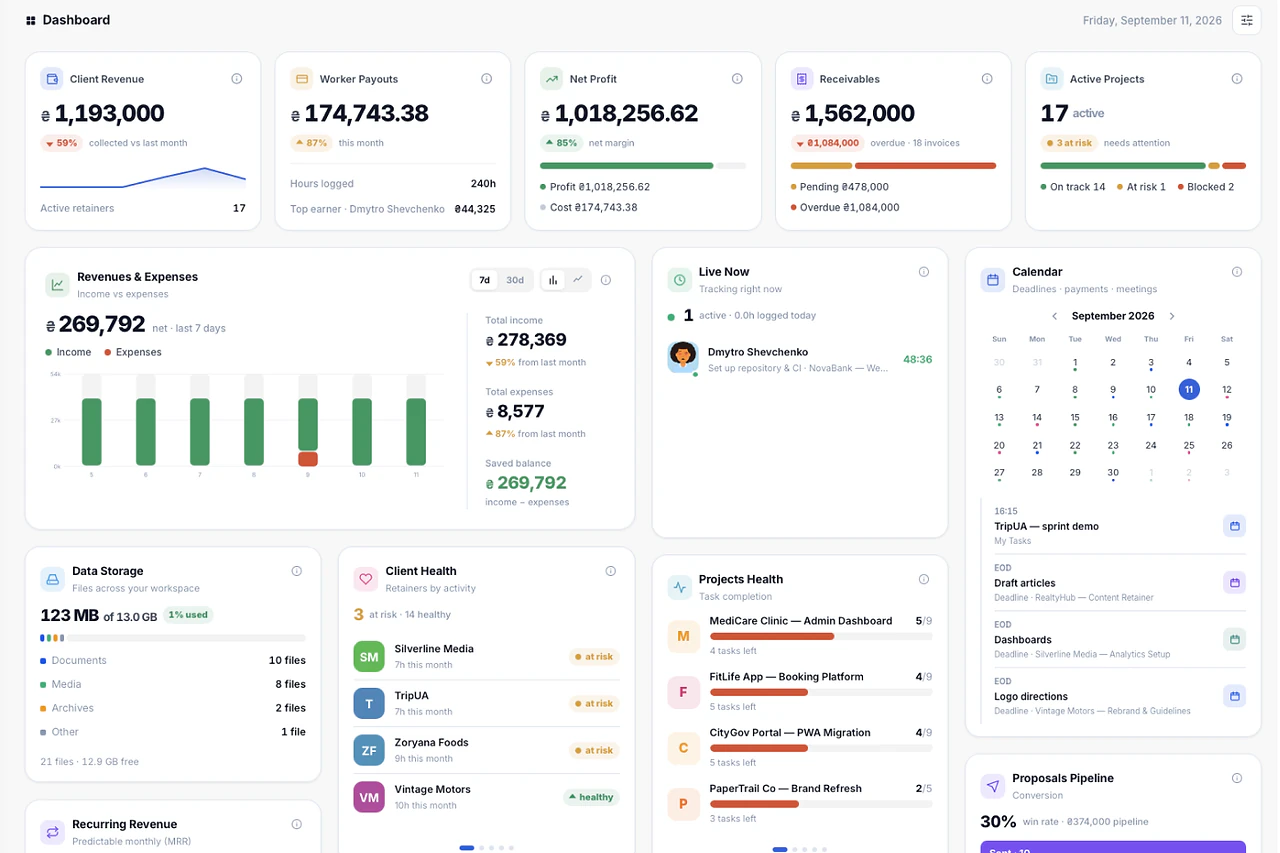
Team Productivity Tracking: Definition & Key Metrics
Team Productivity Tracking
Productivity tracking measures how a team converts time into real deliverables, not how many hours were logged.
Productivity tracking is the process of measuring how effectively team members convert working time into completed work. The goal is not to surveil employees but to identify patterns: who's overloaded, where work is bottlenecked, and whether the team's output matches capacity.
The right productivity data for a 10-person agency looks different from the right data for a 500-person enterprise. For small teams, the most useful signals are simple: tasks completed per week per person, billable hours logged versus hours worked, and time allocated to each project versus actual time spent.
Team Productivity Tracking: Quick Definition
Team productivity tracking measures how effectively team members convert working time into completed deliverables. It combines task output data (what got done) with time data (how long it took) to show whether the team is producing at capacity, and where bottlenecks or overload are building.
- Output metrics: tasks completed per week, deliverables shipped, milestones hit
- Time metrics: hours logged per project, billable vs. non-billable split, hours per task
- Combined view: maps output to time, shows efficiency, not just activity
- Team-level signal: who's underloaded, who's at risk of burnout, where work is stuck
Output-Based vs. Time-Based Productivity Tracking
Two fundamentally different approaches exist, and most teams need both.
- Output-based: counts completed tasks, delivered milestones, or shipped features. Answers: is the team producing enough? Is output distributed fairly?
- Time-based: tracks hours worked per task, project, or client. Answers: is the team billing correctly? Which projects consume more time than estimated?
- Combined view: maps output to time. A designer completing 15 tasks/week at 2.1 hours per task is more efficient than one completing 12 tasks/week at 3.4 hours per task.
Productivity Metrics That Actually Help
Most productivity tracking tools generate more metrics than any manager will review. Focus on four.
| Metric | What It Measures | When It's Useful |
|---|---|---|
| Tasks completed per week | Individual output volume | Spotting underload or overload across the team |
| Hours per task | Efficiency and estimation accuracy | Improving future project estimates |
| Billable vs. total hours | Client billing accuracy | Profitability analysis per project |
| Work session timeline | When and how long team members work | Identifying overtime patterns before burnout |
Productivity Tracking in Melororium
Each employee's profile in Melororium includes a Productivity tab showing their work session timeline, a visual axis from 09:00 to 19:00 showing active work segments, breaks, and overtime periods. Managers can filter by day, week, or custom period to spot sustained overtime before it becomes a burnout risk.
Work Reports show hours per person per project, with a billable/non-billable breakdown. The global Kanban board shows active tasks across the team at a glance. No separate monitoring software needed.
Why Most Productivity Tracking Setups Fail
Three mistakes account for the majority of failed tracking implementations.
**Tracking activity instead of output.** Screenshot tools and keystroke loggers measure presence, not progress. A designer who spends 45 minutes on a single vector path is producing real work. A team member refreshing email every 4 minutes produces the appearance of activity. Output data (tasks completed, deliverables shipped, hours logged against specific work) tells you more in a weekly summary than a week of activity screenshots.
**Reviewing data too frequently.** Daily productivity reviews create anxiety without useful patterns. Weekly or bi-weekly reviews give enough data to distinguish a slow day from a structural problem. Daily check-ins belong in standups, not dashboards.
**Tracking too many metrics simultaneously.** A manager who watches 12 productivity metrics watches none of them well. Start with two: tasks completed per week per person, and billable hours logged as a percentage of hours worked. Add a third metric only after the first two become routine.
- Activity tracking (keystrokes, screenshots) measures presence, not progress
- Daily reviews generate anxiety; weekly data shows patterns
- More than 3 metrics at once dilutes attention rather than improving it
- Tracking without a feedback loop is surveillance, not management
Productivity Tracking for Remote and Hybrid Teams
Remote teams lose the passive visibility managers get from an office environment. No one sees who is at their desk, when they start, or when they log off. Productivity tracking becomes more necessary and more sensitive simultaneously.
The approach that works: shared output visibility, not surveillance. A team that updates task status in a shared Kanban board gives every member visibility into who is working on what. A work session timeline that the employee can see (not just the manager) builds self-awareness rather than resentment.
For hybrid teams, the main risk is proximity bias: managers unconsciously rate in-office team members as more productive because they see them working. Output data corrects this. A remote developer completing 14 tasks per week is more productive than an in-office developer completing 9, regardless of office hours logged.
- Shared Kanban boards give visibility without requiring separate tracking software
- Session timelines visible to the employee first reduce surveillance feeling
- Weekly output reports for hybrid teams prevent proximity bias in performance reviews
- Billable hours data is neutral: it reflects work done, not where it was done
How to Set Up Productivity Tracking for Your Team
Three steps that take under an hour to implement for a team of 4-15 people.
**Step 1: Define two output metrics.** Choose the metrics that map to your team's actual work. For agencies: tasks completed per week per person, and billable hours as a percentage of total hours. For product teams: features shipped per sprint, and bug resolution time. Write down what each metric measures and why it matters. Skip this step and the data will be ignored.
**Step 2: Assign a tool that captures data automatically.** Manual timesheets are never complete. Choose a task management tool with native time tracking so hours are logged at the point of work, not reconstructed at end of day. Melororium logs time inside task cards with a one-click timer. Toggl and Clockify work if your task manager doesn't support native timers.
**Step 3: Set a review cadence.** Pick one day per week to review the previous week's data. Block 20 minutes. Compare output across the team. Look for sustained low output (under 70% of expected) or sustained high hours (over 45 per week) as signals that need discussion. Bring data to 1:1s as a coaching tool, not as evidence against someone.
In Melororium
Productivity tracking in Melororium
Common mistakes with team productivity tracking
What teams get wrong most often, and what to do instead.
- 1
Tracking hours as a proxy for output
Measuring who logged the most hours instead of who delivered the most.
- 2
Using it to rank individuals publicly
Turning productivity data into a leaderboard shared with the whole team. That pressure pushes people to game the numbers.
- 3
Ignoring quality entirely
Tracking output volume with no measure of rework or errors.
- 4
No context for dips
Flagging a slow week without asking why. A dip during a complex task looks the same as disengagement in the data, but needs a different response.
Frequently asked questions
What is productivity tracking?
Productivity tracking measures how effectively team members convert working time into completed work, through task completion data, time logs, and work session analysis.
How do you track team productivity without micromanaging?
Focus on output metrics (tasks completed, deliverables shipped) rather than activity monitoring (keystrokes, screenshots). Review trends weekly rather than daily, and discuss data in 1:1s as a coaching tool rather than surveillance.
What's the most useful productivity metric for agencies?
Billable hours versus total hours worked is the most financially meaningful metric for agencies. It shows what percentage of team time is actually chargeable, which directly determines project profitability.
Does tracking productivity hurt team morale?
It depends on how data is used. Teams that use session data to catch overwork early and redistribute capacity tend to report higher satisfaction. Teams that use tracking as a surveillance tool see morale decline. The difference is whether insights go to the person or to their manager first.
What is the difference between productivity tracking and time tracking?
Time tracking records how many hours someone works. Productivity tracking uses time data plus output data (tasks completed, deliverables shipped) to measure how effectively those hours were used. Time tracking is an input; productivity tracking connects that input to outcomes.
What software do teams use for productivity tracking?
Common options: Melororium (tasks + session timelines + work reports in one tool), Toggl Track (time tracking only, integrates with project managers), ClickUp (tasks + basic time tracking), Harvest (time tracking + invoicing). The best choice depends on whether you need time data alone or output data combined with time.
How often should managers review productivity data?
Weekly is the right cadence for most teams. Daily reviews produce anxiety and surface noise rather than patterns. Monthly reviews catch problems too late to act on them. A 20-minute weekly review comparing output across the team is enough to spot issues before they compound.