What is Workload Management?
Workload Management
Workload management is distributing work across the team so deadlines get hit without quietly overloading any one person.
Workload management is the process of distributing work across a team to meet project deadlines without overloading individual team members. It requires visibility into two things simultaneously: how much work exists (demand) and how much capacity the team has to absorb it (supply).
Poor workload management has two failure modes. Underloading wastes capacity and reduces team engagement. Overloading leads to burnout, quality deterioration, and attrition, each of which has a higher long-term cost than a missed deadline.
Capacity vs. Workload: The Core Distinction
Capacity is the maximum amount of work a team member can reasonably handle in a given period. Workload is the amount of work currently assigned to them. Workload management keeps workload at or below capacity, while ensuring total team output meets project commitments.
For a 10-person team with 8 delivery hours per person per day, total daily capacity is 80 hours. If active projects require 96 hours of daily output, the team is at 120% capacity, and something will slip, degrade in quality, or cause overtime.
- Demand > Capacity: overtime, quality issues, missed deadlines, burnout risk
- Demand ≈ Capacity: sustainable pace, predictable delivery
- Demand < Capacity: underutilization, engagement risk, potential for taking on more work
Early Warning Signs of Overload
Burnout does not appear suddenly. It develops over weeks of subtle signals that most managers miss until the team member is already in crisis.
- Work sessions extending regularly beyond contracted hours
- Declining sentiment scores over 2-3 consecutive weeks
- Increasing task cycle times (work that used to take 3 days now takes 5)
- Reduction in proactive communication: fewer questions, fewer updates
- Quality issues or increased revision requests on previously strong work
Workload Management in Melororium
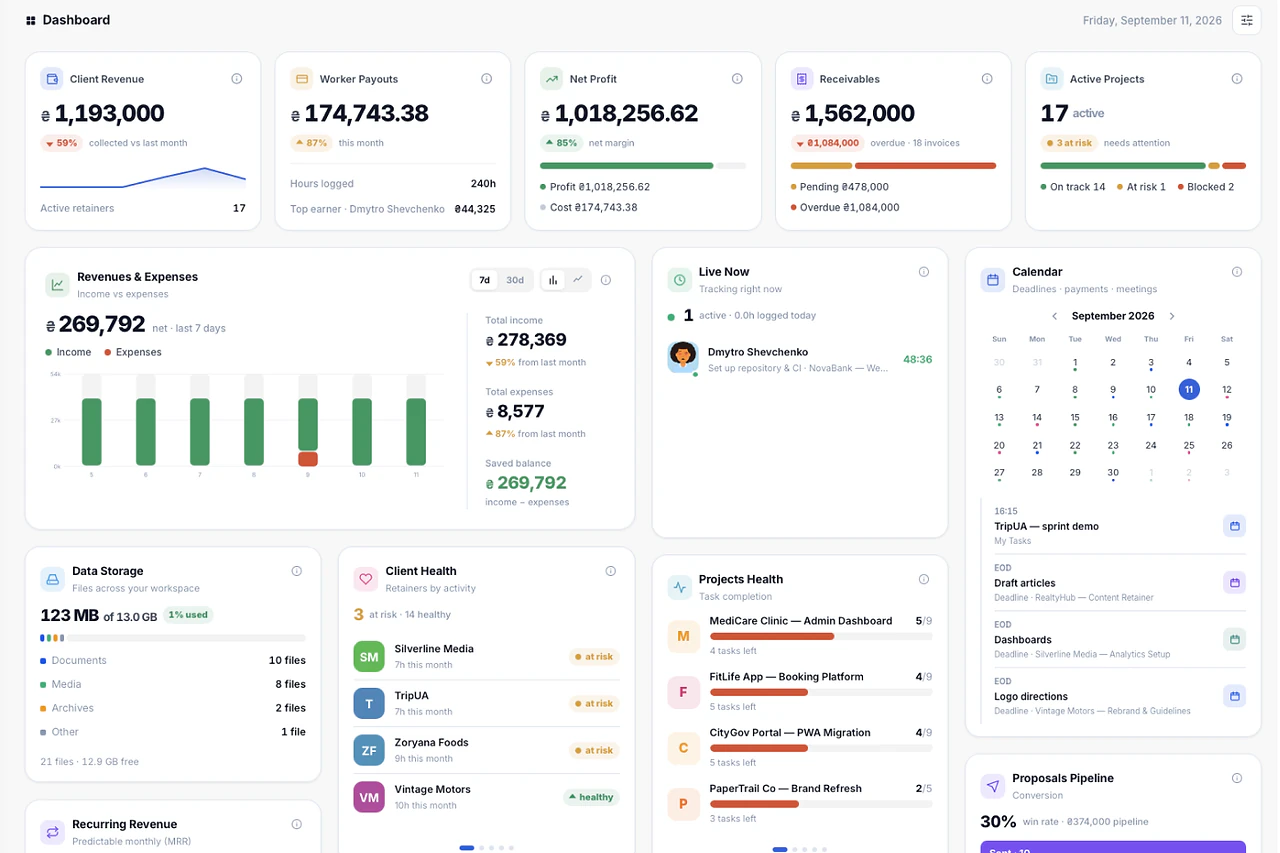
Melororium's global Kanban board shows all active tasks across the team with assignees visible. The Work Reports module shows hours per person per week, making it immediately visible when one designer is logging 55 hours while another logs 32. The Productivity tab on each employee profile shows work session timelines, surfacing overtime patterns. Sentiment check-ins from the Sentiment module add the subjective signal alongside the objective data.
In Melororium
Workload management in Melororium
Common mistakes with workload management
What teams get wrong most often, and what to do instead.
- 1
Assigning based on who says yes
Giving new work to whoever doesn't push back, instead of checking real capacity.
- 2
No visibility into current load
Assigning new tasks without seeing what someone's already committed to.
- 3
Treating workload as static
Setting an assignment plan once and not adjusting as priorities shift mid-week.
- 4
Ignoring early burnout signals
Waiting for someone to say they're overwhelmed before addressing overload.
Frequently asked questions
What is workload management?
Workload management is the process of distributing work across a team in a way that meets deadlines without overloading individuals, balancing demand against capacity for each team member.
How do you manage workload in a remote team?
Remote workload management requires explicit data: visible task boards, logged hours, and work session data. Without physical presence, managers need these signals to replace the informal capacity awareness they'd have in an office.
What does Melororium offer for workload management?
Melororium shows assigned tasks per team member on the global Kanban, hours per person in Work Reports, and work session timelines per employee. Together these give managers a complete picture of who's overloaded and who has capacity.
What is capacity utilization and what rate is healthy?
Capacity utilization is the percentage of available hours spent on actual tasks (billable or productive). For agencies, 70-80% utilization is sustainable, leaving room for admin, learning, and buffer. Sustained utilization above 85% leads to quality decline and burnout within 4-8 weeks.