What is Profitability Tracking?
Profitability Tracking
Profitability tracking measures what a project earned after real costs, not what was invoiced, so agencies know which work is worth doing again.
Profitability tracking is the process of measuring the financial performance of projects, clients, or service lines by calculating revenue earned against costs incurred to determine actual profit margins. For agencies and service teams, profitability tracking answers the questions that determine business health: are our projects making money? Which clients are profitable? Are we estimating accurately?
Without profitability tracking, teams work hard without knowing if that work is financially viable. A project that billed $8,000 but consumed $9,500 of team time cost the agency money, even if it felt busy.
Key Profitability Metrics for Agencies
Four metrics form the core of project profitability tracking.
| Metric | Formula | What It Tells You |
|---|---|---|
| Gross margin | (Revenue - Direct costs) / Revenue | What percentage of project revenue is actual profit |
| Billable utilization | Billable hours / Total hours worked | What fraction of team time is actually chargeable to clients |
| Estimated vs. actual hours | Estimated hours vs. logged hours per project | Whether estimates are accurate enough for profitable pricing |
| Revenue per team member | Total revenue / Team headcount | Productivity benchmark that scales with team size |
Why Agency Projects Lose Profitability
Most agency project profit erosion comes from three sources:
- Scope creep with no change order: revision rounds and feature additions that weren't in the original brief, absorbed without billing adjustment
- Estimation errors: projects quoted at 40 hours that take 65 because discovery wasn't scoped separately
- Non-billable overhead: team time on account management, internal meetings, and admin that doesn't show up in client invoices but still costs money
Profitability Tracking in Melororium
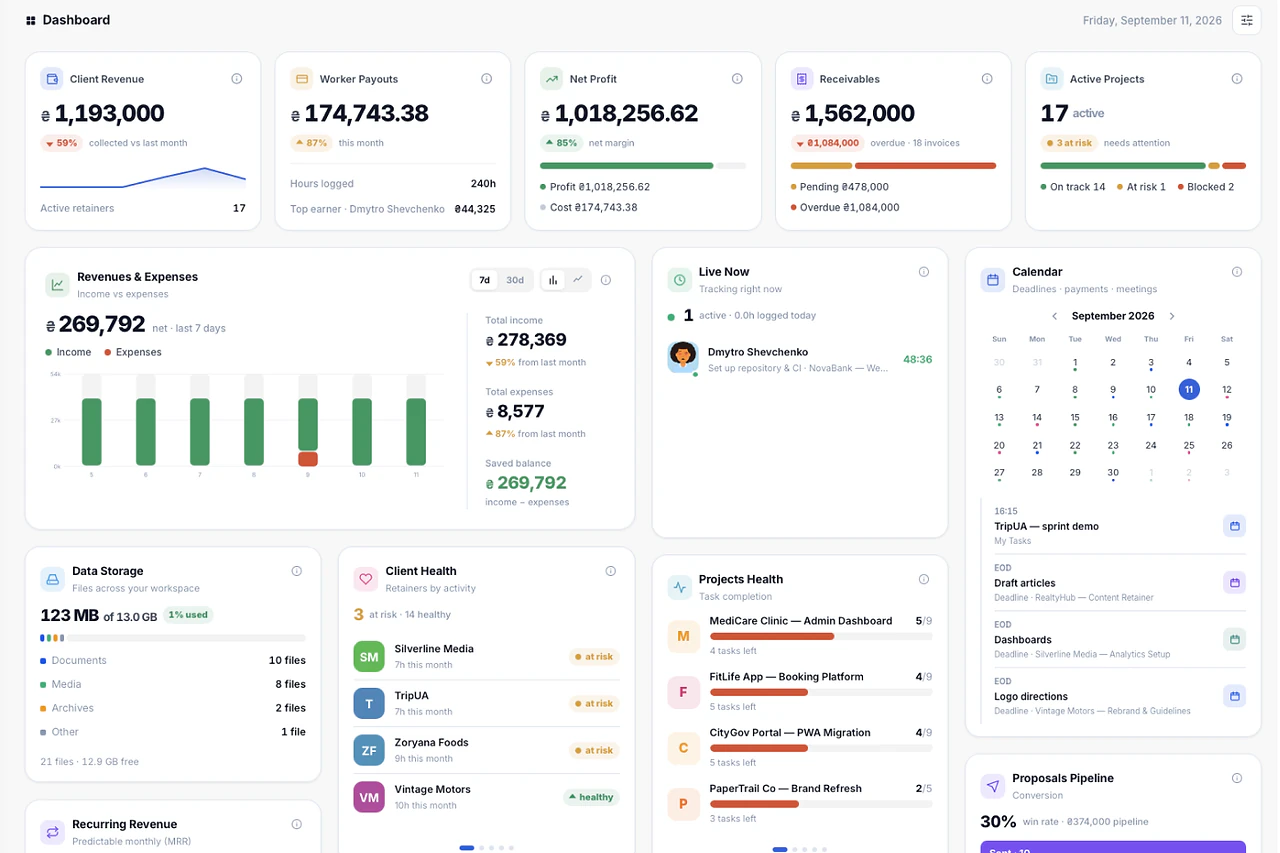
Melororium's Work Reports module shows hours per team member per project, with a billable/non-billable split. Cross-referencing logged hours with the project's budget (set on the project card) shows real-time budget burn: how much of the budgeted time has been used versus remaining. Invoice history on the client CRM card shows total billed versus estimated, making the full picture available in one view.
In Melororium
Profitability tracking in Melororium
Common mistakes with profitability tracking
What teams get wrong most often, and what to do instead.
- 1
Tracking revenue without cost
Looking only at what was invoiced, not what it cost in labor to deliver.
- 2
Using a flat hourly cost for everyone
Applying one blended rate to every team member regardless of actual pay.
- 3
Checking profitability only at project close
Waiting until the project's finished, when there's no time left to course-correct.
- 4
Ignoring non-billable time in the calculation
Excluding internal meetings and admin time spent on a client from the cost side.
Frequently asked questions
What is profitability tracking?
Profitability tracking measures the financial performance of projects and clients: revenue earned versus costs incurred, to determine actual profit margins and whether the business is growing sustainably.
What is billable utilization?
Billable utilization is the percentage of total working hours that are chargeable to clients. A team member working 40 hours per week with 32 billable hours has 80% utilization. The agency benchmark is typically 65-80% for delivery staff.
How do agencies track project profitability?
The core method: compare logged billable hours against the project budget, and compare invoiced revenue against the direct cost of those hours (team member rates). Tools that connect time tracking to project budgets make this automatic.
What profit margin is healthy for an agency project?
Gross margins of 50-60% are common targets for agency project work. Below 40% suggests underpricing, scope creep, or inefficient staffing. Above 70% on a recurring basis may indicate underinvestment in quality. Margins vary by service type: strategy work typically carries higher margins than execution-heavy production.