How to Build a Personal Weekly Review That Actually Changes How You Work
Most freelancers and knowledge workers know they should do a weekly review. Almost none do it consistently. Here's why — and how to build the version that finally sticks.

Contents
One flat fee for the whole team
Tasks, timers, CRM and invoices in one workspace. From $29 a month, no seat tax.
Start free demo14 days · no credit card
01. What a Weekly Review Actually Is (And Isn't)
A weekly review is a structured personal audit of where your work stands, what you've committed to, and what you're going to do about it in the week ahead. It's a planning session, a capture session, and a decision-making session compressed into one. What it isn't: a journaling practice, a motivational ritual, an elaborate system that requires two hours to complete, or a productivity performance you do to feel organised without actually changing what you do. The test of a good weekly review is whether the following week goes better because you did it. Not whether you feel better after doing it — whether the week actually runs better.
"I've tried weekly reviews six times over eight years. The first five failed because they were too elaborate or too vague. The sixth worked because I designed it around the specific decisions I needed to make, not the practices a productivity book suggested."
— Freelance strategist, 7 years independent
02. Why Most Weekly Reviews Fail Within Three Weeks
The failure pattern is predictable. Week one: motivated, thorough, takes 90 minutes. Week two: slightly rushed, 60 minutes, a few sections skipped. Week three: skipped entirely because of a 'busy week.' Week four: the habit is gone. The failure is almost always structural, not motivational. The review was designed for an idealised version of the reviewer's life — not for the actual conditions of a busy freelance week. It was too long. It required too many inputs. It wasn't tied to a specific, reliable time slot. A sustainable weekly review needs to be short enough to do even on a bad week, specific enough to produce real decisions, and structured enough that you can complete it on autopilot when your mental energy is low.
03. The Five Functions of a Weekly Review
Function 1: Capture Everything that's floating in your head — commitments, ideas, concerns, tasks — gets captured into a single trusted system. The review is the mechanism that empties the mental RAM that's been running in the background all week. Function 2: Clarify Vague captured items get clarified into specific next actions. 'Sort out the client thing' becomes 'email Maria to confirm the revised deadline for the Henderson project.' Function 3: Organize Clarified actions get assigned to projects, deadlines, and the right week. The chaos of a full capture becomes a structured list with context. Function 4: Reflect A brief backward look at what happened — what went well, what didn't, what you'd change. The reflection is the learning function that makes each week better than the last. Function 5: Plan The forward-looking piece: what are the three to five most important things that need to happen next week? These become the anchoring intentions that guide daily decisions.
04. Building Your Review Trigger and Ritual
A habit that depends on motivation fails. A habit attached to a trigger survives. The weekly review needs a specific, reliable trigger — a time and context that occurs every week without exception. Triggers that work: The trigger should be the same every week. The brain builds contextual associations — the same time, same place, same setup begins to trigger the review mode automatically after six to eight weeks of consistency. The five-minute pre-review ritual: The ritual signals to your brain that review mode is beginning. It sounds minor. The neurological effect is real.
- Friday afternoon at 4pm — end of the work week, before the weekend mental switch
- Sunday evening at 7pm — before the new week begins, clear mind
- Monday morning before the first task — set intentions before the week pulls you in
- Make a hot drink
- Open your task system and calendar
- Put on consistent audio (same playlist, same white noise, or silence)
- Close all other tabs and apps
05. The Four-Part Review Structure
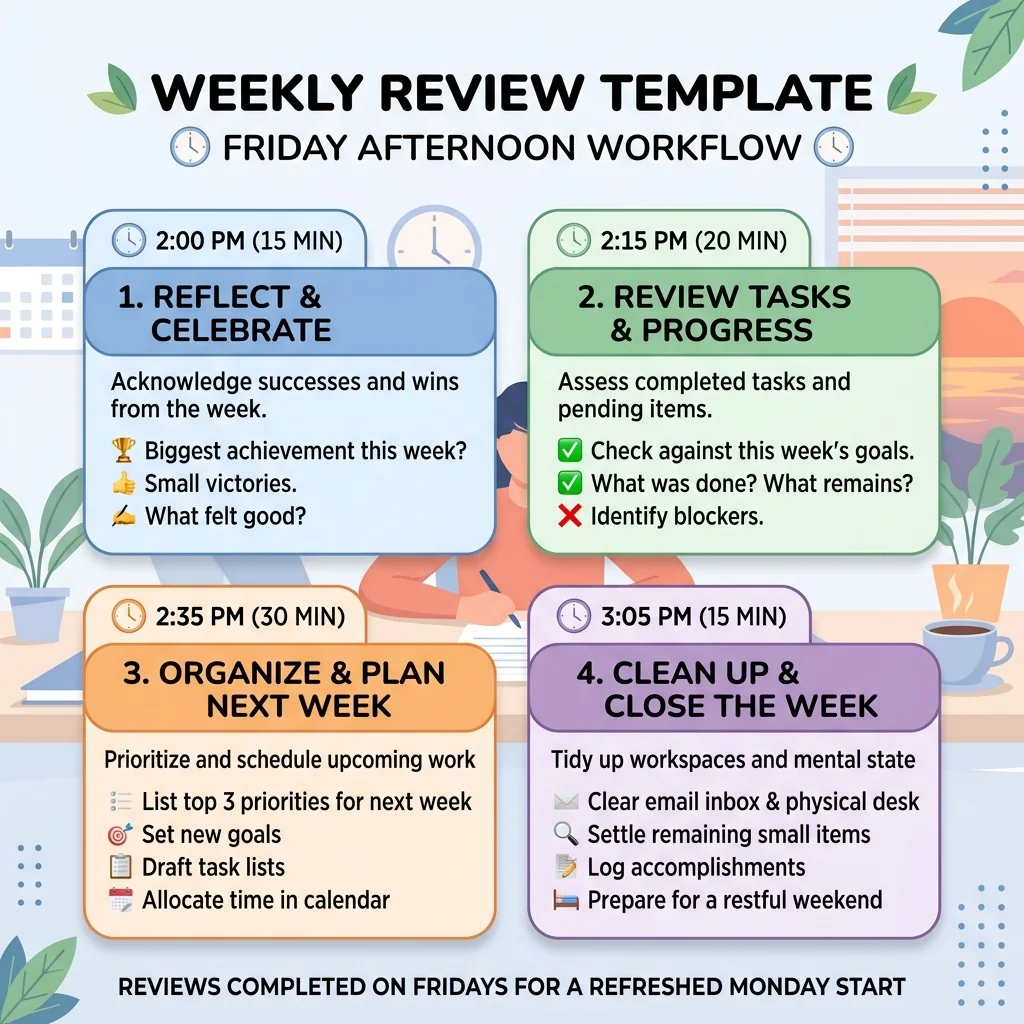
The review that works in 45 minutes has four sequential parts. Skipping parts or changing the order reduces effectiveness — each part builds on the one before it.
- Part 1: Capture Sweep — 10 minutes
- Part 2: Project Review — 15 minutes
- Part 3: Calendar Review — 10 minutes
- Part 4: Weekly Plan — 10 minutes
06. Part 1: The Capture Sweep — Clear Your Head
Spend 10 minutes capturing everything that's in your head into your task system. Not organising or deciding — just capturing. Every open loop, every nagging commitment, every idea, every thing you meant to do. The capture sources to sweep: The goal is an empty inbox and an empty head at the end of the sweep. Everything is now in one trusted system. Melororium Task Tracker — capture all tasks from every source into one system during your weekly sweep URL: melororium.com
- Brain — what's floating around that isn't written down anywhere?
- Email inbox — what needs action that isn't in your task system yet?
- Slack and messages — any commitments buried in conversations?
- Notebook or physical inbox — anything written down that needs to move to your system?
- Calendar — any prep needed for upcoming events?
Melororium
Part 1: The Capture Sweep — Clear Your Head
Learn more about Melororium
07. Part 2: The Project Review — Where Does Everything Stand?
Open every active project and answer one question: is there a clear next action defined for this project? If yes, is it in the right place with the right deadline? If no, define it now. This part of the review is the most cognitively demanding. You're not doing the work — you're making sure the work is organised well enough that you can do it without re-deciding what to do every time you open a project. The project review questions: 1. What's the current status of this project? 2. What's the next concrete action required? 3. Is there a deadline, and is it realistic? 4. Is anything blocking progress? 5. Does the client need anything from me this week?
Flat fee · no seat tax
Ready to get started?
Melororium gives your weekly review a home — all active projects, tasks, and deadlines in one place so your 45-minute review produces real decisions, not a hunt for information.
Starter: $29/mo (4 users)
Agency: $59/mo (15 users)
08. Part 3: The Calendar Review — What's Coming?
Scan the next two weeks of your calendar. For each commitment, ask: am I prepared for this? Is there prep work that needs to be scheduled? Most calendar anxiety comes from commitments that arrive without preparation. A client call on Tuesday that requires a progress update — when is the time blocked to prepare that update? A pitch meeting on Thursday — when are the preparation hours scheduled? The calendar review converts passive calendar entries into active preparation tasks.
09. Part 4: The Weekly Plan — What Actually Happens Next?
The final 10 minutes is forward-looking: based on everything you've captured, reviewed, and clarified, what are the three to five most important things to accomplish next week? Not everything — the three to five anchoring priorities that, if done, make the week a success regardless of what else happens. These go into your calendar as protected time blocks. They're your weekly definition of done. The weekly intention format:
- This week's most important outcome: [one sentence]
- Project priorities: [three to five specific tasks]
- The thing I've been avoiding that needs to happen: [one item]
10. The 45-Minute Review Protocol
The complete flow: 6. Pre-review ritual: 5 minutes — drink, setup, close everything else 7. Capture sweep: 10 minutes — brain dump into task system from all sources 8. Project review: 15 minutes — check every active project for next action 9. Calendar review: 10 minutes — prep tasks for upcoming commitments 10. Weekly plan: 10 minutes — three to five intentions for the week Total: 50 minutes. On a good week, it takes 40. On a bad week when your system is disorganised, it might take 60. Either way, the return on the time investment is significant.
11. Making the Review a Non-Negotiable
The weeks you most need a review are the weeks it feels most difficult to do one. Build in a minimum viable version for high-pressure weeks: a 15-minute abbreviated review that covers only the project status check and the three intentions for the coming week. A 15-minute review done every week beats a 45-minute review done whenever the stars align.
12. Adapting the Review for Teams
Small teams benefit from a shared version of the weekly review. A brief Friday team sync that covers: what did we complete, what's the priority for next week, is anything blocked? Fifteen minutes, structured, every week. The team review complements individual reviews — it surfaces blockers and alignment issues that individual reviews can't catch.
13. Measuring Whether Your Review Is Working
After four weeks of consistent weekly reviews, ask: do I start Mondays with more clarity than before? Are fewer things falling through the cracks? Do I feel less reactive and more intentional about how I spend my time? If the answer to all three is yes, the review is working. If not, something in the structure needs adjusting — not abandoned, adjusted. The review that works is the one calibrated to your specific work, not copied from someone else's system. Melororium Task Tracker + Timers — your weekly review home base: capture, review all projects, plan the week. One workspace, all in one place URL: melororium.com
Boards that run themselves
Kanban with subtasks, priorities and a timer on every card
Demo request from Bloom Cosmetics
Website redesign · due Oct 14