AI in Your Project Management — But Only Your API Key, Not Ours
The AI button in your current project tool costs you $10-20/month extra whether you use it once or a hundred times. There's a better model — and it's already how developers buy everything else.
Contents
One flat fee for the whole team
Tasks, timers, CRM and invoices in one workspace. From $29 a month, no seat tax.
Start free demo14 days · no credit card
01. The AI Premium Problem
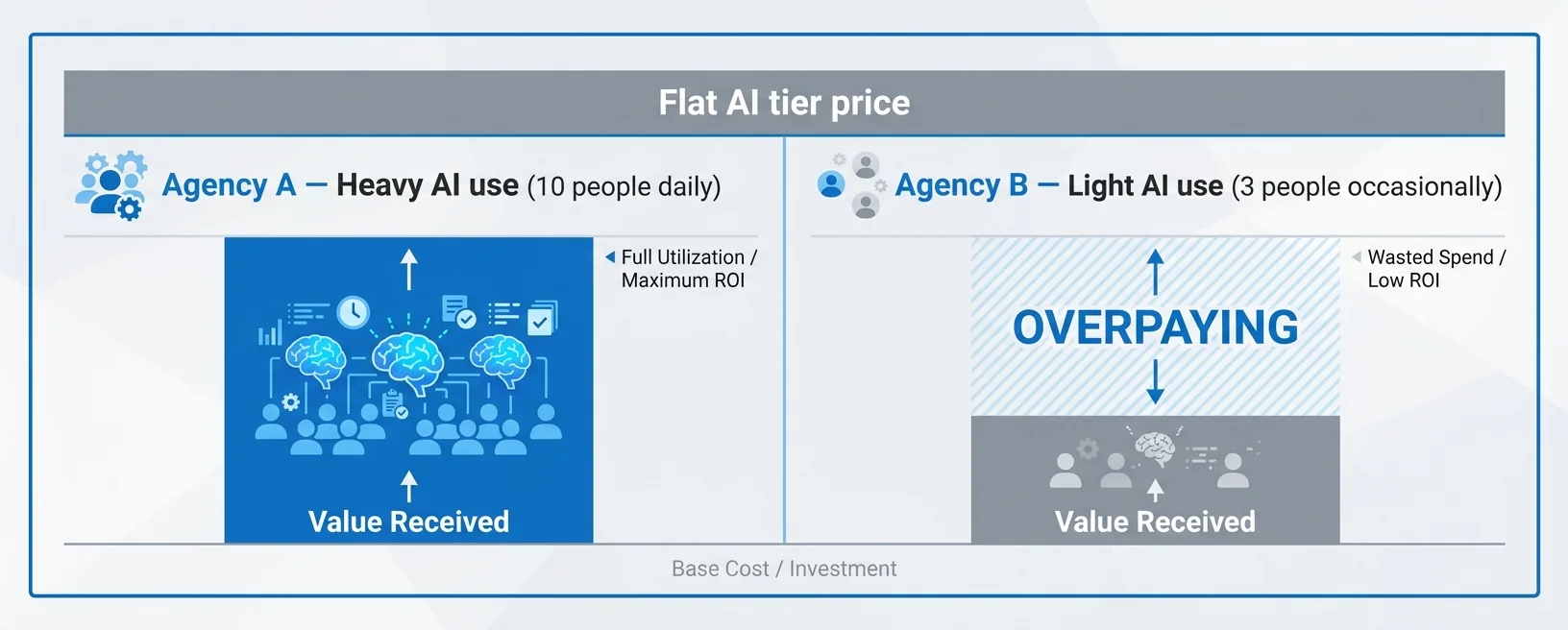
Most project management tools with AI features follow the same pricing pattern: a base subscription, and then an AI-enabled tier that costs $10-20/month more per seat. A 10-person agency upgrading to the AI tier on Notion or ClickUp pays an additional $1,200-2,400/year, regardless of how often the AI feature is actually used. The fee is flat. Your usage isn't. If three people on your team use the AI summary feature regularly and seven rarely touch it, you're still paying for all ten seats at the AI tier rate.
"For a 10-person agency using AI moderately, BYOK costs $36-96/year vs $1,800/year for a bundled AI tier. The gap is roughly $1,700/year — for identical AI functionality."
02. How Flat-Fee AI Pricing Works Against Small Teams
The flat AI markup makes economic sense from the tool company's perspective: they need to cover the infrastructure cost of running AI inference across their entire user base, and a flat tier price creates predictable revenue. The problem is that individual usage varies enormously — and the flat model averages everyone to the same cost. For small agencies with five or six genuinely frequent AI users, the flat tier might be approximately fair. For agencies where the AI feature gets used sporadically — a summary here, a suggestion there — the flat premium means you're consistently overpaying relative to the value you're getting.
03. What BYOK Actually Is
BYOK — Bring Your Own Key — means you connect your own API account with an AI provider (OpenAI, Anthropic's Claude, or Google's Gemini) directly to your project management workspace. Instead of paying the project tool a flat monthly markup to access AI, you pay the AI provider directly, at their actual rate, for exactly what you use. This is how developers have always bought API access. It's usage-based, transparent, and scales with actual consumption rather than seat count. A team that runs ten AI queries in a month pays for ten. A team that runs a thousand pays for a thousand. Nobody pays for the seat next to them.
04. Setting Up Your Own API Key in 5 Minutes
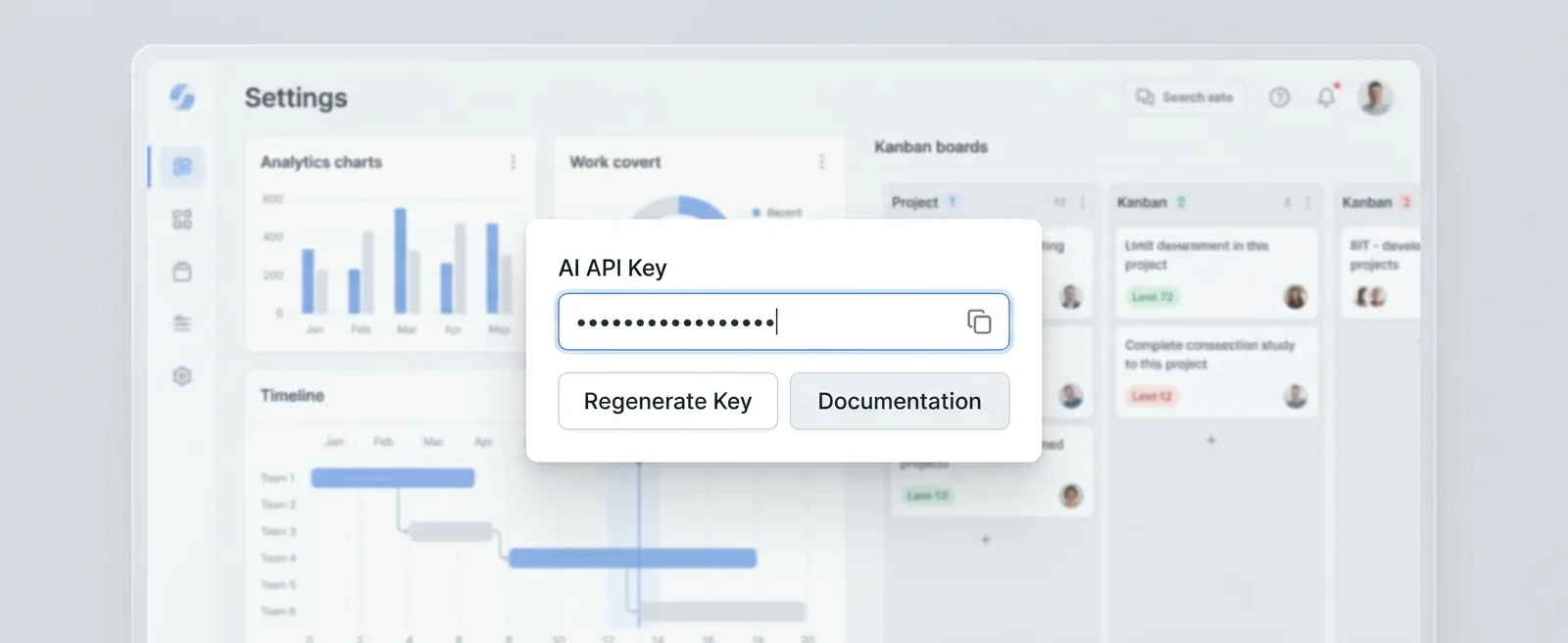
Step 1: Create an account with your preferred provider — OpenAI (platform.openai.com), Anthropic (console.anthropic.com), or Google AI Studio. Each generates an API key in your account settings. Step 2: In Melororium workspace settings, paste your API key. Select your preferred model — GPT-4o, Claude Sonnet, Gemini Pro, or equivalent. The connection takes under a minute. Step 3: AI features appear inside your tasks and projects — bottleneck analysis, workload distribution suggestions, project status summaries. You're billed by your AI provider at their standard rate per token, typically fractions of a cent for most routine queries.
Melororium
BYOK AI — No AI Markup, Ever
Connect your own OpenAI, Anthropic, or Gemini API key for project analytics. Included in all plans at no AI markup.
05. What AI Can Actually Do Inside Your Project Workspace
Project bottleneck detection: AI analyses your active tasks and identifies where work is piling up — a phase with too many tasks in 'Awaiting Review,' a team member whose assignment count has spiked relative to their historical average. Workload distribution suggestions: When a project comes in with a tight deadline, AI can look at the current timer logs and task assignments across your team and suggest how to distribute the new work without pushing anyone into overtime. Project status summaries: Ask for a plain-language summary of where a project stands — what's done, what's in progress, what's at risk — and get a paragraph you can paste into a client update.
Flat fee · no seat tax
Connect your own AI key. Pay pennies per use.
Project analytics at API rates — no flat AI markup, no seat-based fee for AI. Try free for 14 days.
Starter: $29/mo (4 users)
Agency: $59/mo (15 users)
Studio: $119/mo (Unlimited users)
06. Real Cost Comparison: Bundled vs BYOK
For a 10-person agency using AI features moderately — status summaries twice a week per active project, occasional bottleneck checks — the actual token cost at API rates runs to approximately $3-8/month total across all usage. Compare that to a $15/seat/month AI tier on a 10-seat plan: $150/month, or $1,800/year. For the same underlying capability accessed via BYOK, the actual cost is $36-96/year. The gap is roughly $1,700/year — for identical AI functionality with more model choice and more data privacy.
07. Your Data Stays Yours
When you use a bundled AI feature in ClickUp or Notion, your project data — task descriptions, client names, timelines, internal notes — goes to that company's AI infrastructure under their data terms. For most agencies, the practical risk is low. But the question 'are they training on our client data?' is a real one with answers that vary by provider and aren't always clearly disclosed. With BYOK, your data goes directly to the AI provider you chose, under their published terms. You chose the provider. You understand their data policy. There's no intermediary making decisions about how your project data gets handled.
08. Which AI Model to Connect
All three major providers work well for project analytics tasks. GPT-4o is the most capable for complex analysis but most expensive per token. Claude Sonnet is strong at summarisation and structured analysis at moderate cost. Gemini Pro is the most cost-effective for high-frequency routine tasks. For most agencies, Claude Sonnet or Gemini Pro covers the project analytics use case well at a cost that makes the BYOK model meaningfully cheaper than any flat-fee alternative.
09. July 2026 Update: The AI Task-Management Wave — and Why BYOK Matters More Now
TaskFlow AI launched on Product Hunt in July 2026 and hit 342 upvotes in its first week. The pitch: AI-powered task management that automatically prioritises your backlog, writes task descriptions, and surfaces bottlenecks. The pricing: a bundled AI tier on top of the base subscription. It's not alone. A wave of AI-native project tools launched in the same month, each bundling AI inference into a subscription tier ranging from $15 to $30/user/month extra. For a 10-person team, that's $1,800–$3,600/year in AI fees on top of the base tool cost. The pattern is predictable: the AI features are genuinely useful, but the pricing model bets that you won't do the math. The bundled fee covers all users at the same rate, whether your team runs 5 queries a month or 500. Someone is subsidising someone else — and for agencies with moderate AI usage, it's almost always you subsidising the heavy users. BYOK inverts this. You pay for what you actually use, directly to the provider you trust, at their published API rate. TaskFlow AI with bundled AI for 10 users: $1,800+/year in AI fees. Melororium Agency with BYOK: $708/year flat, AI costs $36–96/year at API rates. Total: under $804/year vs $1,800+ with a bundled AI tier elsewhere. The more AI tools launch with bundled AI pricing, the more the BYOK math becomes the obvious move.
- TaskFlow AI (342 PH votes, July 2026): bundled AI tier = ~$15-30/user/month extra on 10 seats = $1,800-3,600/year in AI fees alone
- Bundled AI charges the same per seat whether your team uses AI 5x or 500x per month
- BYOK at API rates: 10-person agency typical usage = $3-8/month = $36-96/year
- Melororium Agency $59/mo ($708/yr) + BYOK AI ($36-96/yr) = under $804/year total
- With a bundled AI tier elsewhere: same team pays $1,800-3,600/year in AI fees alone
Boards that run themselves
Kanban with subtasks, priorities and a timer on every card
Demo request from Bloom Cosmetics
Website redesign · due Oct 14