How to Write Etsy Listings That Actually Rank and Convert
Your product might be perfect. But if your listing doesn't speak to Etsy's search algorithm and your buyer's decision process simultaneously, it won't matter.
Contents
One flat fee for the whole team
Tasks, timers, CRM and invoices in one workspace. From $29 a month, no seat tax.
Start free demo14 days · no credit card
01. How Etsy Search Actually Works in 2026
Etsy's search algorithm ranks listings based on relevance, listing quality score, customer experience score, and shipping speed. Understanding each factor helps you prioritise where to invest improvement time. Relevance: How well your listing matches the search query. Determined primarily by your title, tags, and category. This is where most listing optimisation work happens. Listing quality score: How often your listing converts when it appears in search results. A listing that gets shown but rarely clicked, or clicked but rarely purchased, receives a lower quality score. Good photography and competitive pricing directly affect this score. Customer experience score: Your shop's review rating, dispatch speed, and case history. This is a shop-level metric that affects all your listings — a poor experience score suppresses everything you sell.
"I spent months working on my tags and titles with no improvement. Then I fixed my main photos. Conversion rate doubled in three weeks. The algorithm rewards what buyers respond to."
— Etsy seller, handmade ceramics, 600+ monthly sales
02. The Listing Title: Where SEO and Conversion Meet
Your title has two jobs: match the search queries your buyers use, and communicate enough value that they click on your listing over the alternatives. These goals are in slight tension — maximum SEO keyword density reads badly as human communication. The approach that balances both: lead with your primary keyword phrase (what your buyer types to find this product), follow with the most important descriptors (material, style, occasion, size), and end with secondary keyword phrases if space allows. Title structure that works: Full title: 'Personalised Name Necklace Sterling Silver Dainty Chain Birthday Gift for Her Mothers Day' This title matches multiple buyer search queries, communicates the product clearly, and handles both discovery and decision-making functions.
- Primary keyword: 'Personalised Name Necklace'
- Key descriptors: 'Sterling Silver, Dainty Chain'
- Secondary context: 'Birthday Gift for Her, Mothers Day'
03. Tags: The 13 Decisions That Determine Your Visibility
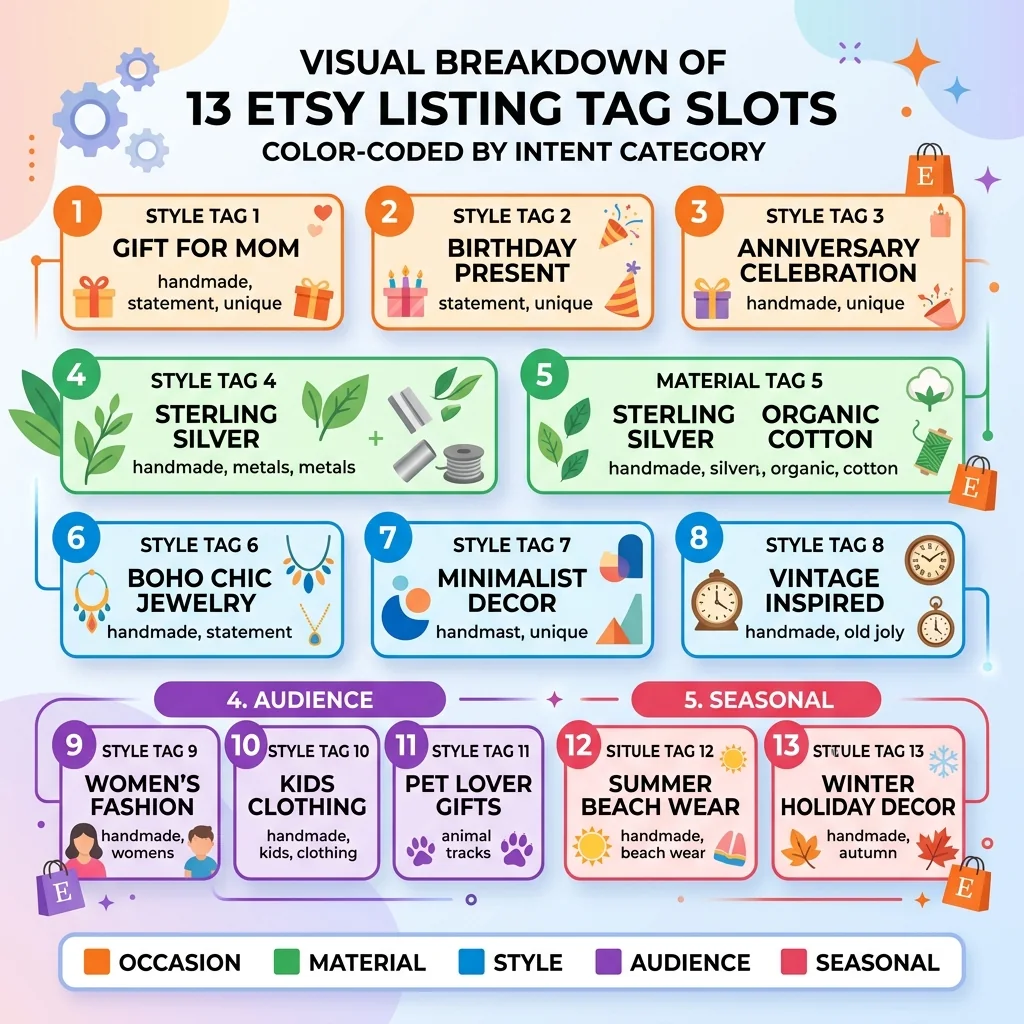
Etsy gives you 13 tags per listing. Most sellers use fewer than 13, use single-word tags that are too broad to be useful, or duplicate words already in the title (Etsy's algorithm already uses title words — tags should add new search phrases, not repeat existing ones). The tag strategy that works:
- Use all 13 — every unused tag is an unused visibility opportunity
- Use multi-word phrases — 'silver name necklace' not just 'necklace'
- Think in buyer language — what exact phrase does someone type when looking for this?
- Cover different buyer intents — the gift buyer, the self-purchase buyer, the occasion-specific buyer
- Test seasonal variations — 'Christmas gift ideas for her' has a seasonal traffic spike
04. The Description That Converts
Etsy's search algorithm doesn't heavily weight descriptions for ranking — but buyers read them before purchasing. The description is a conversion tool, not primarily an SEO tool. The converting description structure: 1. Lead sentence: state the product and its primary benefit clearly 2. Details: dimensions, materials, colours, variations available 3. Personalisation instructions: exactly how to customise if applicable 4. What's included: everything the buyer receives 5. Care and use: how to care for or use the product 6. Shop information: processing time, shipping method, your approach The description should answer every question a buyer might have before they need to message you. Every unanswered question is a potential abandoned purchase.
05. Photography as a Conversion Tool
Photography is the highest-leverage improvement most Etsy sellers can make. The algorithm ranks listings partly on listing quality score — which is determined by whether buyers click and purchase. Better photos improve click rate and conversion rate simultaneously. The listing photography essentials: Natural light beats studio lighting for most handmade products. A consistent editing style across all listings creates a professional, cohesive shop appearance that builds buyer trust.
- First photo: clean product on neutral background, fills the frame, clearly shows the item
- Second photo: product in use or in context — shows scale and lifestyle fit
- Third photo: detail shot — shows quality and craftsmanship up close
- Fourth photo: variation options if applicable — shows all available colours, sizes, or styles
- Fifth photo: packaging — buyers increasingly care about the unboxing experience
Flat fee · no seat tax
Ready to get started?
Melororium keeps your Etsy operations, listing tasks, and improvement workflows organised — so your shop keeps getting better without adding more hours to your week.
Starter: $29/mo (4 users)
Agency: $59/mo (15 users)
Studio: $119/mo (Unlimited users)
06. Pricing Psychology in Listings
Your price is part of your listing's conversion performance. Too high relative to apparent value produces low conversion. Too low relative to competitors signals quality concerns. The pricing sweet spot varies by category but the principle is consistent: price should be slightly above the category average if your photography and presentation are above average. Charm pricing ($29.99 vs $30.00) has measurable effects in e-commerce. Free shipping included in the price (vs separate shipping charge) improves conversion significantly — Etsy's algorithm also favours free shipping listings in some placements.
07. Using Sections and Variations Correctly
Etsy's shop sections help buyers navigate your product range. Well-named sections (not 'Section 1' but 'Personalised Jewellery' or 'Silver Necklaces') appear in Etsy search and help buyers who land on your shop find what they're looking for. Variations — size, colour, personalisation options — reduce the number of separate listings needed while serving more buyer preferences from a single listing. A listing with five variation options serves five types of buyers and accumulates reviews from all five into one listing's social proof.
08. The Review Accumulation Strategy
Reviews are the single most powerful conversion tool on Etsy. A listing with 200 reviews and a 4.9-star rating will outsell a better product with 3 reviews almost every time. Accelerating review accumulation: The goal isn't to pressure buyers — it's to make leaving a review feel easy and worthwhile for buyers who are already satisfied.
- Post-purchase follow-up message at delivery: brief, warm, specific to the product
- Include a physical note with orders that thanks the customer and mentions reviews
- Respond to every review — especially negative ones, with genuine problem-solving intent
09. Tracking Your Listing Performance
Etsy provides listing statistics: views, visits, conversion rate, and revenue. Reviewing these monthly reveals which listings are underperforming their traffic (high views, low conversion — a photography or pricing problem) and which are underperforming their potential (low views — a title or tag problem). Melororium Task Tracker — create a recurring monthly task to audit listing performance and schedule optimisation work as trackable tasks URL: melororium.com
10. Building a Listing Improvement Workflow
Listing optimisation compounds over time. A shop where listings are reviewed and improved quarterly will significantly outperform one where listings are created once and left unchanged. Build a quarterly listing audit into your Etsy operations: review performance data, update titles and tags on underperforming listings, refresh photography on low-conversion listings, and add new listings to replace discontinued ones.
Boards that run themselves
Kanban with subtasks, priorities and a timer on every card
Demo request from Bloom Cosmetics
Website redesign · due Oct 14