MELORORIUM FOR SMALL OPERATORS
One workspace for your entire operation.
Ditch the subscription stack. Unify client management, task tracking, time logs, and invoicing into one flat-fee workspace — starting at $29/mo flat.

SUBSCRIPTION FATIGUE
Business growth gets taxed by monthly subscription fees.
SaaS subscriptions leak your hard-earned revenue. We replace your fragmented toolstack with one powerful, flat-fee workspace — no seat tax, ever.
The SaaS Tax
Here is what you are paying every year to run a fragmented workflow:
Cumulative SaaS Tax vs. Flat-Fee Subscription
Equivalent to keeping 100% of your billable hours instead of paying subscription taxes.
UNIFIED WORKFLOW
A business workflow that just makes sense.
No jumping across isolated utilities. Just a tight, logical 4-step execution track built natively inside one fast hub.
Client Account Configuration
Define your active customer, record contract billing days, and track monthly retainer profiles securely inside the CRM ledger.
Frictionless Task Mapping
Deploy lightweight vertical Kanban cards to organize your production line with instantaneous drag-and-drop response.
Task-Embedded Time Tracking
Engage the interactive stopwatch trigger right inside your task details drawer to log billable minutes without background tools.
Automated Activity Reports
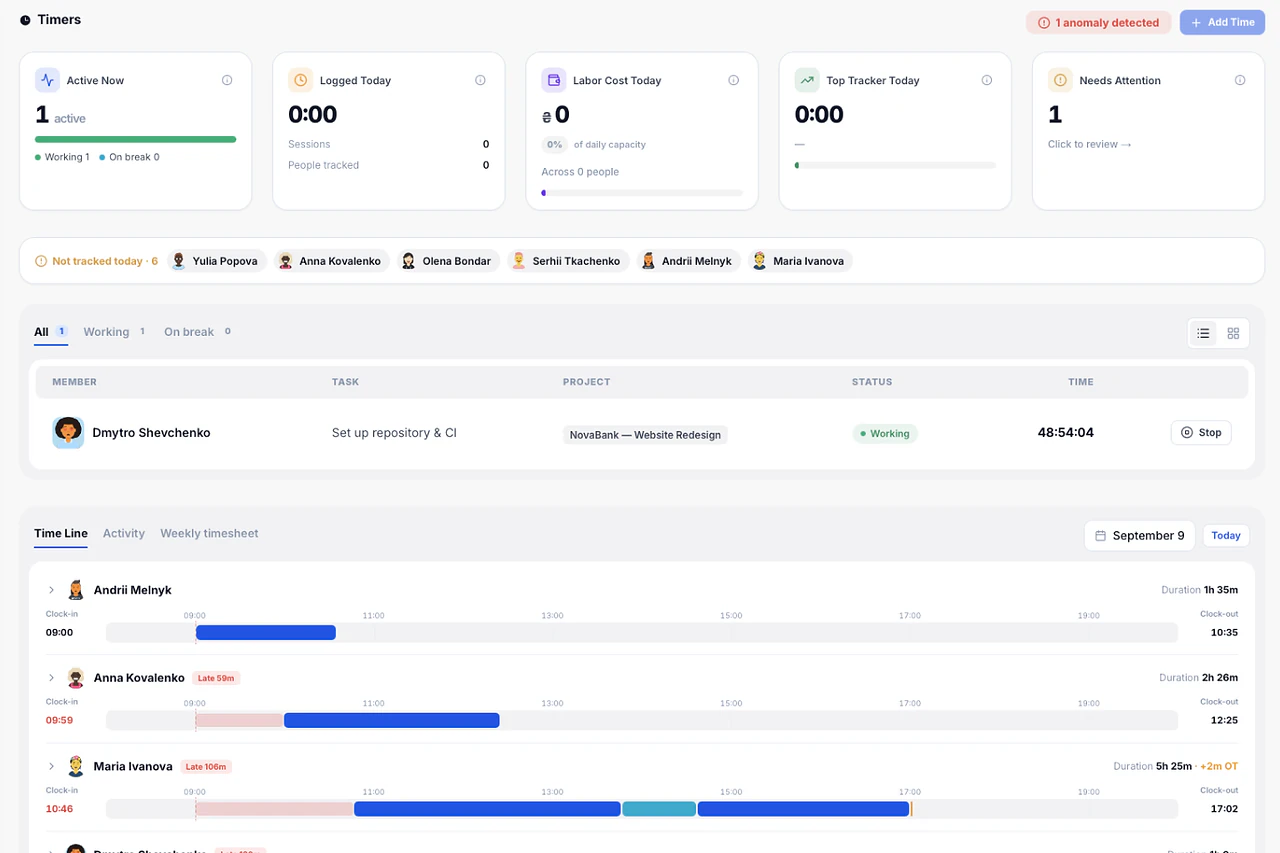
Open the automated database spreadsheet to see tracked hours instantly mapped against custom rates and accumulated earnings.
Vertex Studio
Active Retainer ClientVALUE COMPARISON
Why pay per seat when you can go flat-fee?
Compare face-to-face. Other SaaS platforms lock your workflows and data behind endless per-seat fees. We believe professional software should be a flat fee for your whole team.
The old way
Paying monthly subscription taxes for every minor tool you use.
Scattered operational records causing workflow gaps and missed hours.
Heavy, sluggish cloud interfaces wasting your daily billable capacity.
Compiling raw timesheets manually to calculate project margins.
The Melororium way
Flat monthly fee for your whole team. Secure, scalable workspace.
Unified time logging and accounting tied directly to active tasks.
Blazing-fast local-first execution with zero interface latency.
Integrated ledger automation generating live performance reports.
ZERO LOADING SPINNERS
Local-first compilation. Zero server delays.
Melororium compiles all database transactions straight inside your client engine before pushing silent sync tasks to the server.
IndexedDB direct write — zero network dependency
React virtual DOM diff — 1 animation frame
Async worker sync — invisible to the user
Server roundtrip + JSON parse + re-hydrate
LIVE TEST
Run a latency benchmark
Simulate a real workspace action and measure local vs remote execution time.
Click run to measure local performance.
EARLY FEEDBACK
See what teams say about Melororium.
Early adopters from agencies and studios share how ditching the subscription stack changed how their teams operate.
Clara Moss
Founder, Mossglow Studio
"I had a successful shop and absolutely no idea if I was actually making money."
Tom Brauer
Founder, Linkframe
"I was paying to make my own life harder."
Marcus Webb
Founder, North Signal Studio
"Every Friday felt like an archaeology dig."
Built for modern digital operations.
Join the early adopters scaling their business layout with Melororium.
PRODUCT FAQ
Frequently
Asked Questions
Have a question that needs a human to answer?
No problem, email us at support@melororium.com
Compare alternatives
Starter ($29/mo) covers up to 4 users — ideal for small teams. Agency ($59/mo, most popular) covers up to 10 users and lets you pick 5 additional modules on top of the 12 core ones. Studio ($119/mo) covers up to 25 users and unlocks all 20+ announced modules. All plans are billed monthly or yearly (save ~30% annually).
Switch plans anytime — your data stays intact and the transition takes seconds. Upgrade is prorated automatically. No lock-in, no penalties for growing your team.
With per-seat tools, every new hire costs more. A 10-person team on ClickUp pays $1,440/yr in seat fees alone. Melororium charges one flat monthly fee for your whole team — add 1 person or 10, the price stays the same. No seat tax that eats into your margins as you grow.
Security is non-negotiable. Melororium operates on end-to-end data encryption (TLS 1.3) with enterprise-grade database separation. Our AI features use strict Bring Your Own Key (BYOK) architecture — your data is never used for model training.
Yes. Melororium supports dedicated Client Portals at no extra cost. Clients can view project timelines and download deliverables. Guest client access does not count against your team seat limit.
Every plan includes: Dashboard, Kanban, Projects, Calendar, Team management, Client CRM, Invoices, Work Reports, Live Timers, Inbox, Time Tracker, and Settings. Agency and Studio plans add extra modules on top of these.
Small Team Workspace Guide: Managing Projects, Time, and Clients Without Per-Seat Fees
Growing a small business from one person to a team of four, six, or ten means your operational needs multiply fast. What worked as a solo operator — a shared spreadsheet, a free Trello board, an email chain for invoices — breaks down the moment you have multiple people working on multiple client projects simultaneously. But jumping to enterprise SaaS means per-seat pricing that penalises you for every hire. This guide covers how a flat-fee team workspace solves the operational challenges of growing small businesses.
The Operational Jump From Solo to Team
The transition from solo operator to small team is one of the most disruptive operational moments in a business's early life. As a solo operator, you can hold the full picture in your head: which clients are active, what work is in progress, how many hours you have spent this week. Add three people to that picture and the complexity multiplies by an order of magnitude. Suddenly you need to know not just what you are doing, but what each team member is working on, whether their hours are being logged correctly, whether client work is progressing on schedule, and whether the invoices going out at the end of the month accurately reflect the work delivered. The only way to manage that without losing your mind is systematic tools — and those tools need to work together.
What Breaks When You Scale Without the Right Tools
The most common failure modes for growing small teams: missed billing (time logged in one tool does not make it to the invoice in another), scheduling conflicts (tasks spread across email, Slack, and a task board nobody updates), and client visibility gaps (nobody can answer 'where is this project right now?' without 20 minutes of detective work). Each of these problems is directly caused by tool fragmentation — and each one costs money, client trust, or both.
How Melororium Solves Small Team Coordination
Melororium is built around the assumption that a team of 4–10 people needs the same operational capabilities as a 50-person agency — but without the enterprise price tag or the complexity. The workspace connects task management, time tracking, client records, and invoicing so that the data flows naturally from one stage of work to the next. A client record in the CRM has billing details and a linked project. The project has tasks assigned to team members. Those tasks have embedded time trackers. At the end of a billing period, the work report shows every logged hour by project and by person, ready to convert to an invoice. Nothing needs to be manually reconciled because nothing was ever separated.
Roles and Permissions for Small Teams
Melororium supports three permission levels: Owner, Admin, and Worker. The owner controls billing and workspace settings. Admins can create and manage projects, assign tasks, and generate reports and invoices. Workers can view their assigned tasks, log time, and see their own reports — without access to financial data or other team members' records. This role structure makes it easy to give your team members the access they need without exposing sensitive client or billing data.
Planning Ahead: A Tool That Does Not Penalise Growth
One of the most underrated advantages of flat-fee pricing is the ability to plan your tool budget with confidence. When you are running a small business and thinking about hiring, the calculation is already complex: salary, equipment, onboarding time, productivity ramp. Per-seat SaaS adds another variable — your tool costs increase with every hire. Flat-fee pricing removes that variable entirely. With Melororium, your workspace cost is known and stable. Starter at $29/month covers four users. Agency at $59/month covers ten. The difference is $30/month — fixed, regardless of how many of those ten seats are filled. A growing four-person team can upgrade to Agency when the fifth person joins, knowing the cost ceiling is $59/month for the foreseeable future.
Daily Workflow for a Growing Small Team
A typical day for a Melororium-powered small team starts with the dashboard: a live view of tasks due today, hours logged this week, active projects, and any flagged items needing attention. Team members move to their personal task boards and begin working through their queue. When a task is in progress, the timer runs in the background — no separate app to open, no manual log to fill. Project managers check the global Kanban board to see overall project health across all active clients. When a task is blocked or falling behind, it is visible immediately — not discovered in a Friday status meeting. Client communication stays logged in the CRM, so any team member can see the history of a client relationship without digging through email.
End of Month: From Work Report to Invoice in Minutes
The billing cycle on Melororium is significantly faster than managing separate tools. At the end of the month, a report pulls all logged hours for the period across all team members, grouped by client and project. You verify the totals, apply any adjustments, and generate a PDF invoice with one action. The invoice carries your branding, lists the work items, and is ready to send to the client. A billing cycle that used to take two to three hours of manual reconciliation takes under 30 minutes.
From Spreadsheets to a Real Workspace: Making the Transition
The best time to move to a proper workspace is before the chaos of growth makes it urgent. Most small teams wait until they are already experiencing the pain — missed billable hours, confused client communication, invoices that do not reconcile — and then make the switch under pressure. Starting Melororium when you hire your second or third team member means you build good habits from the beginning. The migration is low-friction. Your client list moves to the CRM in an hour. Your active projects become Kanban boards in an afternoon. Your team members are invited and logging time on their first day. There is no data migration, no IT setup, no training programme. The interface is built to be intuitive for people who have never used a dedicated workspace before.
Take full control of your operations.
No seat tax, no cloud lag, no data leaks. Pure local execution built for modern operators.