What is Realized Rate?
Realized Rate
Realized rate is total labor cost divided by total hours worked, the actual blended hourly rate the team delivered at, not the rate quoted to the client.
Realized rate is the actual average hourly cost of work delivered on a project or period. The formula is simple: total labor cost divided by total hours logged. If 40 hours of work cost $2,000 in wages, the realized rate is $50/hr.
The realized rate differs from each team member's nominal hourly rate because people with different rates work different amounts on each project. A senior designer at $80/hr and a junior designer at $40/hr working equal hours produces a realized rate of $60/hr, different from either individual rate.
Agencies use realized rate to verify that projects were actually delivered profitably. If the project was quoted at $75/hr and the realized rate came in at $90/hr, the project lost money on every hour worked.
Why Realized Rate Matters for Agencies
Most agencies quote projects using an assumed hourly rate: a blended estimate of what work will cost. The realized rate is what it actually cost. The gap between the two is the profitability problem.
If the senior designer worked more than expected (because the brief changed), the realized rate rises above the quoted rate. If the project took longer than scoped, the same thing happens. Tracking realized rate per project shows which types of work are consistently more expensive to deliver than quoted, and therefore where to revise scope or rates.
Without realized rate tracking, agencies discover profitability problems from their bank account, not from their project data.
Realized Rate vs. Effective Rate vs. Bill Rate
These three rates describe different things. Keep them separate.
| Rate | What it measures | How calculated |
|---|---|---|
| Realized rate | What the work cost internally | Total labor cost ÷ total hours |
| Effective rate | What the client paid per hour billed | Invoice amount ÷ hours billed to client |
| Bill rate | The target rate on quotes and invoices | Set per project or rate card |
Realized Rate in Melororium
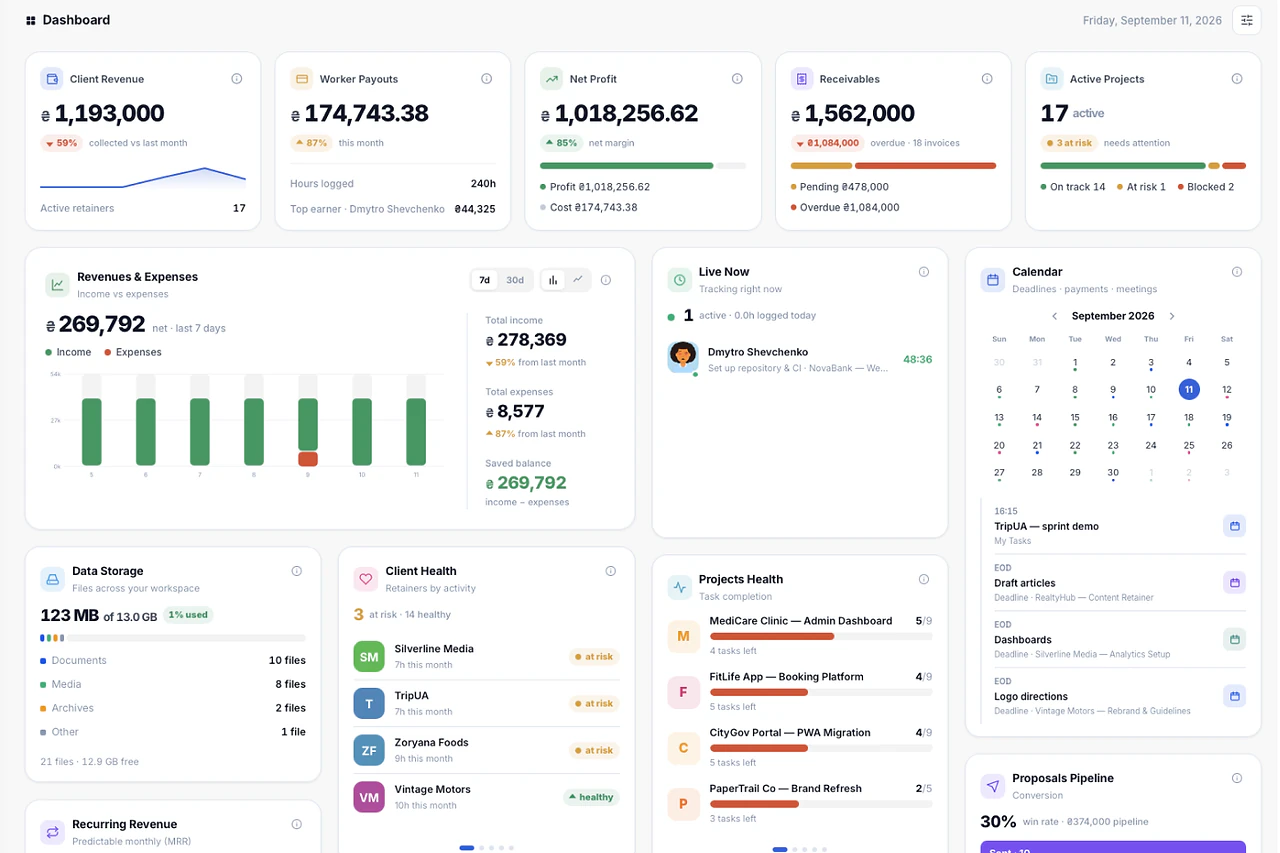
The Realized Rate KPI card appears in the Work Reports page. It shows total cost ÷ total hours for all logged time in the selected period and filter. Switch the filter to a single project to see the realized rate for that project specifically.
Realized rate updates automatically as time is logged: no manual calculation required. The formula pulls from the same time logs and employee rates that drive all other labor cost calculations in the workspace.
In Melororium
Work Reports in Melororium
Common mistakes with realized rate
What teams get wrong most often, and what to do instead.
- 1
Confusing it with the billed rate
Assuming realized rate matches whatever was quoted or invoiced.
- 2
Calculating it only per project, never company-wide
Tracking it on individual projects but never rolling it up across the whole business.
- 3
Ignoring the gap between quoted and realized
Noticing it's consistently lower than quoted and not adjusting future estimates.
- 4
Using average hourly pay instead of real cost
Calculating off a rough average salary instead of true loaded labor cost.
Frequently asked questions
Is realized rate the same as my employees' hourly rate?
No. Each employee has their own hourly rate. The realized rate is the weighted average across all employees who logged time in the period: a blended figure that reflects who worked and how much.
How do I improve a realized rate that is too high?
Either reduce the time senior (higher-rate) employees spend on the project, or increase the scope to justify the higher cost, or revise the quoted rate upward on future work of the same type.
Where do I see realized rate in Melororium?
Work Reports → the Realized Rate KPI card above the matrix table. It shows cost ÷ hours for the selected period and any active filters.