What is a Recurring Invoice?
Recurring Invoice
A recurring invoice generates automatically on a schedule for retainer clients, instead of someone rebuilding the same invoice by hand every month.
A recurring invoice is an invoice that generates on a fixed schedule for a client paying a regular amount. Instead of creating the same invoice manually each month, you configure the client's payment day and amount once. The system creates the invoice automatically when the date arrives.
For agencies with retainer clients, recurring invoices remove a predictable monthly task from the PM's plate. Five retainer clients, five manual invoices, twenty minutes of work that produces nothing new. Recurring invoice automation turns that into a five-minute review of auto-generated drafts.
Recurring invoicing also improves timing consistency. Manual invoices go out when someone remembers to create them. Automatic invoices go out on the scheduled day, every month, without depending on anyone's calendar.
How Recurring Invoices Work
Recurring invoice automation has three components: a payment schedule attached to the client record, a trigger that fires when the payment day arrives, and a delivery method (auto-draft or auto-send).
The payment schedule stores the monthly amount, the day of the month the invoice should go out, and whether the invoice should auto-send or create a draft for review.
On the payment day, the trigger creates an invoice with the standard fields pre-populated: client name, billing address, line items from the retainer agreement, amount, and due date.
Auto-draft mode creates the invoice and stops. A PM reviews it and sends. Auto-send mode creates and dispatches the invoice without a manual review step. Auto-draft is safer for engagements where scope or amount occasionally changes. Auto-send works well for fixed retainers with no variation.
- Payment schedule: monthly amount, day of month, auto-draft or auto-send mode
- Trigger fires on the payment day and creates the invoice
- Auto-draft: invoice created, PM reviews and sends
- Auto-send: invoice created and dispatched without manual action
Recurring vs Manual Invoicing: The Real Difference
Manual invoicing is not just slower. It introduces timing variance that compounds over months.
A PM who creates invoices manually sends them when they remember or when a calendar reminder fires. On a busy week, the reminder gets snoozed. The invoice goes out three days late. Payment arrives three days late. Over 12 months with 5 retainer clients, timing variance can mean 20 to 30 late-payment days across the portfolio, each representing working capital the agency fronted on the client's behalf.
Recurring automation eliminates timing variance. The invoice goes out on day 1, every month, because nothing depends on a PM's task list. Clients who are accustomed to receiving invoices on a predictable date also pay faster, because the rhythm is established.
| Factor | Manual Invoicing | Recurring Automation |
|---|---|---|
| Timing | Varies by PM workload | Fixed day every month |
| Setup time | 20-40 min/month per client | One-time setup, ongoing review only |
| Consistency | Different formats per PM | Identical format every cycle |
| Error risk | Wrong amount, missed client | Pulls from stored client data |
| Cash flow | Unpredictable receipt dates | Predictable receipt dates |
Handling Common Edge Cases
Three edge cases require explicit decisions when setting up recurring invoices.
Payment day 29, 30, or 31: months with fewer days than the configured payment day. The safest handling is capping the payment day at 28, which exists in every month including February. Configuring day 28 means February clients always get billed on the last day, and other months bill on the 28th. It is not perfect but it is consistent and predictable.
Amount changes: a client upgrades their retainer. The recurring invoice should use the new amount. This requires updating the monthly payment field on the client record before the next payment day, not after.
One-off invoice in the middle of a cycle: a recurring client needs an additional invoice for out-of-scope work. Create it manually as a standard invoice. It does not affect the recurring schedule.
Bulk Invoice Generation for Multiple Retainer Clients
Agencies with five or more retainer clients on the same payment day face a batch invoicing problem. Creating invoices one at a time for each client takes longer than it should.
Bulk generation selects multiple clients with billing due and creates draft invoices for all of them in a single action. The PM reviews the batch, adjusts any that need changes, and sends. The review step that would have taken 40 minutes of manual creation takes 10 minutes of review.
Bulk generation does not bypass the review step. It compresses creation time so review gets the full attention. An invoice sent without review to the wrong client at the wrong amount is harder to recover from than one created slowly and correctly.
Recurring Invoices in Melororium
Recurring invoices in Melororium work through two connected settings. On each client card, the billing panel has a Monthly/One-off toggle, a payment amount field, a payment day selector (1 to 28), and an auto-invoice toggle.
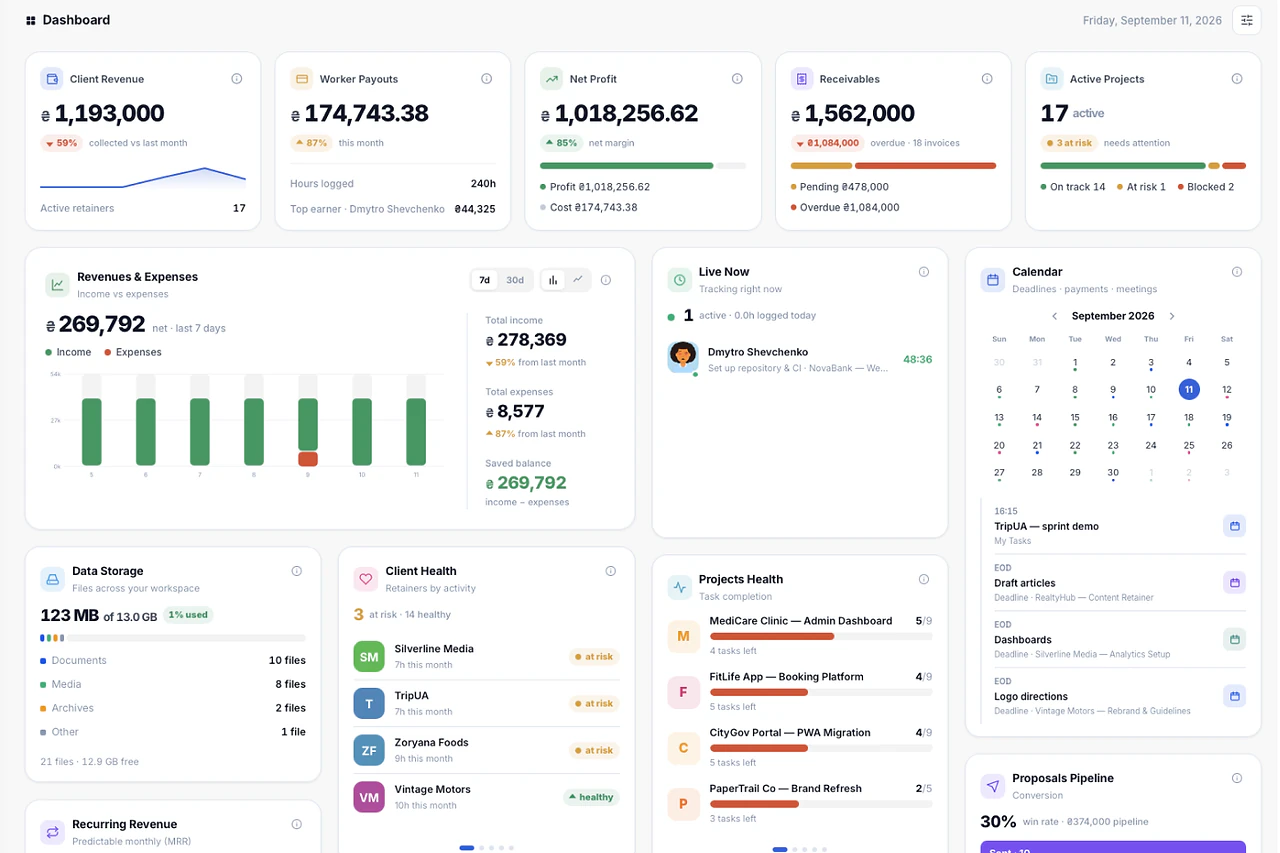
The Billing tab on the Clients page shows all recurring clients in a single dashboard: total MRR, upcoming charges sorted by date, a 'due in 7 days' amber highlight, and the auto-invoice status per client. The Generate Now button creates a one-off invoice for a specific client without affecting their recurring schedule.
The invoice form supports three invoice types: Standard, Prepayment, and Recurring. Recurring invoices show the configured day and time on the invoice itself. Eight currencies are available: UAH, USD, EUR, GBP, PLN, CZK, CAD, AUD.
Start a 14-day free demo at https://melororium.com. Agency plan at $59/month covers 15 users, flat-fee.
In Melororium
Recurring invoices in Melororium
Common mistakes with recurring invoice
What teams get wrong most often, and what to do instead.
- 1
Not updating it when the retainer scope changes
Leaving a recurring invoice running at the old amount after a retainer's scope or price was renegotiated.
- 2
Auto-send on a retainer that isn't fixed
Using auto-send mode for a client whose scope or amount still shifts month to month. Auto-send fits a fixed retainer with no variation; anything less stable belongs in auto-draft, where a person reviews before it goes out.
- 3
Ignoring failed or bounced sends
Not monitoring whether recurring invoices reach the client's inbox.
- 4
No clear cancellation process
Having no defined way to stop a recurring invoice when a retainer ends.
Frequently asked questions
What is the difference between a recurring invoice and a subscription?
A subscription charges the client automatically via a payment gateway. A recurring invoice generates the invoice document automatically but still requires the client to pay it. Recurring invoicing is appropriate when clients pay by bank transfer or when payment gateway integration is not set up.
Can I change the amount on a recurring invoice mid-cycle?
Yes. Update the monthly payment amount on the client record before the next payment day. The next auto-generated invoice uses the new amount. Any already-sent invoices are not affected.
What happens if I need to skip a month?
In auto-draft mode, delete the draft before sending. In auto-send mode, you need to cancel the invoice before the system sends it. For client-requested pauses, disable the auto-invoice toggle on the client record and re-enable it when billing resumes.
How do recurring invoices affect MRR tracking?
If your CRM calculates MRR from the monthly payment field on each client record, recurring invoices and MRR tracking stay in sync automatically. A client with a $2,500 recurring invoice has a $2,500 MRR contribution. Change the invoice amount, and MRR updates.