What is Attendance Tracking?
Attendance Tracking
Attendance tracking shows which team members have logged time today and who's on approved leave, without anyone needing to send a daily check-in message.
Attendance tracking in a remote or hybrid team context means knowing who is working today without asking. It answers a simple question: "Is everyone accounted for?" This means distinguishing between team members who are working, team members who are on approved leave, and team members who are absent without explanation.
Traditional attendance tracking (sign-in sheets, biometric clocks, manual check-ins) does not translate to distributed teams. A Slack message asking "Is everyone around today?" creates friction and generates noise in channels that are already busy. The better approach is passive attendance tracking: a system that registers presence when someone starts logging time, without requiring any additional action.
How Passive Attendance Tracking Works
In a time-tracked environment, attendance tracking is a byproduct of time logging. When a team member starts a timer on a task, they are implicitly marking themselves as present. A manager checking the Live Timers page can see at a glance who is actively working, who logged time earlier today, and who has not logged any time at all.
The key distinction is between absent (no logged time, no leave request) and on leave (no logged time, approved leave request). An attendance tracker that does not integrate with leave management will flag people on holiday as absent, a false alarm that erodes trust in the system.
- Working: active timer running right now
- Logged today: timer stopped, but hours recorded for today
- Not tracked: no time logged today, no approved leave
- On leave: no time logged, approved leave request covering today
Attendance Tracking for Remote Teams
Remote teams cannot use visual cues to know who is working. An empty desk signals absence in an office. An empty desk in a distributed team is invisible.
For remote managers, attendance tracking serves two functions: operational (do we have coverage today?) and wellbeing (is anyone working unusual hours or disappearing for long stretches?). The first is answered by the attendance widget. The second is answered by overtime and anomaly detection.
The goal is not surveillance. It is removing the need for the daily check-in message: the "just checking if you're around" Slack that interrupts everyone and produces the same information the attendance widget already shows.
Attendance Tracking in Melororium
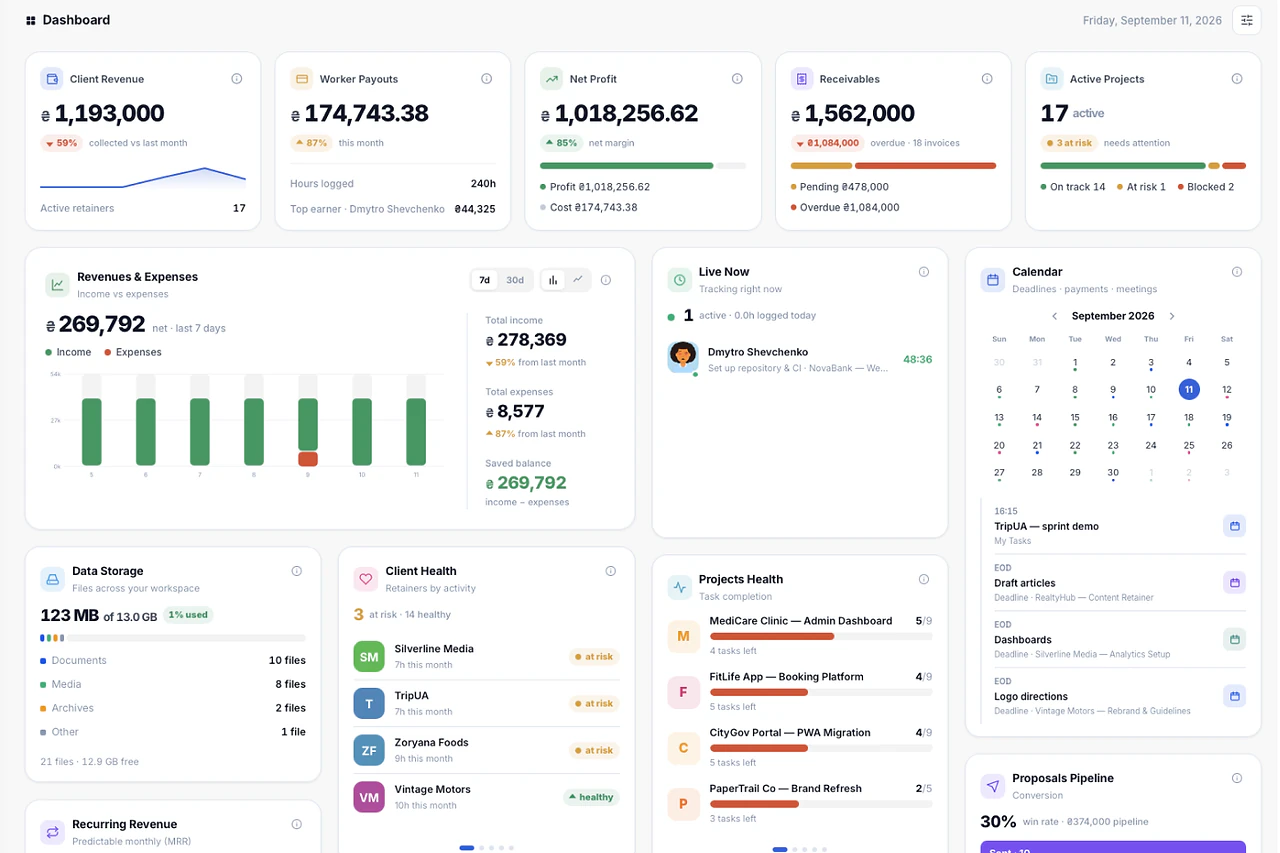
The Live Timers page shows an attendance widget at the top of the page (visible to Admins and Owners). It lists two groups: team members who have not logged any time today, and team members with approved leave requests for today.
The not-tracked list filters out people on leave automatically. If someone is absent without a leave request, they appear in the not-tracked list. The manager can follow up with one click.
The Time Line view shows each person who logged any time today as a visual bar. It is a second view of the same data, who was present and when, but with timing context rather than a binary yes/no.
Attendance tracking is included in all paid plans.
In Melororium
Attendance Tracking in Melororium
Common mistakes with attendance tracking
What teams get wrong most often, and what to do instead.
- 1
Requiring manual daily check-ins
Asking people to message "I'm online" every morning, exactly the busywork it's supposed to eliminate.
- 2
Confusing logged-in with working
Treating someone as present because a tool shows them online.
- 3
No connection to approved leave
Flagging someone as absent when they're on pre-approved time off.
- 4
Using it for surveillance instead of coordination
Rolling it out purely to monitor who's "really working."
Frequently asked questions
Do team members need to do anything special for attendance to register?
No. Logging time on any task registers them as present. Starting a timer is the only action required. There is no separate clock-in or check-in step.
What if a team member works but does not log time?
They appear in the not-tracked list. Attendance tracking relies on time logging: if someone works without logging, the system cannot know they were present. This is one reason consistent time logging habits matter.
Can I see historical attendance?
Yes. The Time Line view lets you pick any past date with the date picker. The Weekly Timesheet shows hours per person per day for any past week. Work Reports shows total hours per person across any date range.
Which plan includes attendance tracking?
All paid plans: Starter ($29/mo), Agency ($59/mo), and Studio ($119/mo). The attendance widget on the Live Timers page is included in all plans.