What is Remote Team Management?
Remote Team Management
Remote team management is leading a team that isn't in the same room, where communication and visibility need deliberate structure instead of hallway conversations.
Remote team management is the practice of leading, coordinating, and developing a distributed team where members work from different locations: different offices, cities, or countries, often across time zones. It requires the same management fundamentals as in-person management but without the ambient information flow an office provides: overheard conversations, visual cues, impromptu desk chats.
For agencies and service teams, remote work is now a baseline expectation rather than an exception. Teams that built strong remote management practices during 2020-2022 now have a structural advantage in hiring, cost, and resilience.
Remote vs. Hybrid Team Management
Remote and hybrid teams have different management challenges.
- Fully remote: all team members work outside a shared office. Communication is entirely async or via scheduled video calls. Documentation must be exhaustive because there's no 'just ask someone nearby.'
- Hybrid: some members in office, some remote. The risk: office-based members get informal access to information and decision-making that remote members miss. Requires intentional effort to include all remote members equally.
- Distributed remote: team across multiple time zones. Requires async-first communication and careful meeting scheduling to avoid always disadvantaging the same time zone.
The Core Problem: Visibility Without Presence
In an office, a manager can see who's overloaded, who's stuck, and who is having a bad week, through observation, body language, and casual conversation. Remote managers have none of these signals automatically.
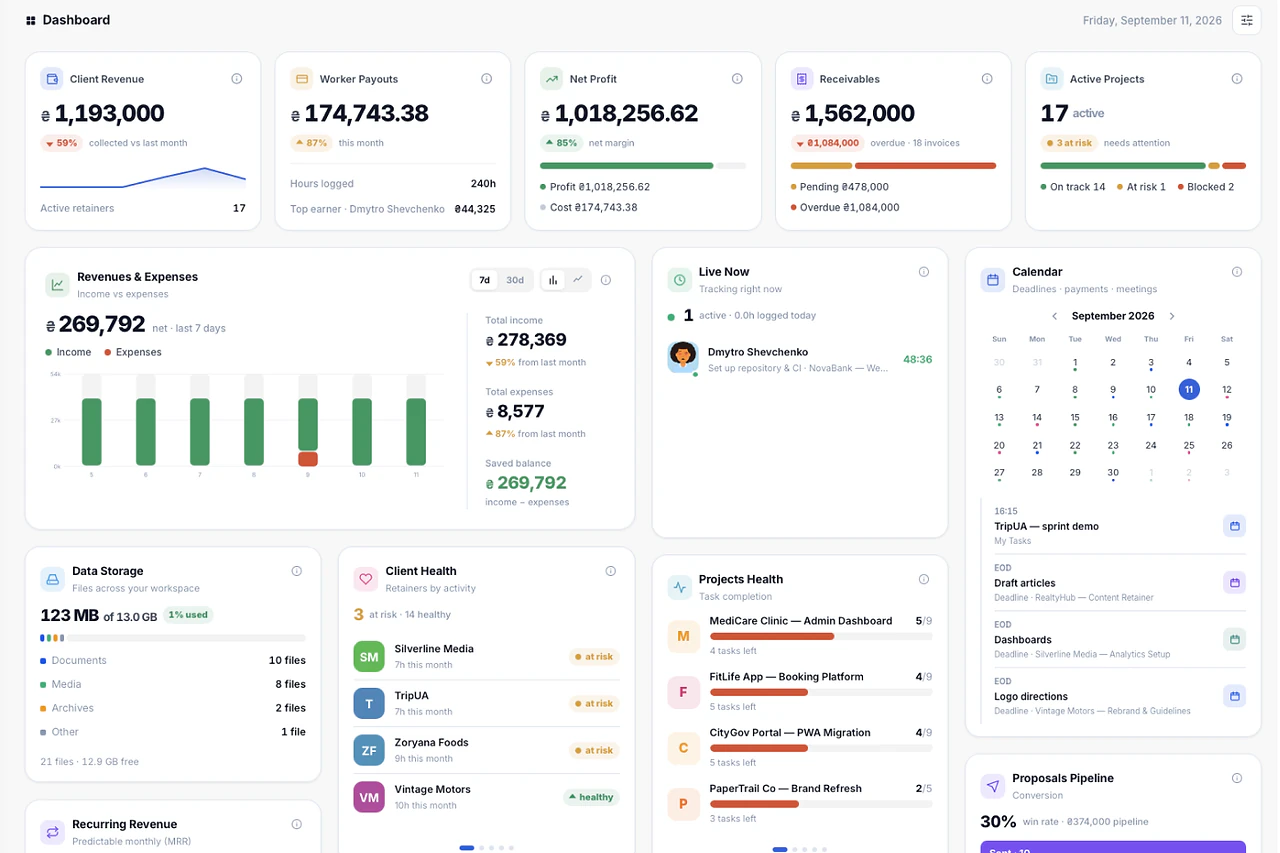
They need to replace passive observation with active data: regular 1:1s with a structured format, sentiment check-ins, visible task boards, and work session data. Not surveillance. Structured visibility..
The best remote teams err toward over-documentation and over-communication. If a decision was made, it's written down. If a process exists, it's documented. If someone is blocked, there's a clear channel to surface it.
Async-First Communication
Synchronous communication (meetings, calls, real-time Slack) is expensive for remote teams. Every meeting requires scheduling across time zones, context-switching, and recovery time.
Async-first teams default to written communication. Decisions are documented before the meeting, not during it. Project updates go in the task tool, not Slack. Questions are asked in writing, not via call, unless the issue genuinely requires real-time back-and-forth.
The measure of a good async message: does the recipient have everything they need to act on it without a follow-up question?
Tools Remote Teams Actually Need
Remote teams do not need more tools. They need fewer, better-integrated ones. The minimum stack:
- Task management: visible to the whole team, showing who's working on what
- Time tracking: especially for billable work; remote makes accurate time logging harder without a built-in timer
- Team calendar: showing leave, meetings, and project milestones across time zones
- Async communication: a channel-based tool where context stays searchable
- Document storage: per-person, per-project, accessible to the whole team without emailing attachments
In Melororium
Manage remote teams in Melororium
Common mistakes with remote team management
What teams get wrong most often, and what to do instead.
- 1
Assuming visibility that isn't there
Managing remotely the same way you'd manage in-office, assuming you'll notice if someone's struggling.
- 2
Meetings as the default communication channel
Scheduling a call for everything instead of using async updates. Constant meetings across time zones burn out a distributed team.
- 3
No single source of truth for status
Letting project status live in whoever you last talked to.
- 4
Ignoring time zone overlap
Scheduling standing meetings without checking who's awake for them.
Frequently asked questions
What is remote team management?
Remote team management is the practice of leading a distributed team where members work from different locations. It replaces passive office observation with structured visibility through tools, check-ins, and documentation.
What are the biggest challenges of managing remote teams?
Three main challenges: visibility (knowing what team members are working on and how they're doing), communication overhead (replacing casual office conversation with structured async communication), and onboarding (integrating new hires without in-person context).
What tools does a remote team need?
The minimum useful stack: task management, time tracking, team calendar, an async communication tool, and document storage. Ideally these are integrated in one workspace to avoid context switching.
What is the biggest challenge in remote team management?
Visibility without micromanagement. Managers lose the ambient awareness of an office: who is working on what, who looks stressed, who is falling behind. The solution is structured async check-ins and data from work reports and time tracking, not constant video calls.