What are Project Artifacts?
Project Artifacts
A project artifact is any tangible document a project produces, from the charter that authorizes it to the backlog that tracks what is left to do.
A project artifact is any tangible document a project produces along the way: a charter, a brief, a work breakdown structure, a backlog, a list of deliverables, a schedule. The word comes from the same root as an archaeological artifact, something a process leaves behind that someone else can pick up, read, and understand without having been in the room when it was made.
Artifacts matter because projects run on more than conversations. A decision made in a meeting and never written down is a decision three people remember three different ways six weeks later. A decision captured in a charter or a scope document is a decision anyone on the project can check against, including the client, including a new hire who joined after the meeting happened.
This entry is a map, not a manual. Melororium's glossary already covers the charter, the client brief, the work breakdown structure, the backlog, and the deliverables list in depth, each with its own template and worked example. What follows here is what an artifact is generically, how the common types relate to each other, and where to go for the one you need.
What Counts as a Project Artifact
Not everything a project produces is an artifact in this sense. The test is whether it persists and can be handed to someone who was not there when it was created.
- Artifact: a written charter, a signed brief, a backlog in a shared tool, a scope document, a meeting agenda saved to the project
- Not an artifact: a verbal agreement in a call, a decision mentioned in passing in a hallway, a chat message nobody pins or references again
- A meeting itself is not an artifact; the agenda before it and the notes after it are
- The line matters because artifacts survive team turnover and time; everything else has to be re-established from scratch when it is needed
The Core Project Artifacts, at a Glance
Six artifacts cover most of what a project produces before and during delivery. Each one is covered in full detail elsewhere in this glossary.
| Artifact | What it captures | Created |
|---|---|---|
| Project charter | Why the project exists, who is accountable, what is explicitly out of scope | Before work starts |
| Client brief | Goals, audience, and constraints, from the client's side | Before or at kickoff |
| Work breakdown structure | Every phase and task needed to deliver the project, broken down until each piece is estimable | Early planning |
| Backlog | The ranked list of work identified but not yet started | Ongoing, for the life of the project |
| Deliverables list | The specific, tangible outputs the project will hand over | Defined at planning, tracked through delivery |
| Milestone plan | The checkpoints along the timeline, each tied to a date | Early planning |
| Project baseline | The approved scope, schedule, and cost, frozen for later comparison against actuals | At sign-off, before execution starts |
Artifact vs Deliverable
These two get confused because a single document can be both at once. The distinction is about audience and purpose.
- An artifact is usually internal: it helps the team plan, decide, and coordinate. A charter, a WBS, a backlog are for the people doing the work.
- A deliverable is what gets handed to the client or stakeholder as the point of the project: a finished website, a campaign report, a signed-off design file
- Some documents are both at once: a strategy report the agency writes to plan the work, then hands to the client as the actual output of a discovery phase
- When it is unclear which one a document is, that ambiguity is worth resolving, since internal and external documents get different levels of polish and different review before they go out
Who Owns and Versions Project Artifacts
An artifact that lives in one person's inbox, or in a document only they can find, is not doing its job. Three habits keep artifacts usable by the whole team.
- One home per artifact: the current charter, brief, and backlog each live in exactly one place, not copied across email, chat, and three different drives
- One owner per artifact: usually the project manager for planning documents, though the client effectively owns the brief and the agency owns the charter built from it
- Dated versions, not silent overwrites: when a charter or scope document changes materially, label the new version and date it rather than editing over the original agreement
How Artifacts Age Over a Project
Artifacts do not all stay active the same way. Some get locked down after approval; others stay alive and change every week.
| Artifact | Typical lifecycle |
|---|---|
| Charter | Frozen after sign-off; changes go through formal revision, not quiet edits |
| Brief | Frozen once the scope built from it is agreed; a new brief means a new phase or project |
| Work breakdown structure | Active during planning, then becomes a reference once execution starts |
| Backlog | Never frozen; reviewed and re-ranked on a running basis for as long as the project exists |
| Deliverables list | Active until each item is marked delivered and accepted |
| Project baseline | Frozen at sign-off; replaced only through a formal rebaseline, not a quiet edit |
Project Artifacts in Melororium
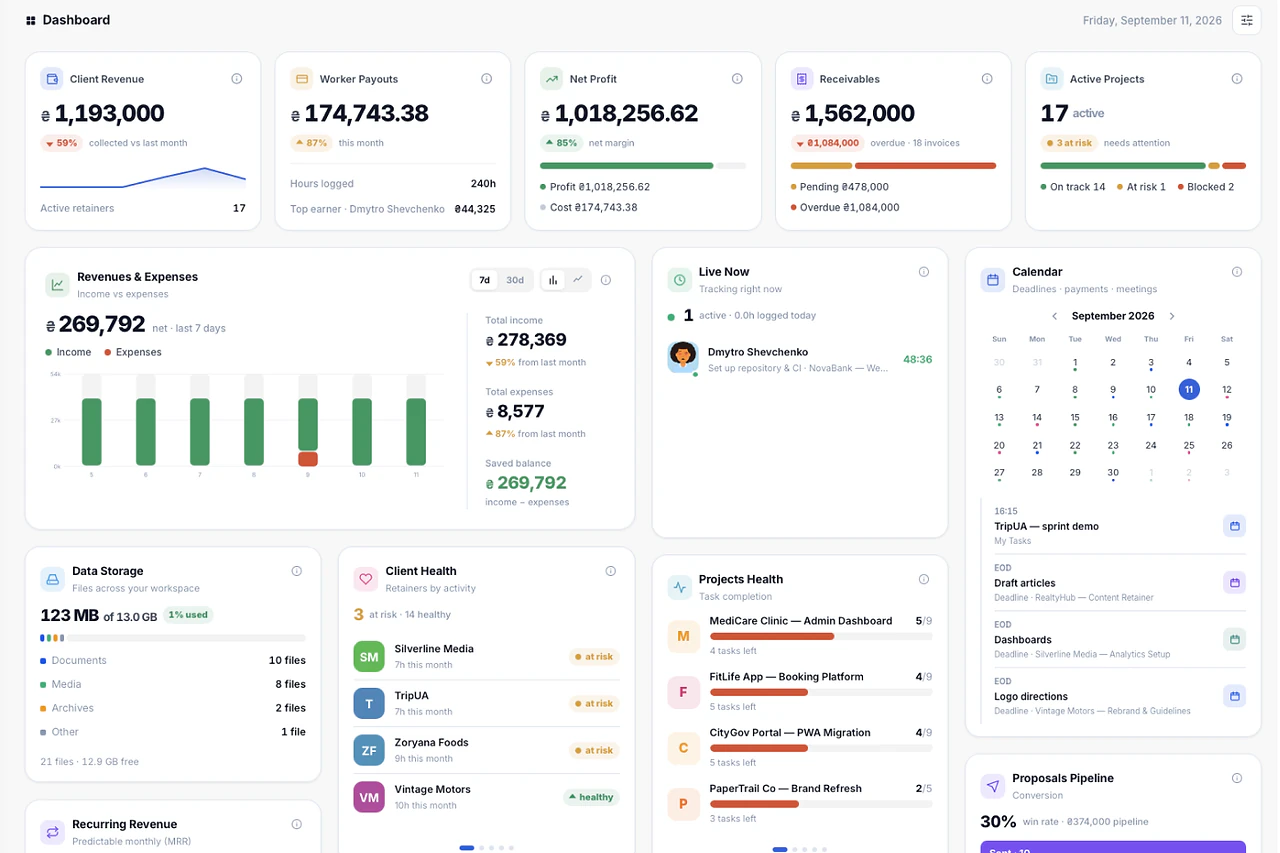
Melororium keeps a project's working documents in Canvas, one shared document per project, alongside the task board, files, and history for that same project. A charter, scope notes, or a working WBS live in the same place the team already checks for status, instead of a separate wiki nobody opens after kickoff. The client brief lives in the Clients module's Intake section, linked to the client record, and the backlog and deliverables list live as tracked tasks and milestones on the project board itself.
14-day free demo at melororium.com. Agency plan at $59/month for 15 users.
In Melororium
Keep every project artifact in one place in Melororium
Common mistakes with project artifacts
What teams get wrong most often, and what to do instead.
- 1
Storing artifacts across five different tools
The charter in a shared drive, the brief in an email thread, the backlog in someone's personal spreadsheet. Nobody, including the project manager, can say for certain which version is current.
- 2
Overwriting instead of versioning
Editing the original charter or scope document directly when something changes, with no record of what the client agreed to at kickoff.
- 3
Producing an artifact once and never opening it again
Writing a WBS or charter during planning, then running the actual project from memory and chat threads instead of the document meant to anchor it.
- 4
Matching every project with the same level of formality
Producing a ten-page charter for a two-week project, or skipping a written brief entirely for a six-month engagement. The artifact should scale with the project, not follow a fixed template regardless of size.
Frequently asked questions
Do small projects need all of these artifacts?
No. Scale to the project: a two-week engagement might need a one-paragraph brief and a task list, while a six-month project benefits from a full charter, WBS, and tracked backlog. The principle behind each artifact matters more than the document format.
What's the difference between a project artifact and a project deliverable?
An artifact is internal, built to help the team plan and coordinate. A deliverable is what the project hands over to the client or stakeholder as its actual output. A few documents serve as both at once.
Who is responsible for keeping project artifacts current?
Usually the project manager for internal planning documents, though ownership of any single artifact should be explicit rather than assumed. A RACI chart is a useful way to assign that ownership up front.
Which artifact should a project start with?
The brief or charter, since both establish why the project exists and what it is meant to achieve before anyone breaks the work into tasks. A WBS or backlog built before that groundwork tends to need rework once the goal is clarified.
Where should project artifacts be stored?
One shared, versioned location tied to the project itself, accessible to everyone who needs it, rather than personal drives, email threads, or chat history that only the original author can search.