What is a Project Portfolio?
Project Portfolio
A project portfolio is the complete set of a team's active and potential projects, managed together so resourcing and priority decisions account for everything competing for the same hours.
A project portfolio is the complete set of projects a business is running, or considering running, managed together rather than one at a time. Where a single project has its own scope, budget, and deadline, a portfolio sits above all of them: it's the view that lets a business decide which project gets the next available hour of the team's time, which one waits, and which one should never have started.
A project portfolio is not a roadmap and not a set of OKRs, even though the three get used loosely as synonyms. A roadmap is a single plan of what ships and roughly when, usually for one product or one line of work. OKRs are a goal-setting framework, an objective paired with the results that prove it happened. A portfolio is neither a plan nor a goal; it's an inventory, every project currently competing for the same pool of people, hours, and budget, looked at side by side so resourcing decisions get made with the full picture instead of project by project.
For an agency or studio running several client engagements at once, the portfolio view answers a question a single project plan can't: given everything already committed, where does the next hire, the next open hour, or the next new client fit? Without that view, a business says yes to a new project the same way it said yes to the last five, and discovers in week 3 that six of them need the same two senior developers in the same week.
Project Portfolio vs Roadmap vs OKRs
The three terms sit at different altitudes and answer different questions, even though they're often used interchangeably:
| Tool | Question it answers | Unit | Typical owner |
|---|---|---|---|
| Project portfolio | What is competing for our time right now, and what should? | Projects, evaluated side by side | Founder, ops lead, or portfolio owner |
| Roadmap | What are we shipping, and roughly when? | Themes or initiatives on a timeline | Product or delivery lead |
| OKRs | What outcome are we chasing this quarter, and how do we know we hit it? | An objective and its key results | Leadership, set with the team |
What Belongs in a Project Portfolio
A portfolio isn't only the projects already underway. Four categories usually sit in the same view:
- Active projects: currently staffed and billing or delivering right now
- Pipeline projects: proposals sent or under negotiation, not yet started but likely to need resourcing soon
- Internal projects: tooling, process work, or marketing that competes for the same hours as client work but doesn't bill
- Paused or at-risk projects: work that's stalled, waiting on a client, or under review for whether it should continue at all
How Projects Get Prioritized Within a Portfolio
Prioritizing across a portfolio is a different exercise from ranking a backlog: the unit is a whole project, not a task, and the criteria weigh business outcomes rather than build effort. Four factors carry the most weight in practice: margin (what this project nets after the hours it costs), strategic fit (does it open a market or client relationship worth more than the invoice), resourcing conflict (does it need people already fully committed elsewhere), and risk (how likely is scope, a client relationship, or a deadline to go sideways). A project can score well on revenue and still lose its place in the portfolio if it needs the one developer three other active projects also depend on that month.
What a Portfolio Health Review Looks At
A portfolio review is a recurring look across every active and pipeline project at once, distinct from a single project's status update. It answers questions no individual project owner is positioned to answer alone:
| Question | What it catches |
|---|---|
| Which projects are over budget or behind, across the whole set? | Problems that look fine project by project but add up to a capacity crisis |
| Is any single person or skill a bottleneck across multiple projects? | A senior developer quietly required by four projects at once |
| What's in the pipeline that would need staffing in the next 4-6 weeks? | New work the team can't absorb without dropping something else |
| What's been paused or stalled for more than a month? | Work quietly consuming attention without moving forward |
How Often to Review the Portfolio
Most agencies and studios review the full portfolio monthly, with a lighter weekly check on anything flagged as at-risk. A monthly cadence catches resourcing conflicts before they become a missed deadline, while staying infrequent enough that it doesn't turn into another status meeting layered on top of each project's own check-ins.
The review needs one owner, not a rotating chair, since portfolio-level trade-offs (delay Project B to protect Project A's deadline) require someone with the authority to make that call across projects, not only within one.
A Worked Example: A 10-Person Studio's Portfolio
Marrow Studio, a 10-person design and development shop, reviews its portfolio on the first Monday of every month. In August, the view looks like this:
| Project | Status | Margin | Resourcing risk |
|---|---|---|---|
| Acme rebrand | Active, on track | 38% | Low |
| Beta Inc platform build | Active, 2 weeks behind | 22% | High: needs the same senior dev as Delta Corp |
| Delta Corp integration | Active, on track | 31% | High: same senior dev as Beta Inc |
| Echo Labs proposal | Pipeline, likely to close | Est. 40% | Needs staffing decision before signing |
| Internal site refresh | Paused 6 weeks | n/a | Low, but stalled |
In Melororium
See your project portfolio in Melororium
Common mistakes with project portfolio
What teams get wrong most often, and what to do instead.
- 1
Managing every project one at a time
Tracking each project's status in isolation and never stepping back to see the whole set, so two projects both need the same senior developer in the same week and nobody notices until it's too late to fix quietly.
- 2
Keeping a project alive on sunk cost
Continuing a low-margin or stalled project because it's already started, when a portfolio review would show it now returns less than a new opportunity waiting in the pipeline for the same hours.
- 3
No single shared view across projects
Each account manager tracks their own project in a separate spreadsheet, so the business has several partial views and no one view showing everything competing for the same team at once.
- 4
Turning the portfolio into a roadmap
Listing every task from every project instead of keeping the view at the project level. A portfolio that granular becomes unusable for the resourcing decisions it exists to support.
Frequently asked questions
How is a project portfolio different from a roadmap?
A roadmap is a single plan of what one product or team intends to ship and roughly when. A project portfolio is broader: every active, pipeline, and paused project a business is running, evaluated together for resourcing and priority, regardless of whether they're on any one roadmap.
How often should a portfolio be reviewed?
Monthly works for most agencies and studios, with a lighter weekly check on anything already flagged as at-risk. Quarterly is too infrequent to catch a resourcing conflict before it costs a deadline.
Who owns the project portfolio on a small team?
One person, usually a founder or operations lead, needs final say on trade-offs between projects, even if project owners contribute status and flag risks. Portfolio decisions cut across projects, so they need someone with authority over the whole set, not only one project.
How many active projects can one portfolio reasonably cover?
There's no fixed ceiling, but past 8 to 10 active projects for a 10-to-15-person team, most businesses find it hard to keep resourcing conflicts visible without a shared, structured view instead of memory and spreadsheets.
Does Melororium have a project portfolio view?
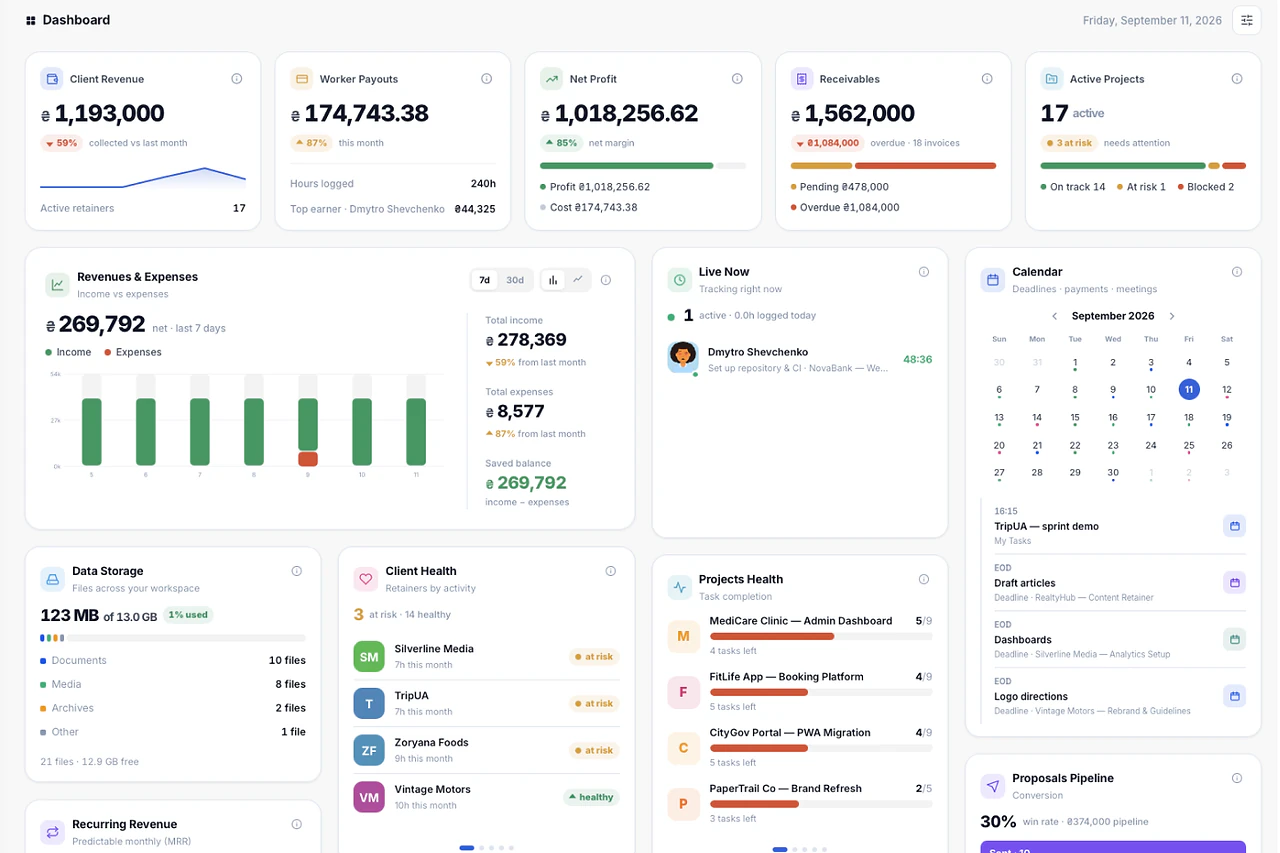
Yes. The Projects module shows every active project's progress, budget burn, and status on one screen, filterable by client or team member, which gives a business the side-by-side view a portfolio review needs without a separate tool.