What is a Project Manager?
Project Manager
A project manager is the person who plans a project, coordinates the people doing the work, and is accountable for delivering it on time and within budget.
A project manager is the person accountable for a project's outcome. They rarely produce the deliverable itself, a designer designs, a developer builds, a copywriter writes, but they make sure the people doing that work have clear priorities, a realistic timeline, and nothing blocking them that could have been resolved a week earlier.
This is a different thing from project management, the discipline covered elsewhere in this glossary. Project management is the practice: planning, tracking, closing. A project manager is the person who practices it, day to day, on a specific set of projects. Every team that delivers work does project management, whether or not anyone holds the title.
On a team of 4 to 10 people, the project manager role is usually combined with another job, an account manager who also runs the board, or a creative director who also chases deadlines. It tends to become a dedicated, full-time role once a team is running more than 4 or 5 concurrent client engagements, at which point coordination alone starts consuming more than a day a week.
What a Project Manager Actually Does
The role breaks down into a handful of recurring responsibilities, repeated on a weekly or daily cycle rather than done once at kickoff.
- Maintains the plan: keeps the timeline, task list, and milestones current as reality diverges from the original estimate
- Assigns and reassigns work: matches tasks to the right person, and moves them when someone is overloaded or blocked
- Tracks budget against actuals: watches hours logged versus hours budgeted, and flags a project before it goes over, not after
- Manages risk and blockers: surfaces what could go wrong next week, not only what already went wrong this week
- Runs communication: keeps the client or stakeholder informed without pulling the delivery team into every conversation
- Protects scope: says no, or negotiates a trade, when a request threatens the agreed timeline or budget
Project Manager vs Product Manager
These titles get used interchangeably at small companies, especially once one person holds both sets of responsibilities, but they answer different questions.
| Aspect | Project Manager | Product Manager |
|---|---|---|
| Core question | Is this defined scope of work on track, on time, on budget? | What should we build next, and why? |
| Owns | The delivery plan for one or more projects | The roadmap and priority order for a product |
| Time horizon | Weeks to months, tied to a delivery date | Quarters to years, tied to market outcomes |
| Typical setting | Agencies, service teams, client delivery | Software companies building their own product |
Project Manager vs Scrum Master vs Account Manager
Three roles that sit close to each other on an org chart and get confused constantly, especially on small teams where one person holds two of them at once.
| Role | Scope of ownership | Has budget authority? |
|---|---|---|
| Project Manager | Delivery of one or more projects, any methodology | Usually yes |
| Scrum Master | The Scrum process for one team, one sprint at a time | No, focused on process and blockers |
| Account Manager | The commercial relationship with a client | Owns the contract, not always day-to-day delivery |
Skills That Separate a Good PM From a Struggling One
Title and years of experience matter less than a specific set of habits that show up in how a project runs day to day.
- Estimating with a buffer, not a wish: padding timelines for the inevitable blocker instead of planning against a perfect week
- Running meetings inside a fixed time box, every time, not letting a 15-minute standup drift into 40 minutes
- Saying no to scope additions without damaging the relationship, by naming the tradeoff instead of refusing outright
- Telling apart a task that's genuinely blocked from one that nobody has started yet, since each needs a different fix
- Writing status updates a client can read in 30 seconds, not a paragraph that buries the one thing that matters
How Many Projects Should One PM Manage?
The right number depends on project complexity, not a fixed rule, but most agencies converge on a similar range once they've run it for a few quarters.
| Project type | Typical concurrent load per PM |
|---|---|
| Simple recurring retainers, low revision volume | 8 to 12 |
| Medium complexity, multi-week engagements | 4 to 6 |
| Complex, high-touch, multi-stakeholder projects | 2 to 3 |
A Day in the Life of a PM at a 10-Person Agency
Renata runs delivery for a 10-person agency across 6 active client projects, ranging from a 2-week social campaign to a 12-week brand overhaul. Her day starts with a 10-minute board review before anyone else logs in: which tasks moved overnight, which are sitting untouched past their deadline, which project's budget burn crossed 80%.
At 9:30, a 15-minute standup with the delivery team surfaces one blocker: a designer waiting on brand assets a client promised Monday and hasn't sent. Renata sends the client a direct follow-up before 10am rather than letting the designer chase it themselves. At 11, a client call for the brand overhaul project covers a milestone review, 20 minutes of showing completed work, 10 minutes of feedback, confirmed in writing the same day.
The afternoon is budget and risk work: she checks hours logged against budget on all 6 projects, flags one running 15% over its midpoint estimate, and moves a task from an overloaded designer to a copywriter with spare capacity that week. By 5pm, the board reflects reality again, and tomorrow's standup starts from an accurate picture instead of a guess.
- 6 concurrent projects, ranging from 2 to 12 weeks
- 10-minute board review before the team logs in, every day
- One blocker chased directly with the client rather than left for the assignee
- Budget check across all 6 projects every afternoon, not once a week
Tools a Project Manager Uses in Melororium
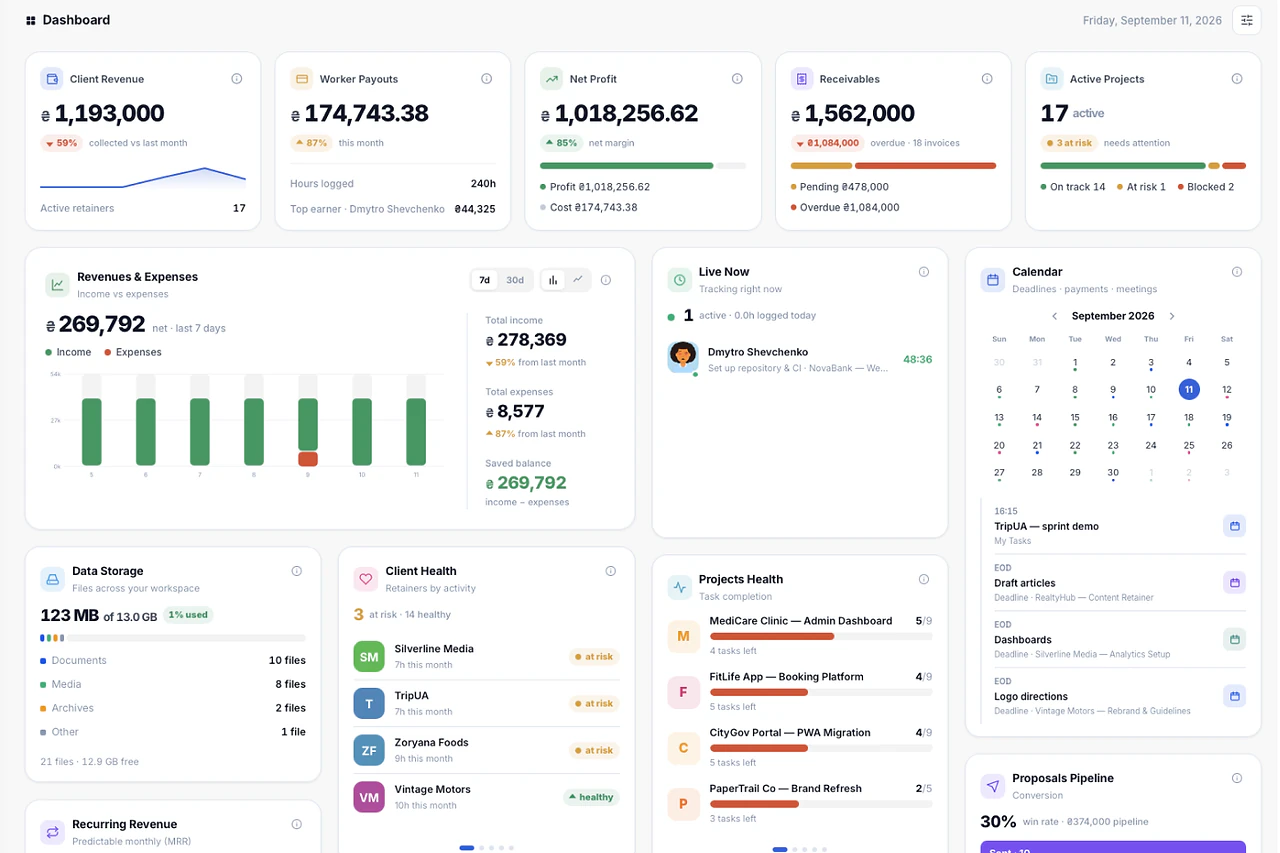
A PM's day runs on four screens in Melororium: Dashboard for the cross-project overview at a glance, Budget Guardian for real-time spend against each project's budget, Work Reports for hours by person and project, and Project Alerts for automatic warnings on overdue tasks and stalled work before a client notices.
Because all four pull from the same data as the task board, a PM doesn't reconcile numbers between a time tracker, a spreadsheet, and a project tool. The board is the single source of truth.
Dashboard, Work Reports, and Time Tracker are included in every plan from $29/mo. Budget Guardian and Project Alerts are included from the Agency plan at $59/mo for 15 users.
In Melororium
See a project manager's dashboard in Melororium
Common mistakes with project manager
What teams get wrong most often, and what to do instead.
- 1
Managing status instead of managing risk
Spending the week producing reports that restate what's already visible on the board, instead of looking ahead for what could go wrong before it does.
- 2
Being the only person who knows the plan
Keeping the real timeline in a personal notebook or their own head instead of a shared system, so the project stalls the day they're out sick.
- 3
Saying yes to avoid an uncomfortable conversation
Agreeing to scope additions or unrealistic deadlines to keep the peace, then letting the delivery team absorb the cost without ever naming the tradeoff out loud.
- 4
Running the same meeting format for every project
Giving a 2-week retainer the same 45-minute weekly check-in as a 12-week rebuild. One wastes everyone's time; the other doesn't get enough attention.
Frequently asked questions
Does a small team need a dedicated project manager?
Not always. Under 3 or 4 concurrent projects, most teams handle coordination informally through an account manager or team lead. Past that point, coordination starts consuming enough time that a dedicated role usually pays for itself.
What certifications do project managers have?
The most recognized are PMP and CAPM from the Project Management Institute, PRINCE2 in the UK and parts of Europe, and CSM for teams running Scrum specifically. None are required to do the job well, but they signal a shared vocabulary on larger teams.
Can one person be a project manager and also do billable work?
Yes, and on small teams it's common. The risk is that PM tasks like status checks and risk reviews are easy to skip when billable client work is due, so the projects with the least oversight tend to be the PM's own deliverables.
What's the difference between a project manager and project management?
Project management is the discipline: planning, tracking, and closing work. A project manager is the person who practices that discipline on a specific set of projects. Every team does project management; not every team has someone with the title.
Does Melororium replace the need for a project manager?
No. Melororium gives a PM the dashboard, budget tracking, and alerts to do the job with less manual reporting, but the judgment calls, prioritizing, negotiating scope, deciding what to escalate, still belong to a person.