What is a Client Health Score?
Client Health Score
A client health score is a single number, usually 0-100, that shows how engaged and at-risk a client relationship currently is, based on real signals.
A client health score is a number from 0 to 100 that represents how actively engaged a client is with your agency right now. It combines data points already in your CRM, such as active task count, days since last contact, and whether a follow-up is scheduled, into a single signal.
The score answers one question: which clients need attention today? Without it, account managers rely on memory to answer that question. Memory fails at scale. A PM managing eight clients can track relationship health intuitively. A PM managing fifteen cannot.
Enterprise SaaS companies have used health scores for customer success for years. Agencies have the same churn problem and the same solution available, using different input data.
Why Agencies Use Health Scores
Client churn at agencies rarely announces itself. A client does not call to say 'we're drifting away.' What happens instead: calls become less frequent, revision requests slow down, the PM stops logging contact because there is nothing to log. Three months later the client sends a short email.
A health score catches this pattern at the second month, not the third. When contact drops below 30 days and no new work is active, the score falls below 50 and the client enters 'At Risk.' That flag appears on a dashboard. The PM makes a call.
Healthy accounts also benefit from scoring. A score above 80 with expanding task count is a signal to propose new scope. Without the score, that expansion opportunity goes unnoticed until the client brings it up themselves.
- Replaces gut-feel account tracking with a measurable signal
- Surfaces at-risk clients before they reach the decision to leave
- Identifies accounts where upsell is timely based on activity data
- Gives new team members instant context without a briefing from the outgoing PM
How to Calculate a Client Health Score
The formula combines four categories of signals: activity, contact recency, project status, and follow-up scheduling. Start with a base of 50, then add or subtract based on each factor.
Activity signals: active tasks in progress (+25), no active tasks (-15), active projects (+10).
Contact recency: contacted within 14 days (+15), within 30 days (+5), 31 to 60 days ago (-10), more than 60 days ago (-25), never contacted (-10).
Follow-up: follow-up date set (+5).
Clamp the result to 0-100. A client with active work and a call three days ago scores around 90. A client with no tasks and last contact 70 days ago scores around 10.
This formula is a starting point. Mature implementations add invoice status as a negative signal. A client with two overdue invoices should score lower than their task count alone would suggest.
| Signal | Condition | Score Change |
|---|---|---|
| Active tasks | In progress | +25 |
| Active tasks | None | -15 |
| Projects | Has active projects | +10 |
| Last contact | Within 14 days | +15 |
| Last contact | Within 30 days | +5 |
| Last contact | 31-60 days ago | -10 |
| Last contact | Over 60 days ago | -25 |
| Last contact | Never | -10 |
| Follow-up | Date set | +5 |
The 3 Health Buckets: Healthy, At Risk, Dormant
Three buckets convert the raw score into actionable categories.
Healthy: score 50 or above with some recent activity. Standard account management applies. Schedule a monthly check-in, look for expansion opportunities.
At Risk: score below 50. Something has slipped, whether contact frequency, active work, or both. The right response is an unscheduled call, not an email. Find out what changed.
Dormant: no active tasks AND either no contact history or last contact more than 60 days ago. Dormant is not simply a very low score. It identifies clients who may have already made a decision to leave, they just have not said so yet. The Dormant bucket requires a personal outreach, not a drip email.
- Healthy (50+): active work, recent contact, regular follow-up
- At Risk (below 50): something has slipped, needs unscheduled attention
- Dormant: no active work plus stale or missing contact history
Client Health Score vs NPS
NPS (Net Promoter Score) asks clients how likely they are to recommend you. It is a survey-based metric, retrospective by nature, and typically run quarterly or annually. A client can give you a score of 9 in February and be considering cancellation by April without any NPS data changing.
A health score is operational, not survey-based. It reads from your CRM data in real time. No client action required. No survey response lag. The score reflects what is actually happening now: task activity, communication frequency, billing status.
The two metrics serve different purposes. NPS measures sentiment at a point in time. Health score measures engagement continuously. Agencies need both, but health score is more actionable for day-to-day account management.
Automating Client Health Scores
A health score that requires manual entry defeats its own purpose. If a PM must update a field to trigger recalculation, the field gets updated inconsistently, and the score becomes stale within days.
Automatic calculation reads directly from existing CRM data: task records, contact log timestamps, project records, and follow-up dates. No new data entry. No scheduled jobs. The score recalculates every time the data it depends on changes.
In Melororium, the health score runs client-side on every render. Log a contact call, and the score updates the moment you click save. Create a task for a dormant client, and they move from Dormant to At Risk in the same view reload. The score reflects the current state, not yesterday's snapshot.
- Calculate from existing CRM data, no new inputs required
- Recalculate in real time when relevant data changes
- Surface the score and its contributing reasons, not just the number
- Show Dormant clients separately from At Risk, not just sorted by score
Client Health Score in Melororium
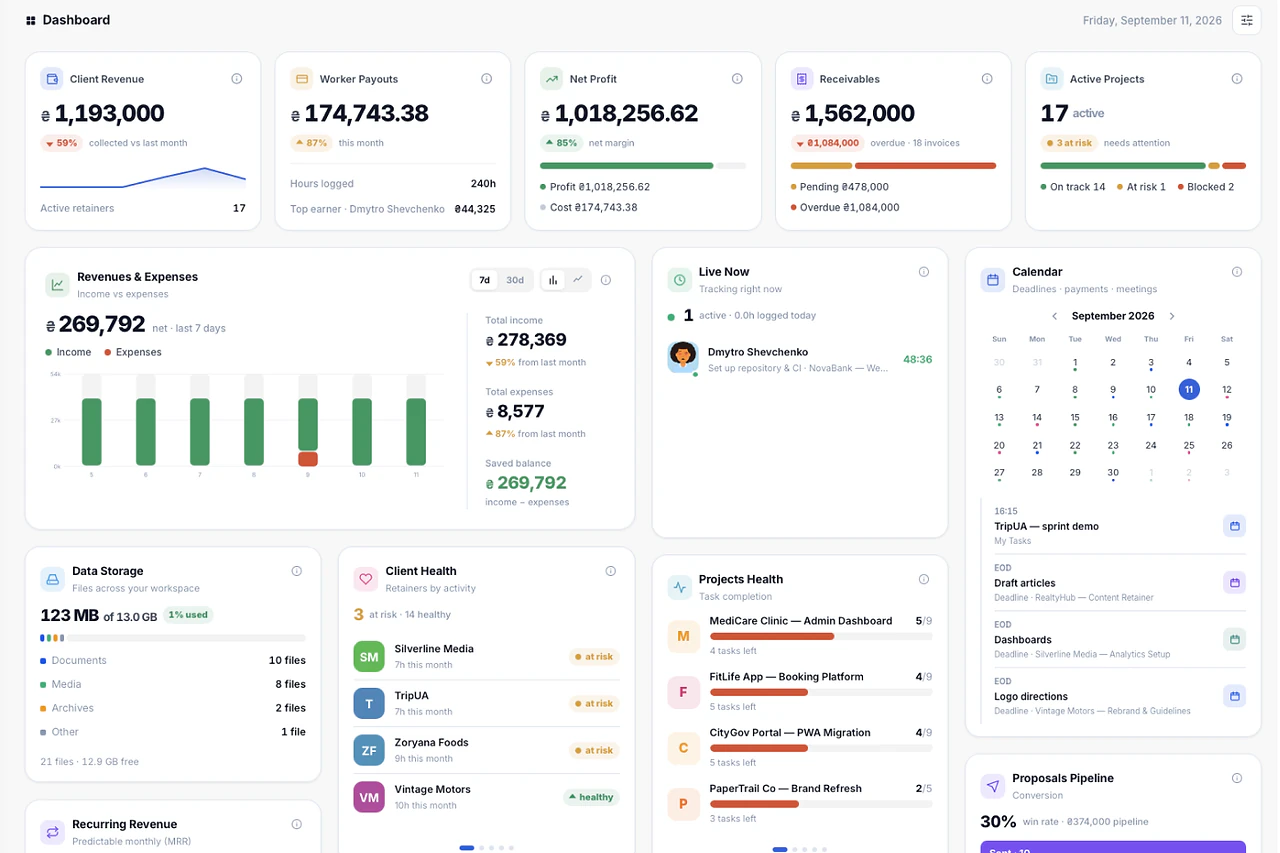
The Health section in Melororium's Clients module shows three stat cards at the top: Healthy, At Risk, and Dormant counts. Below them, two tables list At Risk clients and Dormant clients in priority order.
Each row shows the client name, the score, the responsible team member, and a 'Why' column with the specific factors pulling the score down: 'No active work, 47d since contact' or 'Follow-up overdue.' The PM reading this row knows exactly what to do next.
The score recalculates on every page render from live Zustand store data. No stale overnight batch. No manual refresh. Starter plan ($29/mo, 4 users), Agency plan ($59/mo, 15 users), Studio plan ($119/mo, 25 users). All plans include the CRM and health scoring.
In Melororium
Client health scoring in Melororium
Common mistakes with client health score
What teams get wrong most often, and what to do instead.
- 1
Basing it only on payment status
Scoring health purely on whether invoices are paid on time.
- 2
No regular recalculation
Calculating the score once and not updating it as the relationship changes.
- 3
Ignoring engagement signals
Leaving out response time, meeting attendance, and feedback frequency.
- 4
No action tied to a low score
Calculating scores and never following up on the ones that drop.
Frequently asked questions
What is a good client health score?
A score above 70 indicates a healthy, active client relationship with recent contact and ongoing work. Scores between 50 and 70 are stable but warrant attention. Below 50 signals a relationship that needs intervention.
How often should a client health score update?
Ideally on every relevant data change: when you log a contact, create a task, or update a project. Daily batch recalculation is the minimum acceptable. Weekly batch jobs produce scores too stale to act on.
What data inputs does a client health score need?
At minimum: last contact date, active task count, active project count, and follow-up date. More advanced implementations add invoice payment status and meeting frequency.
What should I do when a client goes dormant?
Make a personal call. Not an automated email, not a drip sequence. A dormant client who receives a personal call from the account lead has a realistic chance of re-engagement. One who receives a marketing email does not.