What is Invoice Aging?
Invoice Aging
Invoice aging groups overdue invoices by how long they've been outstanding, like 0-30, 31-60, and 60+ days, so you can see which unpaid bills need attention first.
Invoice aging is the practice of grouping unpaid invoices by how many days they have been outstanding. An aging report breaks overdue invoices into buckets, typically 0 to 30 days, 31 to 60 days, and 60 days or more, and shows the total amount and count in each bucket.
The term 'aging' is literal. An invoice ages from the moment it is issued or becomes overdue. The older it gets, the lower the probability of collection. Research in accounts receivable management consistently shows that invoices unpaid past 90 days have a collection rate below 25%.
For agencies running retainers or project-based billing, aging reports answer one question clearly: which clients owe the most, and how urgent is each?
Invoice Aging Buckets Explained
Aging buckets segment overdue invoices by time ranges. Standard buckets in agency billing are 0 to 30 days, 31 to 60 days, and 60 days or more.
- 0-30 days: recently overdue, high collection probability, standard follow-up applies
- 31-60 days: payment is delayed, a direct call is more effective than an email
- 60+ days: collection probability drops sharply, escalation or formal notice may apply
- Oldest invoice: the single oldest overdue invoice signals the most severe collection problem
How to Read an Invoice Aging Report
An aging report typically has clients as rows and time buckets as columns. Each cell shows the amount outstanding for that client in that bucket. A totals row at the bottom shows aggregate exposure per bucket.
The two numbers to act on first are the 60+ day total (your most at-risk receivables) and the oldest invoice age (measured in days since the due date). An agency with $8,000 in the 0-30 bucket and $1,200 in the 60+ bucket should prioritize the $1,200. It has a much lower probability of collection than the fresh overdue amounts.
| Client | 0-30 days | 31-60 days | 60+ days | Total |
|---|---|---|---|---|
| Acme Studio | $0 | $1,200 | $0 | $1,200 |
| Brand Co. | $800 | $0 | $2,400 | $3,200 |
| Vista Agency | $1,500 | $0 | $0 | $1,500 |
| Totals | $2,300 | $1,200 | $2,400 | $5,900 |
Invoice Aging and Agency Cash Flow
Agencies front-load their costs. Designers, developers, and writers get paid whether or not the client invoice has cleared. When invoice aging accumulates, the agency funds client work from its own reserves.
A $5,000 invoice 45 days overdue is not just a collection problem. The agency has already paid salary and overhead against that revenue. The longer it stays uncollected, the more it functions as an interest-free loan to the client.
Tracking aging in real time, rather than checking it manually at month-end, gives account managers a chance to follow up before the problem compounds. A call at day 35 is far more productive than a call at day 75.
Invoice Aging vs Simply 'Overdue'
Most invoicing tools show an 'Overdue' list: invoices past their due date, sorted by date. This is better than nothing but loses information. Ten invoices that are all 'overdue' look identical on a flat list. An aging report shows that three of them are 5 days past due and two are 72 days past due. The follow-up priorities are completely different.
Aging reports also accumulate over time. You can compare this month's 60+ day total to last month's to see whether old debt is resolving or building. A flat overdue list gives you no trend data.
Invoice Aging in Melororium
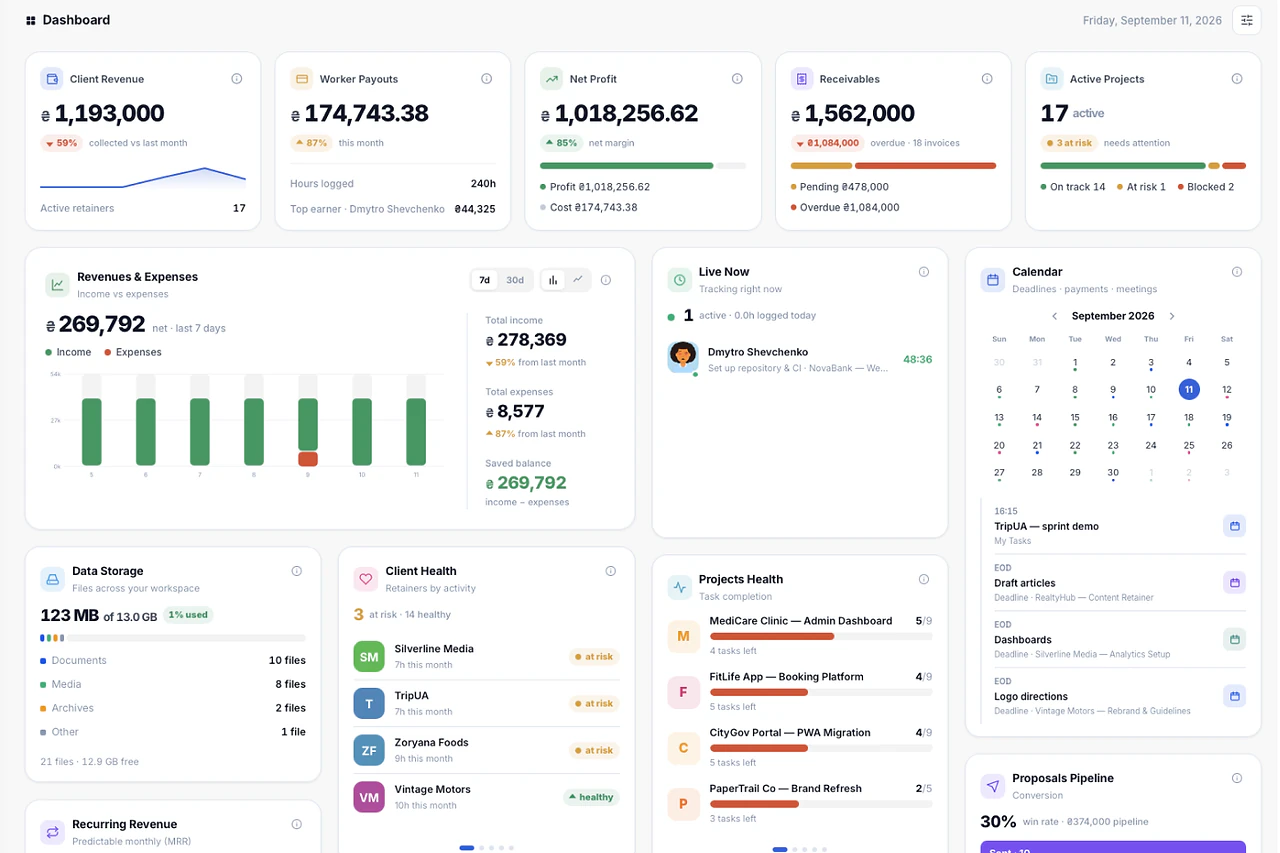
The Invoices section in Melororium shows a stat card for Overdue invoices with a segmented bar visualization. The bar splits outstanding amounts into three colored segments: green for 0 to 30 days, amber for 31 to 60 days, and red for 60 or more days.
A secondary indicator, 'oldest days,' tracks the maximum age across all overdue invoices. When any invoice exceeds 90 days overdue, the stat card displays a red border as a priority flag.
The Overdue filter tab shows the full list of overdue invoices in date order. Each invoice opens in an inline drawer without a page reload. The collection rate stat card shows what percentage of invoiced amounts have been paid this month.
Agency plan at $59/month for 15 users. Start a 14-day free demo at https://melororium.com.
In Melororium
Invoice aging tracking in Melororium
Common mistakes with invoice aging
What teams get wrong most often, and what to do instead.
- 1
Only looking at total overdue amount
Tracking one lump "overdue" number instead of breaking it into aging buckets.
- 2
No follow-up trigger by bucket
Not defining what happens automatically when an invoice crosses into the next bucket.
- 3
Treating every client the same regardless of aging
Applying the same gentle reminder to a 90-day-overdue account as a 10-day one.
- 4
Not reviewing aging reports regularly
Checking the report only when cash feels tight, instead of on a fixed weekly cadence.
Frequently asked questions
What are typical invoice aging buckets?
Standard buckets are 0-30 days, 31-60 days, and 60+ days. Some accounting systems use 0-30, 31-60, 61-90, and 90+ for finer granularity. For agency billing, three buckets give enough resolution for action decisions.
What is accounts receivable aging?
Accounts receivable aging is the same concept applied to all outstanding receivables, not just invoices. In agency contexts, invoice aging and AR aging refer to the same practice.
What collection rate should I expect after 60 days?
Collection rates decline sharply past 60 days. Research in accounts receivable shows rates dropping from roughly 80-90% in the 0-30 day bucket to under 50% in the 60-90 day bucket and below 25% past 90 days.
How do I reduce invoice aging at my agency?
Three levers work: send invoices on time (day-of or day-before due date), follow up at day 7 and day 14 past due with a call not an email, and add a payment link to every invoice. Reducing friction between receiving the invoice and paying it cuts aging consistently.