What is Labor Cost?
Labor Cost
Labor cost is what an employee's time costs the business, hourly rate multiplied by hours logged, the real input behind project profitability.
Labor cost is the expense of employee time. The formula is straightforward: hours worked multiplied by hourly rate. A designer who logs 8 hours at $60/hr costs $480 in labor for that day.
For project-based teams, labor cost is the most controllable variable in project profitability. Revenue is often fixed at the point a contract is signed. Expenses are harder to predict. But labor cost, the time your team puts into a project, is trackable in real time, which makes it manageable in a way that most other costs are not.
Tracking labor cost accurately requires two inputs: reliable time logs and current hourly rates. When both are in the same system, labor cost calculates automatically. When they are in separate systems, labor cost becomes a manual calculation that always lags behind reality.
Labor Cost vs. What You Bill the Client
Labor cost is your internal expense. What you charge the client is separate. The gap between the two is your margin.
If a project generates $10,000 in revenue and $6,500 in labor cost, the gross margin is 35%. If labor cost rises to $9,000 because the project took longer than scoped, the margin drops to 10%, even though the invoice amount did not change.
This gap between quoted scope and actual labor cost is the most common source of profitability problems in agencies. The project was profitable on paper at the start. Labor cost made it unprofitable before anyone noticed.
How to Calculate Labor Cost Per Project
Manual calculation: list every person who worked on the project, multiply their hours by their rate, and sum the totals. Repeat for each period.
Automated calculation: set each employee's hourly rate in a system. When they log time against tasks, the system multiplies hours by rate and accumulates the total per project automatically. Cost is always current, always per-project, and requires no manual work.
The automated approach is the only reliable option for teams running more than two or three concurrent projects. Manual calculation at scale is too slow and too error-prone.
- Set each employee's hourly rate once in team settings
- Team members log hours against project tasks
- System calculates: hours logged × rate = cost per session
- Sessions accumulate to project total in real time
- Compare project total to project budget to get margin
Labor Cost in Melororium
Each employee in Melororium has an hourly rate set by an admin. Every time log records the cost at the moment of logging (hours × rate). This means rate changes only affect future logs: historical cost is preserved.
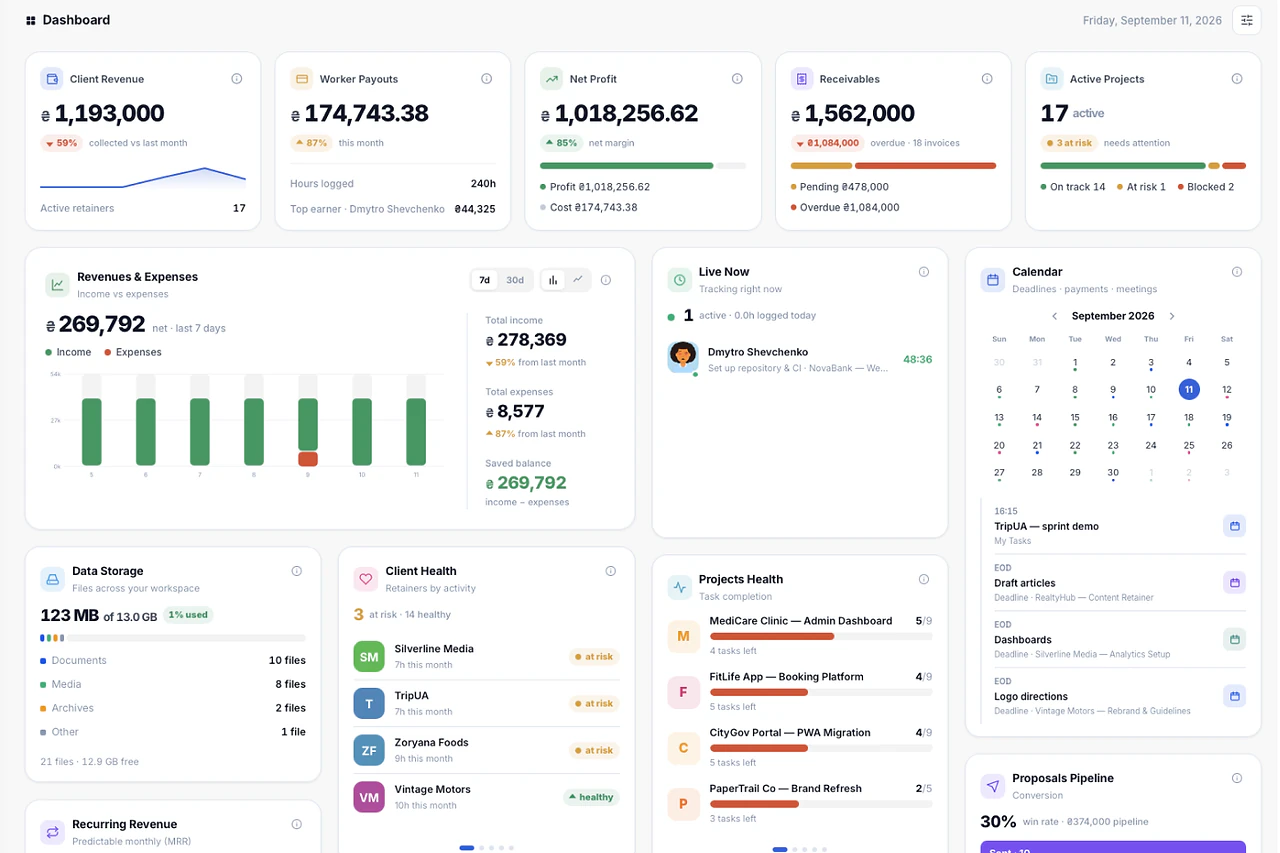
Project-level labor cost appears in the Budget Guardian tab (total spent, profit margin, burn chart). Period-level labor cost appears in Work Reports (total cost, blended rate, cost per person per project in the matrix). Both views update as time is logged: no export, no formula, no manual work required.
In Melororium
Labor Cost Tracking in Melororium
Common mistakes with labor cost
What teams get wrong most often, and what to do instead.
- 1
Using salary instead of true hourly cost
Dividing annual salary by a rough hours estimate instead of a real loaded hourly rate that includes benefits and overhead.
- 2
One blended rate for the whole team
Applying the same hourly cost to a junior and a senior team member.
- 3
Not updating rates as pay changes
Leaving old hourly rates in the system after a raise or a new hire at a different salary.
- 4
Excluding non-billable time from cost
Counting labor cost only for hours billed to a client.
Frequently asked questions
Do I include owner/admin time in labor cost?
Melororium sets owner and admin hourly rates to $0 by default. Their time does not count toward project labor cost. This prevents distorting project margins with management time that is not allocated to specific deliverables. Adjust the rate if you want to track management time as a cost.
What if a team member's rate changes mid-project?
Existing time logs keep the rate they were logged at. Future logs use the new rate. This preserves historical cost accuracy while applying the correct rate going forward.
Where do I see labor cost in Melororium?
Three places: Work Reports (total and matrix by period), Budget Guardian tab per project (spend vs budget), and Live Timers (today's total labor cost KPI card).