What is Lead Time?
Lead Time
Lead time is the total time from when a task is requested to when it's delivered, including whatever time it spends waiting before work begins.
Lead time is the total elapsed time between when work is requested and when it's delivered. If a client submits a revision request Monday morning and receives the finished revision the following Monday, lead time is 7 days, regardless of how many of those days the team spent working on it.
Lead time is a client-side measurement. It answers the question every client asks: I asked for this, when do I get it? It doesn't distinguish between time the team spent working and time the request spent sitting in a queue waiting for someone to pick it up. Both count.
Lead time is often confused with cycle time, a related but different metric that only measures active work time. The two numbers tell different stories, and a team that tracks only one is missing half the picture. See Cycle Time for the full definition of that metric; this entry focuses on lead time.
The Lead Time Formula
Lead time equals delivery date minus request date. That's the full calculation, there's no subtraction for weekends, waiting time, or anything else, unless a team explicitly decides to track business-day lead time instead of calendar-day lead time. Both are valid measurements, as long as the team stays consistent about which one it reports.
Lead Time vs Cycle Time: The Key Difference
The distinction is where the clock starts. Lead time starts when the request is made. Cycle time starts when someone begins the work.
| Metric | Clock starts | Clock ends | Answers |
|---|---|---|---|
| Lead time | Request or ticket created | Task delivered | How long did the client wait, start to finish? |
| Cycle time | Work begins | Task delivered | How long does the team take once it starts? |
Why Lead Time Is the Metric Clients Feel Directly
A client doesn't experience your internal Kanban board. They experience the interval between asking and receiving. A team with a 1-day cycle time but requests sitting untouched for 6 days in a backlog still delivers a 7-day experience to the client, and that's the number the client remembers.
Lead time is also the number that belongs in an SLA or a retainer agreement, because it's the promise a client can verify from their own side of the relationship, without any visibility into how the work was staged internally.
What Adds to Lead Time Beyond Active Work
Several sources of delay show up in lead time but never show up in cycle time.
- Queue time, the days a request sits in a backlog before anyone picks it up
- Approval waits, time spent waiting on an internal sign-off before work can begin
- Handoff gaps, the delay between one person finishing their part and the next person starting theirs
- Weekends and holidays, when lead time is tracked in calendar days rather than business days
- Blocked time, when a task starts, stalls on a missing asset or answer, and later resumes
A Worked Example: Calculating Lead Time on a Revision Request
A client submits a homepage revision request on Monday morning.
| Event | Timestamp | Elapsed |
|---|---|---|
| Request submitted | Mon 9:00 AM | - |
| Picked up by designer | Wed 11:00 AM | 2 days 2h (queue time) |
| Work completed and delivered | Wed 4:00 PM | 5h (cycle time) |
Reducing Lead Time Without Rushing the Work
Since most lead time is queue time, not work time, the fastest way to shorten it rarely involves asking the team to work faster.
- Set WIP limits so a new request gets picked up sooner instead of sitting behind everything already in progress
- Set an intake commitment, every new request gets a first look within 1 business day, even if the full task takes longer
- Separate quick requests from large ones with a fast lane, so a 20-minute fix doesn't wait behind a 3-day project
- Flag requests that have sat untouched past a threshold, so queue time becomes visible before a client asks about it
Lead Time in Melororium
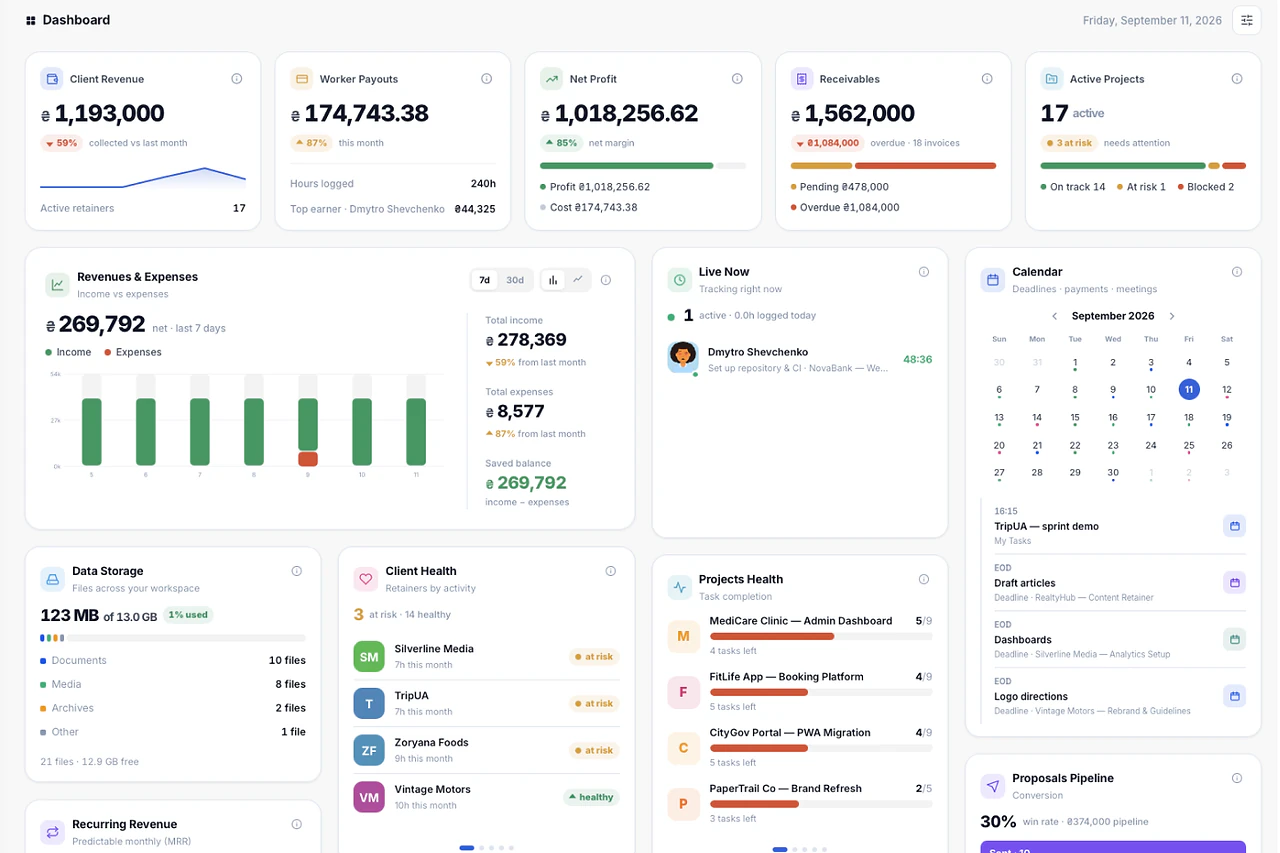
Project History logs every status change and reassignment with a timestamp, so lead time, task creation to task closed, is calculable directly from the record instead of reconstructed from memory. Project Alerts flags a task that's sat untouched past a set number of days before it becomes a client-visible delay. Combined with Work Reports, teams see lead time trends by client or by task type without exporting to a spreadsheet.
In Melororium
Track lead time from task history in Melororium
Common mistakes with lead time
What teams get wrong most often, and what to do instead.
- 1
Only measuring lead time on tasks that finished on time
Calculating an average from the tasks that went smoothly and leaving out the ones still stuck in a queue. The stuck ones are exactly the data that explains why lead time is worse than the average suggests.
- 2
Averaging lead time across unrelated task types
Blending a 20-minute copy fix and a 3-week campaign build into one lead-time number. The average lands somewhere that describes neither task, and a team can't act on a number that represents nothing real.
- 3
No intake commitment, so queue time grows unnoticed
Letting new requests sit with no promise on when they'll get a first look. Without a stated commitment, queue time creeps upward gradually and nobody notices until a client asks why a simple request took a week.
- 4
Chasing a shorter number by rushing delivery
Cutting lead time by skipping review steps or delivering before work is finished. A faster number that ships more revisions back to the queue isn't a real improvement, it's the same work arriving later under a different label.
Frequently asked questions
What is a good lead time for an agency?
It depends on task type. For simple revision requests, a target under 2 business days is reasonable. For larger deliverables inside a project, 5 to 10 business days is typical. The useful number isn't a universal target, it's your own historical average, tracked so you notice when it drifts.
Does lead time include weekends and holidays?
Depends on how a team chooses to report it. Calendar-day lead time counts every day, which is what a client experiences. Business-day lead time excludes weekends and holidays, which is more useful for comparing team performance across periods. Pick one and stay consistent.
How do you calculate average lead time for a team?
Take the lead time of every completed task over a period, delivery date minus request date, then average them, ideally segmented by task type rather than blended into one number. Most teams calculate this weekly or monthly.
Why does lead time keep growing even though the team isn't slower?
Usually because queue time is growing, not cycle time. More requests are arriving than the team can start promptly, so tasks wait longer before anyone touches them. WIP limits and an intake commitment address this directly.
Does Melororium track lead time automatically?
Project History timestamps every status change, so lead time, creation to close, is available from the task record without manual calculation.