What is Procrastination?
Procrastination
Procrastination is delaying a task despite knowing the delay makes it harder to finish, usually because the task has no clear first step, no visible size, or no near-term consequence for waiting.
Procrastination is putting off a task you intend to do, despite knowing the delay will cost you later. On an individual level it feels like a willpower problem. On a team, it's usually a design problem: the task that sits untouched for a week almost always has something wrong with how it was defined, not with the person assigned to it.
The most common trigger isn't the size of the task itself, it's the absence of a clear first action. "Redesign the client's homepage" and "draft two wireframe options for the hero section" describe overlapping work, but one has an obvious starting point and one doesn't. A task with no obvious first move sits in a queue longer than a task that tells the assignee exactly what to open first.
For a manager, the useful shift is treating procrastination as a signal to investigate rather than a character flaw to correct. A task sitting untouched for four days is telling you something: the deadline is too distant to feel real, the scope is too vague to start, or the task is genuinely blocked and mislabeled as open. Each of those has a different fix, and none of them is solved by asking someone to try harder.
Why Procrastination Happens on Teams
Four conditions predict whether a task gets picked up quickly or sits idle, and they have little to do with how conscientious the assignee is.
- Ambiguous first step, the task describes an outcome ("improve onboarding") but not an action, so there's no obvious place to start
- Oversized scope, the task bundles multiple days of work under one card, so it never looks like something that can be finished in one sitting
- Distant deadline, a 3-week runway with no interim checkpoint makes week one feel optional
- No visible cost to waiting, nobody notices or asks about the task until it's already late
Procrastination vs Being Blocked: Not the Same Problem
A task sitting untouched looks identical whether the assignee is avoiding it or genuinely can't move forward. Treating both cases the same way wastes a manager's time and misdiagnoses the fix.
| Signal | Procrastination | Blocked |
|---|---|---|
| What's missing | A clear starting point or motivation to begin | An external input, approval, or asset |
| Who can resolve it | The assignee, once the task is broken down or checkpointed | Someone else: an approver, a client, another team member |
| Right response | Shrink the task or add a checkpoint | Chase the missing input directly |
A Worked Example: A Task That Sat for 9 Days
A copywriter was assigned "write the About page" on a Monday. The task had a due date ten days out and no subtasks. It sat with zero time logged until day 9, when the writer opened it two hours before a client call and produced a rushed first draft.
The following week, the same type of work was assigned differently: "draft 3 headline options for the About page hero" was due in 2 days, followed by "write the About page body, 400-500 words" due 3 days after that. The first subtask had time logged within four hours of assignment.
| Task framing | Time to first action | Outcome |
|---|---|---|
| "Write the About page" (10-day due date, no subtasks) | 9 days | Rushed draft the night before the deadline |
| "Draft 3 headline options" (2-day due date, defined output) | 4 hours | Finished ahead of schedule, revised once |
How Deadline Structure Feeds Procrastination
Work tends to expand to fill the time allotted to it. A task due in three weeks with no interim checkpoint gets roughly the same amount of genuine effort whether it's started in week one or week three, so most people start in week three. The problem isn't that people wait, it's that waiting carries no visible cost until the final days.
Breaking a long-runway task into weekly checkpoints changes the incentive without changing the total scope. A three-week project with a checkpoint every week creates three deadlines instead of one, and each checkpoint gives a manager a chance to notice a stall while there's still time to redirect it.
What Managers Can Actually Measure
A manager can't observe motivation directly. What's visible is how long a task sits in a column without a status change, how long it sits without logged time, and how close to the deadline the first action happens. Those are proxies, not proof, but a pattern across many tasks, the same person's work consistently starting in the final fifth of its timeline, is worth a direct conversation rather than a blanket policy change.
- WIP age, how many days a task has sat in its current column with no movement
- Time-to-first-log, the gap between assignment and the first logged minute of work
- Deadline-proximity of first action, whether work consistently starts near the due date rather than spread across it
Procrastination Signals in Melororium
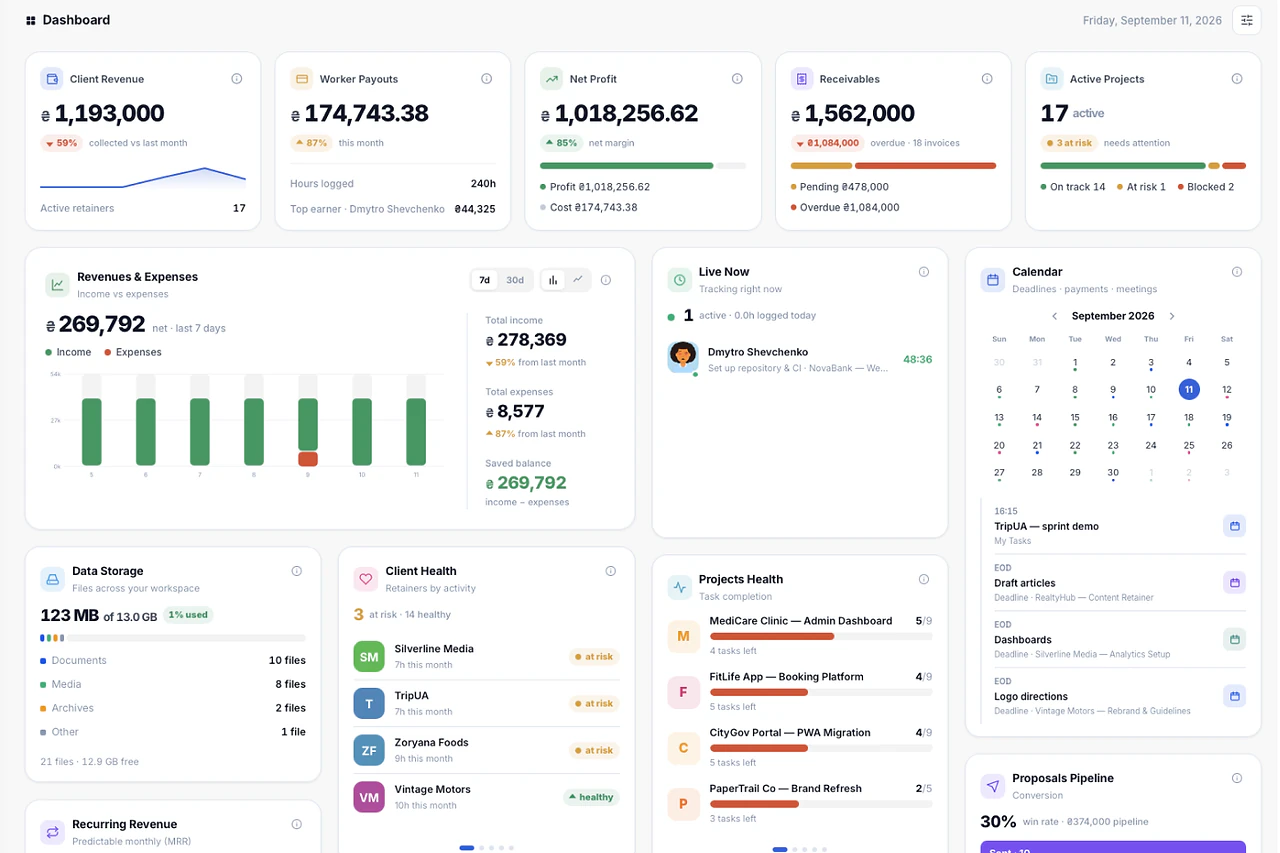
Project Alerts flags a task that hasn't changed status in a set number of days, so a stalled task surfaces before the deadline does, not after. Smart Templates break recurring project types into pre-defined tasks and phases, which removes the "where do I even start" problem for common engagements. Subtasks with individual timers let a large, vague task split into pieces small enough to start the same day they're assigned.
In Melororium
See how Melororium flags stalled tasks
Common mistakes with procrastination
What teams get wrong most often, and what to do instead.
- 1
Managing it as a discipline problem
Assuming a stalled task means the assignee needs a reminder or a talking-to. Most stalled tasks trace back to an unclear first step or an unrealistic deadline, and a lecture doesn't fix either one.
- 2
One deadline for a multi-week task
Setting a single due date three weeks out with nothing in between. Without an interim checkpoint, the first two weeks carry no visible cost, and the whole task compresses into the final days.
- 3
Leaving the first action undefined
Writing a task as an outcome ("improve the onboarding flow") instead of a next step ("list the 5 current onboarding steps and flag the two with the highest drop-off"). A task with no obvious opening move gets skipped in favor of anything with a clearer starting point.
- 4
Treating every idle task the same way
Flagging a task that's been untouched for a week without asking why. A blocked task and an avoided task look identical on a board, and they need completely different responses.
Frequently asked questions
Is procrastination the same thing as laziness?
No. Laziness describes low effort once work starts. Procrastination describes delay before work starts, and it usually has a specific, fixable trigger: an unclear first step, an oversized task, or a deadline too distant to feel real. Two people with identical work ethic will procrastinate on a vague task and start immediately on a clearly scoped one.
How many days should a task sit before it's a warning sign?
For task-sized work, a few hours to a couple of days, 3 days with no status change or logged time is a reasonable point to check in. For larger project phases, the useful signal is a missed interim checkpoint rather than a fixed day count.
Does breaking a task into subtasks reduce procrastination?
In practice, yes, because it replaces an ambiguous outcome with a concrete first action. A task like "write the About page" has no obvious starting point. A subtask like "draft 3 headline options" does, and it can be finished in under an hour, which makes starting far less costly.
Can a deadline make procrastination worse?
A single distant deadline can, because it removes any incentive to start early. A deadline with interim checkpoints, or one close enough to feel real, tends to reduce delay rather than cause it.
Does Melororium help catch procrastination before a deadline is missed?
Project Alerts flags a task that hasn't moved status in a set number of days, which surfaces a stall while there's still time to fix it rather than after the deadline has already passed.