What is Prioritization?
Prioritization
Prioritization is the practice of deciding what to work on first when there's more demand than time or people to meet it, based on a consistent set of criteria rather than whoever asked most recently.
Prioritization is the practice of deciding what gets done first when there's more demand on a team's time than the team has hours to meet it, which describes most weeks for most teams. It's a broader skill than ranking a backlog: a backlog holds tasks or features waiting to be built, but prioritization applies equally to which client gets a same-day response, which project gets the next open developer hour, or which of three fires gets addressed first.
The skill isn't finding the one correct order, since there rarely is an objectively right answer. It's applying a consistent set of criteria so the ranking holds up on a busy Tuesday instead of defaulting to whoever asked last or whoever escalated loudest. A team that prioritizes well isn't necessarily doing less work; it's spending the same hours on the requests that matter more, which is a different outcome from working faster.
For a small team covering a lot of ground, prioritization decisions happen at three different altitudes at once: which project the business takes on this quarter, which tasks a project team tackles this week, and which task one person picks up next. Each altitude calls for different criteria and often a different decision-maker, and applying a task-level rule to a quarter-level decision, or the reverse, is where a lot of prioritization advice falls apart in practice.
Prioritization vs Backlog Ranking
Ranking a backlog is one specific application of prioritization, not the whole subject. See the Backlog entry for how methods like MoSCoW and value-versus-effort scoring rank items inside a single list. This entry covers the broader skill: the decisions that happen above and around a backlog, between projects, between clients, and inside a single person's day, where a backlog's ranking methods don't directly apply.
Prioritization Happens at Three Altitudes
The same word, priority, gets used for three different kinds of decisions, and confusing them is a common source of friction between roles.
| Altitude | Question being answered | Typical owner | Typical cadence |
|---|---|---|---|
| Portfolio | Which projects does the business take on or continue? | Founder or operations lead | Monthly or quarterly |
| Team or sprint | Which tasks does the team tackle this week? | Project manager, with the team | Weekly |
| Individual | What do I work on next, right now? | The individual | Daily, sometimes hourly |
Criteria That Separate Priorities
A ranking is only useful if the criteria behind it separate items instead of labeling everything urgent. Five criteria cover most real decisions:
- Impact: how much does this move revenue, retention, or a client relationship that matters
- Deadline proximity: how much runway is left before missing it causes real damage, not only discomfort
- Dependency: does other work wait on this, so delay here delays several other things
- Cost of delay: what specifically gets worse the longer this sits untouched
- Effort required: how much time this takes relative to its impact, since a high-impact item that takes 3 weeks competes differently than one that takes 3 hours
Which Framework Fits Which Altitude
Several named frameworks exist for prioritization, and most were built for one specific altitude, not all three. Picking the wrong one for the decision at hand is a common reason a framework feels like it doesn't fit.
| Framework | Built for | See also |
|---|---|---|
| Eisenhower Matrix | A short daily or weekly task list, sorted by urgency and importance | Eisenhower Matrix entry |
| MoSCoW, value vs effort | Ranking items inside a backlog before they're scheduled | Backlog entry |
| Weighted scoring | Comparing whole projects or initiatives against fixed criteria | Used at the portfolio altitude |
| Now/Next/Later | Communicating direction on a roadmap, not day-to-day task order | Roadmap entry |
When Priorities Conflict Between People
The most common prioritization failure on a small team isn't a bad ranking; it's two people working from two different rankings without realizing it. A client escalates directly to a developer while the project manager has a different order in mind for the week; both people are acting reasonably, and the work still gets misallocated.
The fix is structural, not a reminder to communicate better: one visible, shared ranking that everyone works from, updated by one named owner, so a change in priority is a decision made once and seen by everyone, not five separate conversations that quietly disagree with each other.
A Worked Example: Monday Morning, 18 Open Requests
Larkspur Agency, a 10-person team running four client accounts, starts Monday with 18 open requests across email, Slack, and the project board: bug reports, new feature asks, two overdue invoices, and a pitch deck due Friday.
The project manager runs a 20-minute triage using impact and deadline proximity as the two main filters. Three requests are true emergencies (a broken checkout, a compliance deadline, an angry client escalation) and get named owners immediately. Six are important but have no deadline this week, they get scheduled for later in the sprint rather than worked today. Five are routine and get delegated to whoever owns that client relationship day-to-day. Four get flagged as not worth doing this quarter and communicated back to whoever asked, rather than left open indefinitely.
By 9:30am, 18 undifferentiated requests have become a ranked list of 5 items the team is working on today, with the other 13 assigned a clear status instead of sitting unanswered in an inbox.
- 18 incoming requests triaged in 20 minutes using 2 criteria: impact and deadline proximity
- 3 true emergencies got a named owner immediately
- 6 important, non-urgent items got a scheduled date rather than staying vague
- 5 routine items got delegated to the relevant account owner
- 4 items got a direct no, communicated back, instead of silently expiring
In Melororium
Prioritize your team's work in Melororium
Common mistakes with prioritization
What teams get wrong most often, and what to do instead.
- 1
Re-prioritizing every time something new arrives
Chasing whichever request is newest instead of whichever matters most, so nothing on the list survives long enough to get finished before the order changes again.
- 2
Letting the loudest voice set the order
Giving the client who escalates hardest, or the teammate who interrupts most, the top spot regardless of actual impact. Over time, this trains everyone to escalate instead of to ask normally.
- 3
Applying one altitude's rule to a different altitude's decision
Using a task-level urgency call to decide whether the business should take on a new client this quarter, or the reverse: treating a strategic decision as something to sort in a 5-minute daily triage.
- 4
No shared, visible ranking
Three people working from three different mental lists of what matters most this week, none of them written down or agreed on, so the team's actual priority is whoever is in the room when a decision gets made.
Frequently asked questions
Is prioritization the same as time management?
No. Time management is about how one person allocates their own hours. Prioritization is about which work gets those hours at all, often decided above the individual level, across a team or a whole portfolio of projects.
Who should have final say when a client and the internal team disagree on priority?
Usually the account owner or project manager, since they can weigh the client's stated urgency against what the team knows about impact and capacity. A rule stating who breaks the tie, decided before the disagreement happens, prevents it from becoming a negotiation each time.
How often should priorities be revisited?
It depends on the altitude: daily for an individual's task list, weekly for a team's sprint or work list, monthly or quarterly for which projects a business takes on. Revisiting more often than that at any altitude usually means nothing gets finished before the ranking changes again.
What's the difference between prioritization and triage?
Triage is prioritization under time pressure, usually applied to a sudden influx of items (a busy Monday inbox, an incident) rather than a routine planning process. The criteria are similar; triage compresses the decision into minutes instead of a scheduled session.
Does Melororium help a team prioritize its work?
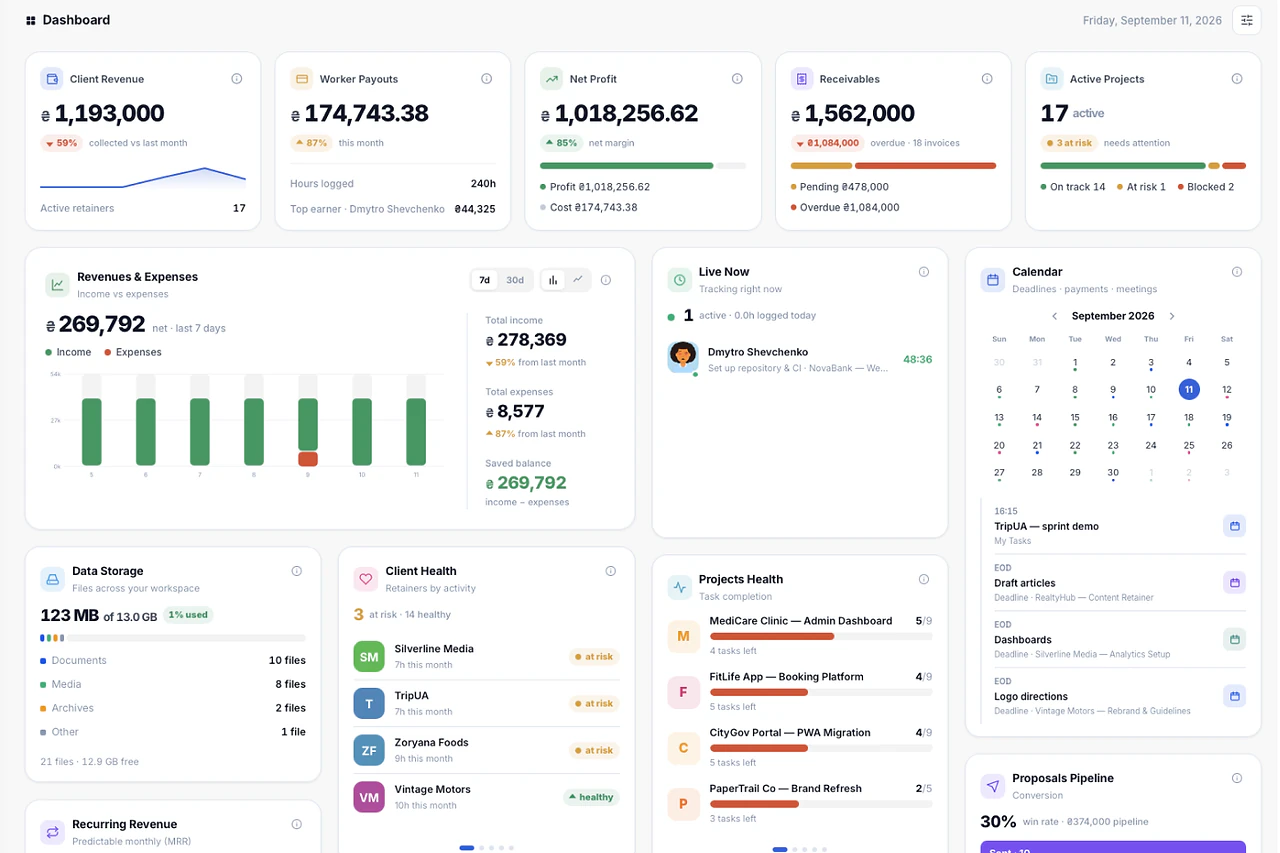
Every task carries a priority field and a due date, and the board can be filtered or sorted by either, so a team can see its true top items instead of relying on whoever spoke up most recently in a meeting.