What is Project Initiation?
Project Initiation
Project initiation is the first project phase, where a team assesses whether the work is worth doing, identifies stakeholders, and defines a high-level scope before detailed planning starts.
Project initiation is the first phase of a project, the stretch of work that happens before a plan exists. It answers three questions: should this project happen at all, who needs to be involved, and roughly what would it include if it goes ahead. Nothing in this phase is final. The output isn't a finished plan, it's enough clarity to decide whether detailed planning is worth doing.
The Project Management Institute lists initiation as the first of five standard process groups, ahead of planning, execution, monitoring, and closing. That ordering matters: initiation happens before a charter is written and before a kickoff meeting is scheduled, both of which are specific artifacts and events that come out of a completed initiation phase, not part of it. Confusing the phase with its outputs is common. A team can hold a kickoff meeting well and still have skipped a real initiation, or run a thorough initiation and still fumble the kickoff that follows it.
This entry covers initiation as a phase: what happens during it, who gets involved, and how a team decides whether to move forward. For the specific document that initiation typically produces, see project charter. For the meeting that typically follows, see project kickoff.
What Happens During Initiation
Initiation covers a handful of specific activities, usually in this rough order:
- Feasibility assessment: can this be done with the time, budget, and skills available
- Stakeholder identification: who has approval authority, who's affected, who needs to sign off
- High-level scope definition: rough boundaries for the work, not a full breakdown
- Order-of-magnitude sizing: a rough sense of cost and effort, not a detailed budget
- A go or no-go decision, documented somewhere rather than assumed by default
Feasibility: The Question Initiation Answers
Feasibility checks usually fall into four categories, and a thorough initiation touches all four before committing to planning.
| Feasibility check | Question it answers |
|---|---|
| Technical | Do we have the skills and tools to deliver this? |
| Financial | Does the cost make sense against the value or budget? |
| Operational | Do we have capacity without dropping other active work? |
| Schedule | Is the requested timeframe realistic? |
Identifying Stakeholders Before Planning Starts
Initiation is when a team maps out everyone with influence or a stake in the outcome, and separates decision-makers from people who only need to be kept informed. Getting this wrong here is expensive later: a project that reaches its kickoff meeting without the real decision-maker in the room usually has to restart the scope conversation from scratch.
- Who approves budget and scope changes
- Who uses the output day to day, once it exists
- Who can block the project if they're unhappy with the direction
- Who needs updates along the way but has no approval authority
Initiation vs Planning: Where One Ends and the Other Starts
The two phases ask different questions at different levels of detail.
| Initiation | Planning | |
|---|---|---|
| Question | Should we do this, and roughly what would it involve? | Exactly how will we do it? |
| Output | Go/no-go decision, rough scope, stakeholder list | Detailed schedule, budget, task breakdown |
| Precision | Order-of-magnitude | Detailed and specific |
| Typical length | Days to a few weeks | Varies with project size |
What Initiation Produces (and What It Doesn't)
Initiation typically produces a rough business case and a stakeholder list. It doesn't produce the formal charter or the kickoff meeting itself; those come after a go decision, at the boundary between initiation and planning.
- A business case: a short, written justification for why the work is worth doing
- A stakeholder register: names, roles, and approval authority
- A high-level scope statement: a paragraph, not a full breakdown structure
- A documented go or no-go decision, so the choice to proceed was made consciously
Project Initiation for Agencies: Before the Contract Is Signed
For agencies, initiation often starts during the sales process itself. Feasibility and rough scoping inform the proposal or quote before a client signs anything, which means part of initiation happens outside any formal project record.
Once a contract is signed, a compressed internal initiation, often 3 to 5 days, confirms which team members are available, checks the scope discussed in the pitch against what the signed contract says, and identifies the client's real decision-maker rather than assuming it's whoever signed. Skipping this step because 'we already scoped it in the proposal' is how sales-stage assumptions quietly become delivery-stage problems.
Running Initiation in Melororium
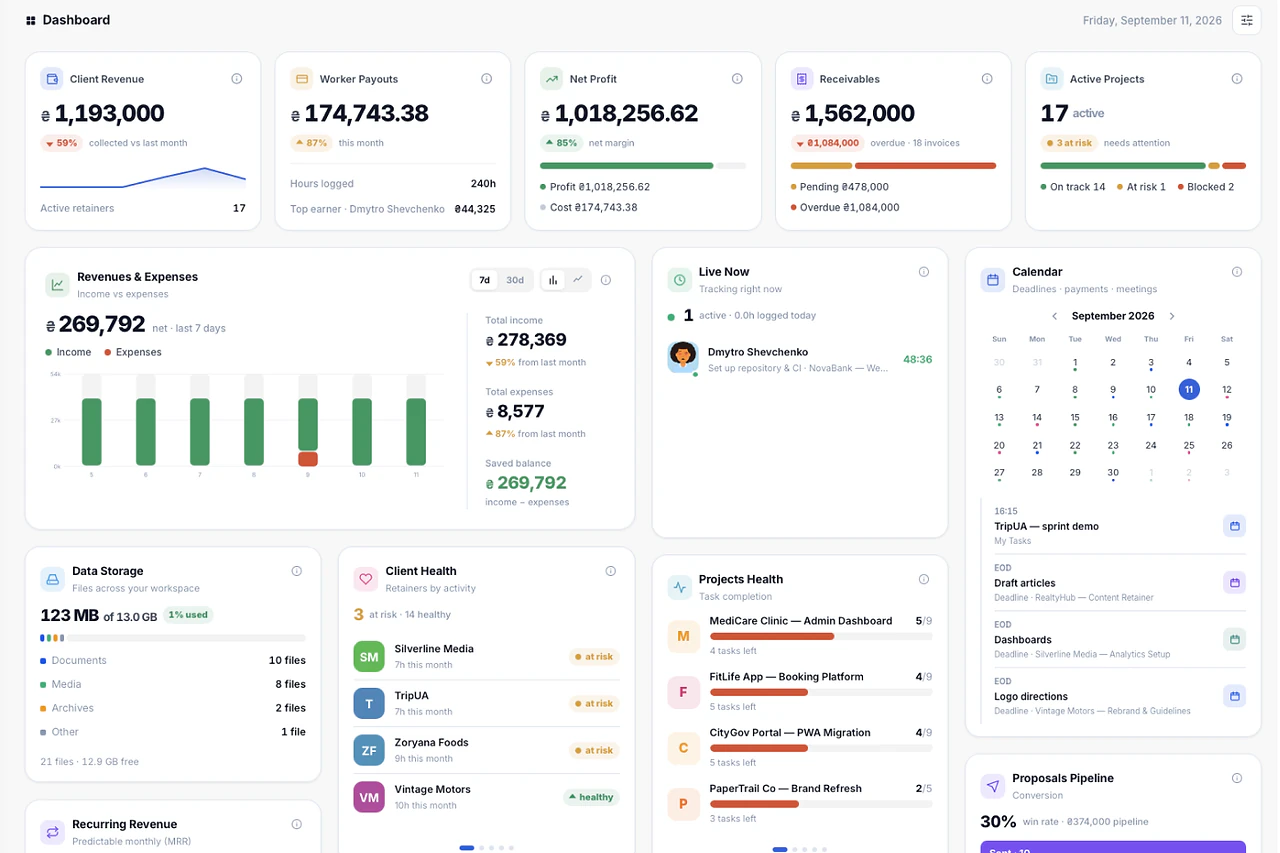
Teams track initiation inside Melororium's CRM before a project object even exists. A client card holds the rough scope notes, stakeholder contacts, and feasibility questions gathered before anything's approved. Once the go decision is made, that card converts into a project, carrying the initiation notes forward instead of starting the record from zero.
In Melororium
Track prospects through initiation in Melororium's CRM
Common mistakes with project initiation
What teams get wrong most often, and what to do instead.
- 1
Skipping feasibility and going straight to scoping
Agreeing to a project's rough shape before checking whether the team has the capacity or skill to deliver it, discovering the problem mid-project instead of on day one.
- 2
Treating the kickoff meeting as the whole initiation phase
Scheduling a kickoff without having done any feasibility check or stakeholder mapping beforehand, so the meeting surfaces problems that initiation should have already caught.
- 3
Letting sales commit to scope before initiation happens
A salesperson promises a timeline or deliverable list during a pitch that the delivery team never got to feasibility-check, so initiation becomes a formality after the real commitment is already made.
- 4
No documented go/no-go decision
Moving from initiation into planning by default, without anyone consciously deciding to proceed, so a project that should have been declined drifts forward on momentum alone.
Frequently asked questions
How long should project initiation take?
For most agency-size projects, a few days to two or three weeks. Longer for large or unfamiliar work where feasibility genuinely needs research, shorter for repeat work with a known client and a familiar scope type.
Who is responsible for project initiation?
Usually whoever ends up owning delivery, a PM or account lead, working alongside whoever ran the sales conversation if the project came through a pitch. It shouldn't run entirely through sales without delivery input.
What's the difference between a business case and a project charter?
A business case is an initiation output, a short justification for why the work is worth doing. A charter is a planning-phase document that formally authorizes the project and names the PM. See project charter for what it contains.
Can a project skip initiation entirely?
Informally, yes. Small or highly repetitive projects sometimes fold initiation into the sales conversation itself. Skipping it on anything new or complex moves the same questions later, into the kickoff or worse, into week three of delivery.
Does Melororium support the initiation phase?
Teams hold rough scope notes, stakeholder contacts, and feasibility questions on a client card in the CRM before a project exists. Once the go decision is made, that card converts directly into a project instead of starting the record over.