What is Time Management?
Time Management
Time management is the practice of deciding what to work on, in what order, and for how long, so a limited number of hours goes to the work that matters most.
Time management is the practice of deciding what to work on, in what order, and for how long, given that the number of hours in a day is fixed and the number of demands on them usually isn't. It's a forward-looking decision: what should get the next hour, given everything else competing for it?
Time management is often confused with time tracking, but they measure opposite directions. Time tracking records what already happened, how many hours went to which task or client, mainly for billing and reporting. Time management decides what happens next. A team can track time perfectly and still manage it badly, if hours are logged accurately against the wrong priorities. See the Time Tracking entry for the recording side; this entry covers the allocation side.
For an individual contributor, time management mostly means protecting attention: which tasks get a focused block, and which get batched or deferred. For someone managing other people's work too, like a project manager or account lead, it also means allocating other people's hours across competing client demands, which is closer to the Capacity Planning entry's territory at the team level.
Time Management vs Time Tracking
The two are related but answer different questions, and confusing them leads teams to think logging hours is the same as managing them well.
| Aspect | Time management | Time tracking |
|---|---|---|
| Direction | Forward-looking: what should happen next | Backward-looking: what already happened |
| Core question | What deserves this hour? | How was this hour spent? |
| Primary use | Prioritization, focus, workload decisions | Billing, reporting, project profitability |
| Who benefits directly | The person doing the work | Clients, finance, and anyone estimating future work |
Core Time Management Methods
A handful of methods cover most of what works in practice, and most teams use some combination rather than any single one.
- Prioritization by impact and urgency, sorting tasks by what matters rather than by what arrived most recently
- Timeboxing, assigning a fixed block of time to a task regardless of whether it feels finished, to stop open-ended work from expanding to fill the day
- Batching, grouping similar small tasks (replying to messages, reviewing drafts) into one block instead of interrupting focused work for each one
- Single-tasking, working one item at a time rather than switching between several, since switching itself carries a real time cost
- The two-minute rule, doing a task immediately if it takes less time than it would take to schedule it for later
Why Time Management Fails at the Team Level
Individual discipline runs into a structural problem the moment work involves other people: competing requests arrive from multiple directions, and no single requester can see everything already on someone's plate.
A day split into six 45-minute meetings leaves no block longer than an hour for anything else, no matter how well the remaining time is planned. Fragmented calendars are a common cause of "bad" time management that has nothing to do with discipline. The fix is structural, fewer and longer meeting blocks, a protected focus window, rather than personal.
Time Management for People Who Manage Other People's Time
A project manager or account lead faces a different problem than an individual contributor. Their day is built from other people's demands, client calls, status questions, approvals, rather than a single task list they control. Batching communication into set windows, checking messages twice a day instead of continuously, tends to work better for this role than timeboxing individual tasks, because the interruptions themselves are the main cost, not any one task's duration.
For individual contributors doing focused work, design, development, writing, protected blocks of 90 minutes to 2 hours with no meetings scheduled tend to produce more finished output than the same total hours spread across a fragmented day.
A Framework for Prioritizing Competing Demands
When five tasks compete for the same afternoon, a simple two-question filter cuts through most of the ambiguity: does this have a real deadline in the next 2 days, and does missing it affect a client or a teammate directly?
A worked example: a project manager has a client revision request, an internal budget review, a new hire's onboarding question, a proposal draft due Friday, and a Slack message from a teammate. Sorted by the two questions, the client revision (a real 2-day deadline, direct client impact) and the proposal draft (a firm date, 3 days out) rank above the budget review and onboarding question, which can wait a day without consequence. The Slack message gets batched into the next check-in window rather than answered immediately.
Signs Poor Time Management Is a System Problem, Not a Personal One
When every task takes longer to start than it should, and it's true for every person on a team rather than one individual, the cause usually isn't ten separate discipline failures. It's a structural overcommitment: the team is holding more active work than its available hours support. That's a capacity problem, and no amount of individual prioritization fixes a workload that's genuinely too large for the hours available. See the Capacity Planning entry for how to check whether that's what's happening before assuming the fix is personal.
Time Management in Melororium
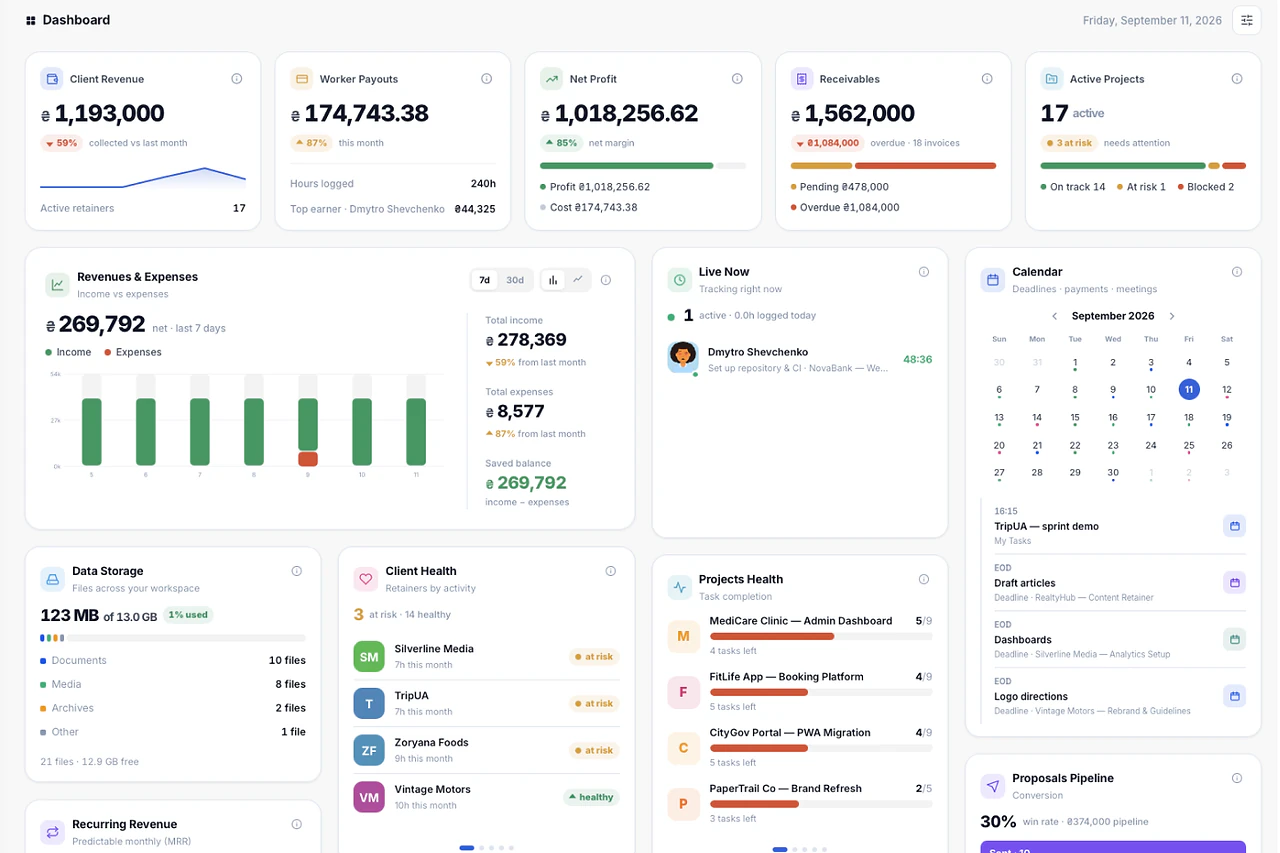
The Calendar module shows tasks, deadlines, meetings, and time off on one grid, so a protected focus block and a meeting request are visible against each other instead of living in separate tools. The Team module's workload view shows who's overloaded and who has room this week, based on hours actually logged, which turns "I don't have time" from a feeling into a number a manager can act on.
In Melororium
See deadlines and priorities in one calendar in Melororium
Common mistakes with time management
What teams get wrong most often, and what to do instead.
- 1
Treating a full calendar as good time management
Measuring success by how packed the day looks rather than by what got finished. A calendar with no gaps often means no room left for the work the meetings were about in the first place.
- 2
Prioritizing by who asked most recently
Working through requests in the order they arrived instead of by actual impact. The last message in an inbox isn't automatically the most important task waiting.
- 3
Blocking focus time but not protecting it
Scheduling a 2-hour deep-work block and then accepting the first meeting request that lands inside it. An unprotected block on a calendar is a suggestion, not a commitment.
- 4
Trying to personally fix a workload that's structurally too big
Applying better prioritization to a task list that's simply larger than the available hours, week after week. When the whole team is behind, the fix is usually reducing commitments or adding capacity, not a better to-do list.
Frequently asked questions
What's the difference between time management and time tracking?
Time management decides what gets your hours before you spend them. Time tracking records how hours were actually spent, usually for billing or reporting. A team can track time accurately and still manage it poorly if the hours are going to the wrong priorities.
What's the best time management method for a busy workday?
There isn't a single best method, since individual contributors and people managing others tend to need different approaches. Protected focus blocks work well for heads-down work like design or development. Batched communication windows work better for roles built around constant interruptions, like account management or project coordination.
How much of a workday should be protected for focused work?
A block of 90 minutes to 2 hours with no meetings is enough for most focused tasks to make real progress. The exact amount matters less than whether the block is actually protected, an unprotected 2-hour block that gets interrupted twice produces less than a genuinely uninterrupted 90-minute one.
Is multitasking a time management problem?
Yes, in the sense that switching between tasks carries a real cost: picking a task back up after an interruption takes longer than continuing it without one. Single-tasking, finishing or reaching a clear stopping point before switching, tends to produce more finished work in the same number of hours.
Does Melororium have time management features?
The Calendar module puts tasks, deadlines, meetings, and time off on one grid, so competing demands are visible together rather than scattered across separate tools, and the Team module's workload view shows who has room this week based on actual logged hours.