What is a Cross-Functional Team?
Cross-Functional Team
A cross-functional team is a group of people from different disciplines or departments who work toward one shared goal, rather than each person reporting progress up a separate functional chain.
A cross-functional team is a group of people from different disciplines, design, engineering, marketing, account management, who work toward one shared goal instead of each reporting progress up a separate departmental chain. The team owns an outcome together, launch this product, deliver this campaign, ship this client project, rather than each function owning its own slice of the work in isolation.
The opposite is a functional team, where a design department works through its own queue and a development department works through its own queue, and the two connect only at scheduled handoff points. A cross-functional team collapses that structure: a designer, a developer, and a project manager sit on the same team, share the same goal, and get measured by the same outcome rather than by how much their individual department shipped this month.
Agencies and studios run cross-functional teams by default, since one client project usually needs a designer, a developer, a copywriter, and an account lead working in parallel rather than in a handoff chain. The coordination cost is real: four disciplines rarely share the same vocabulary, the same sense of what "done" means, or the same read on what's urgent in a given week, and none of that gets solved by putting everyone on the same project board.
What Makes a Team Cross-Functional
Putting people from different roles in the same meeting doesn't make a team cross-functional. Three conditions distinguish a genuine cross-functional team from a group of specialists who happen to be assigned to the same project:
- A shared goal that no single discipline can hit alone, not separate goals that happen to point in the same direction
- Overlapping work rather than a strict handoff sequence, so a developer and a designer are working the same week, not waiting on each other
- One team identity for the duration of the work, even though each member still belongs to their home discipline
- A single measure of success the whole team is judged against, not one metric per function
Cross-Functional Team vs Stakeholders vs RACI
These three terms get used in the same conversations but answer different questions. Stakeholders covers everyone with an interest in a project's outcome, including people who never do any of the work, like an executive sponsor or an end user. A RACI chart maps who does what on a given task or decision, Responsible, Accountable, Consulted, Informed, regardless of what discipline they sit in.
Cross-functional describes something narrower: the composition of the working team itself, specifically that it spans multiple disciplines rather than one. A five-person development team is not cross-functional even if it has clear RACI assignments and an engaged stakeholder list. A cross-functional team adds a structural question on top of both: does this group span enough disciplines to own the outcome without handing work outside the team at every step?
The Coordination Problems Specific to Cross-Functional Teams
Cross-functional teams fail in a specific, predictable way: not from lack of effort, but from each discipline operating with a different default. Four problems show up more often here than on single-discipline teams.
| Problem | Why it happens | Fix that works |
|---|---|---|
| No shared definition of "done" | Design calls a page done at approval; development calls it done when it's live | Write one definition of done per deliverable, agreed by every discipline before work starts |
| Competing priorities with no tiebreaker | Each discipline's manager sets priority for their own people, and the two lists conflict | One team lead with authority over the whole team's priority order, not only their own function |
| Vocabulary gaps | A "quick fix" means an hour to a developer and a day to a designer | Put time estimates in hours on every task, not adjectives |
| No one owns the whole outcome | Each person can point to their piece being done while the overall goal slips | One name accountable for the shared goal, not only for their discipline's slice |
How Big Should a Cross-Functional Team Be
There's no fixed number, but a useful guide: a cross-functional team needs one representative from every discipline the goal genuinely requires, and no more than that until the workload proves it. A typical agency project team runs 4 to 7 people spanning 3 to 4 disciplines, design, development, copy, and account management, which is enough coverage without adding a coordination cost that outweighs the extra hands.
Past roughly 8 to 10 people, a single cross-functional team usually needs to split into two, each with its own goal, rather than growing one team past the point where everyone can track what everyone else is doing.
Running a Cross-Functional Team Day to Day
The mechanics that keep a cross-functional team coordinated look different from a single-discipline team's, because the risk isn't that one person misses a deadline, it's that two disciplines quietly drift out of sync without either noticing until a handoff fails.
A short daily or twice-weekly check-in works better than status reports, since it surfaces cross-discipline blockers, the design isn't ready for the developer, the copy isn't approved for the designer, before they cost a day. One shared board, visible to every discipline on the team, beats separate tools per function; if design tracks work in one tool and development in another, the two disciplines are already coordinating blind.
A Worked Example: A 7-Person Product Launch Team
Harlow Studio assembles a cross-functional team to launch a new service line for a client: one project lead, two designers, two developers, one copywriter, and one account manager, seven people from four disciplines, with a single shared goal: launch the client's new product page in 6 weeks with a working checkout flow.
The team runs one shared kanban board instead of separate design and development queues. Weeks 1 to 2: designers and copywriter work in parallel, not handoff, drafting layout and copy together so neither waits on the other. Weeks 3 to 4: developers start building against approved sections as they clear, instead of waiting for the full design to finish. Week 5: cross-discipline QA, where the copywriter reviews live pages for tone and the designer reviews for visual fidelity, not only the developers testing function.
The project lead holds the single measure of success, the product page live and functional by week 6, and that measure sits above each discipline's individual output. When the design ran two days behind in week 2, the project lead reallocated a developer to help build a static placeholder rather than letting development sit idle waiting on design, a call a functional manager without authority over the whole team could not have made.
Common mistakes with cross-functional team
What teams get wrong most often, and what to do instead.
- 1
No single owner across disciplines
Each function still reports to its own departmental manager, so priority conflicts get escalated up two separate chains instead of resolved by one person with authority over the whole team.
- 2
Running it as a handoff chain, not a shared team
Design finishes, then hands off to development, then hands off to copy, in sequence, which is a functional team with extra meetings, not a cross-functional one. The point is overlapping work, not a longer relay.
- 3
No shared definition of done across disciplines
A designer calls a page done at approval while a developer can't start because assets weren't delivered in the right format. The gap surfaces mid-project instead of on day one, when it's cheap to fix.
- 4
Adding headcount instead of a missing discipline
Assigning a second developer to a team that's missing a copywriter. More people from disciplines already represented doesn't fix a coverage gap; it adds coordination overhead without adding coverage.
Frequently asked questions
What's the difference between a cross-functional team and a matrix organization?
A matrix organization is a company-wide reporting structure where people have both a functional manager and a project manager on an ongoing basis. A cross-functional team is usually a smaller, project-scoped group; a company can run cross-functional project teams without adopting a full matrix reporting structure.
How big should a cross-functional team be?
Most agency and studio teams run 4 to 7 people across 3 to 4 disciplines. Past 8 to 10 people, coordination overhead usually outweighs the benefit of keeping everyone on one team, and it works better to split into two teams with separate goals.
Who manages a cross-functional team if not the departmental leads?
A single project or team lead needs authority over the whole team's priorities, not only their own discipline's people. Without that, priority conflicts between disciplines get resolved by whichever department manager is loudest, not by what the shared goal needs.
Is a cross-functional team the same as a project team?
Not always. A project team can be single-discipline, five developers building one feature. A cross-functional team is a project team that specifically spans multiple disciplines. Every cross-functional team is a project team; not every project team is cross-functional.
Does Melororium support cross-functional project teams?
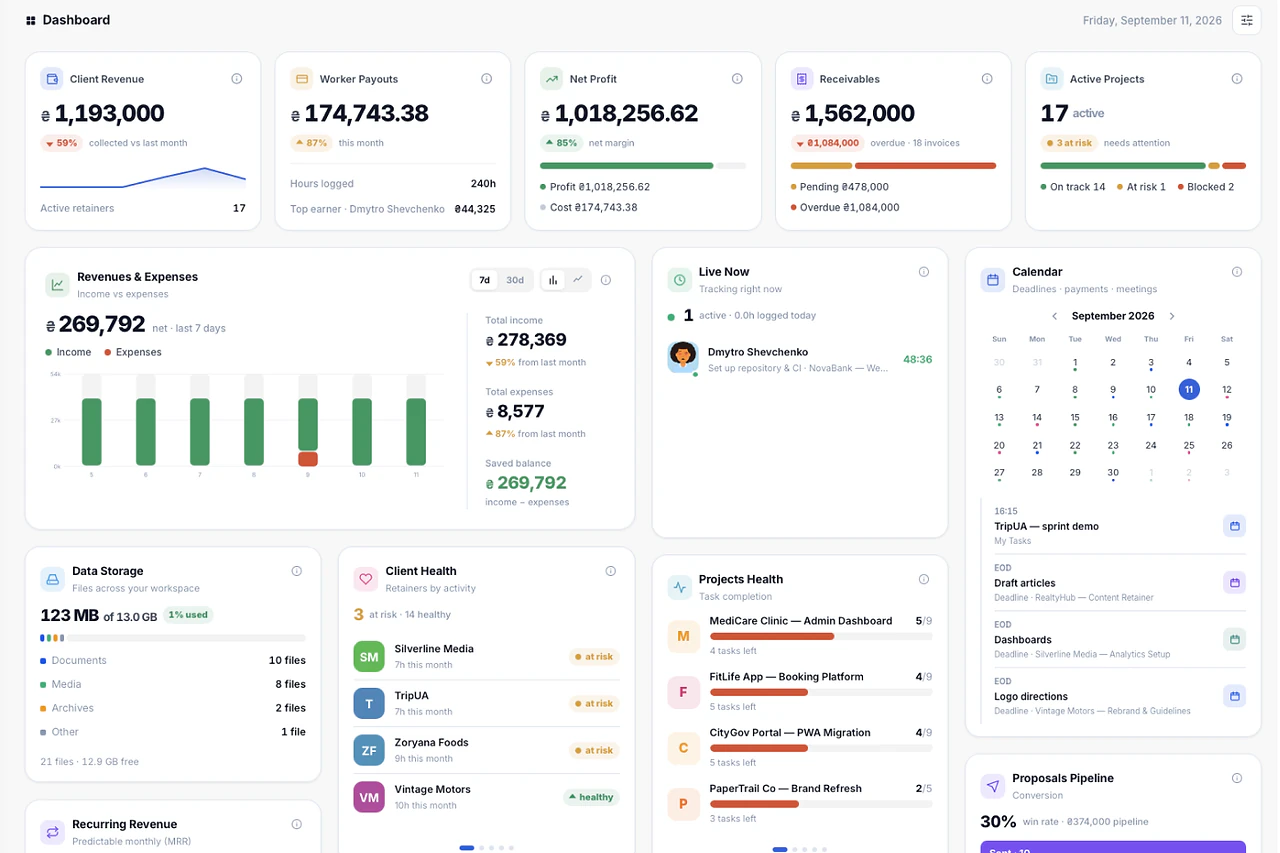
Every project in Melororium carries one shared board and one team roster, regardless of what role each member holds, so a designer, developer, and account manager work off the same task list and the same deadline instead of separate tools per discipline.